Offshore Accounting Company vs Staffing Agency vs Freelancer
Three weeks into tax season, our freelance bookkeeper disappeared.
There was no warning, handoff note, or reliable status update. Forty-seven client files were sitting at different stages of completion, and the next 72 hours were spent reverse-engineering unfinished work.
The direct cost was approximately $23,000 in overtime. The greater cost was the pressure placed on the team and the risk created for two client relationships.
That experience changed how I viewed offshore support. It was no longer simply a hiring decision. It was an infrastructure decision.
An offshore accounting company, a staffing agency, and a freelancer can all provide remote accounting talent. The real difference is who owns the workflow, quality control, continuity, security, and daily management.
For most CPA firms looking for dependable long-term capacity, an offshore accounting company offers the strongest balance of structure, accountability, and scalability.
Key Takeaway
Freelancers may suit simple, short-term tasks, while staffing agencies work for firms with established processes and managers available to supervise remote employees. For CPA firms seeking secure, review-ready, and scalable support with stronger workflow control, quality checks, and continuity, an offshore accounting company such as SafeBooks Global is usually the most reliable long-term model.
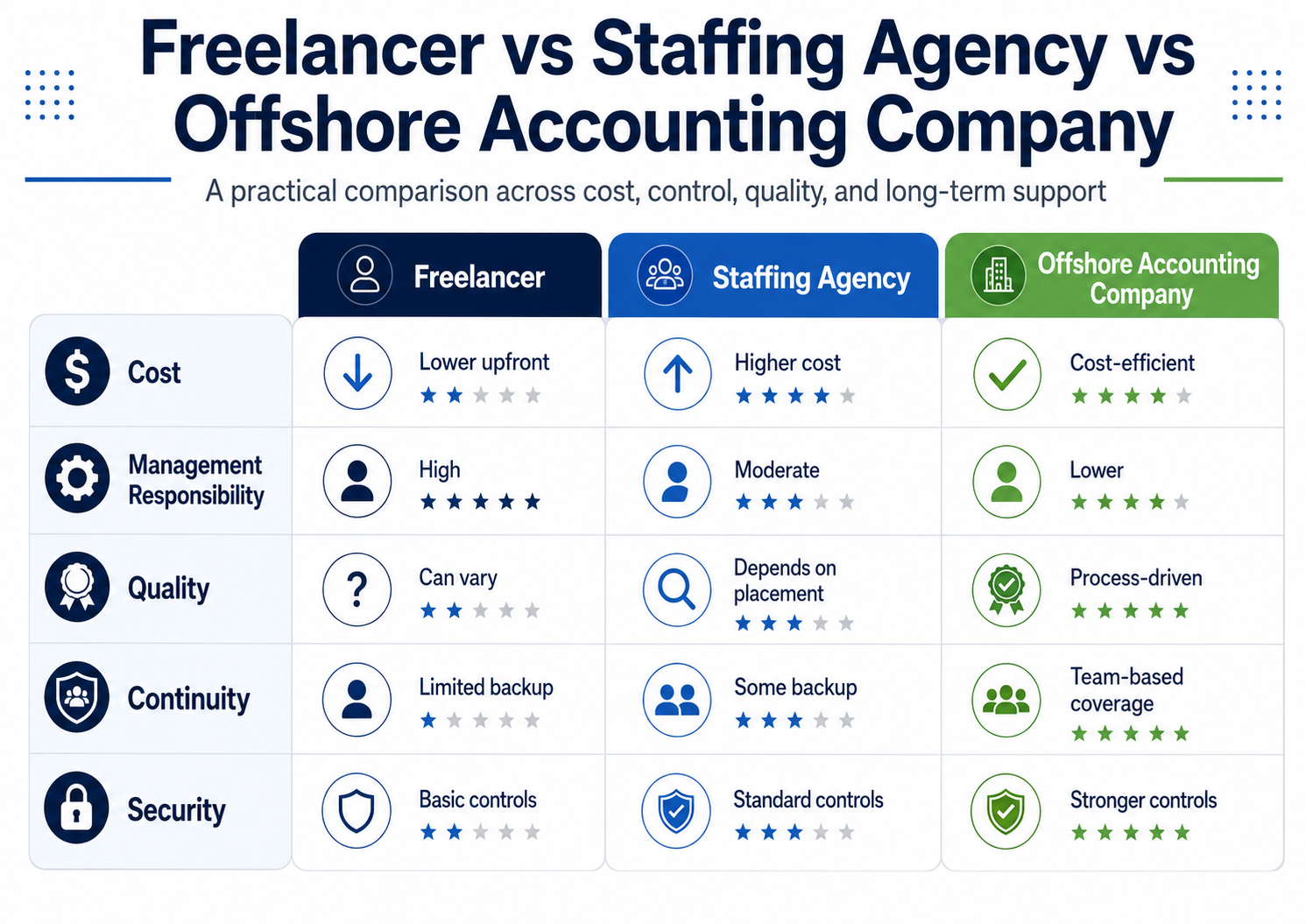
Comparing the Three Offshore Accounting Models
The three models may appear similar at first, but they create very different levels of responsibility for the accounting firm.
Comparison area | Freelancer | Staffing agency | Offshore accounting company |
Primary offering | One independent contractor | Dedicated remote employee | Managed accounting delivery |
Daily management | Fully handled by the CPA firm | Mostly handled by the CPA firm | Shared or managed through a defined delivery structure |
Accounting training | Firm responsibility | Firm responsibility | Supported by accounting-specific onboarding and processes |
Workflow ownership | CPA firm | CPA firm | Defined jointly, with process controls built in |
Quality control | Firm reviews all work | Firm reviews all work | Quality checkpoints can be included before onshore review |
Backup coverage | Usually unavailable | Replacement may take time | Continuity and replacement support can be built into the engagement |
Security controls | Depends on the individual | Depends on agency infrastructure | Firm-controlled access, VPN, VDI, permissions, and monitoring |
Scalability | Limited by one person’s capacity | Can scale through additional hiring | Designed to scale through teams and standardized workflows |
Best use case | Short-term, simple tasks | Firms with strong internal management | CPA firms needing secure, review-ready, scalable support |
Main risk | Availability and continuity | Management burden remains with the firm | Higher initial structure, but lower operational risk |
A freelancer may work for narrow, low-risk tasks. A staffing agency can work when the firm already has strong managers and mature processes.
An offshore accounting company is usually the better option when the firm wants work completed through a controlled system rather than simply adding another person to supervise.
Compare Cost per Usable Deliverable
The lowest hourly rate does not always create the lowest total cost.
A freelancer may charge less, but the firm still carries the cost of onboarding, supervision, rework, security controls, and sudden availability changes.
A staffing agency handles recruitment, payroll, and local employment requirements. However, the CPA firm generally remains responsible for daily assignments, technical training, workflow control, and quality review.
An offshore accounting company may have a higher hourly equivalent, but the engagement can include workflow coordination, quality checkpoints, management oversight, and backup support.
The more useful calculation is:
Cost per Usable Deliverable = Remote Delivery Cost + Review Cost + Rework Cost + Delay Cost
Calculate the full cost of completing one monthly bookkeeping file, tax workpaper, or audit schedule. Include the offshore team’s time, onshore review, corrections, write-offs, and delays.
When these costs are included, the cheapest provider may become the most expensive model.
The comparison between offshore bookkeeping and freelance support can help firms assess the difference between a lower initial rate and more reliable delivery.
Where Freelancers Fit
Freelancers can be useful for narrow, temporary, and closely supervised work.
Examples may include transaction coding, data entry, document collection, or standard reconciliations.
This model works only when the firm has clear instructions, secure access, daily review, and backup coverage. The firm must also accept the risk that the individual may reduce hours, move to another project, or become unavailable during a deadline.
For recurring client work, tax season support, or workflows involving sensitive data, this model often creates more operational risk than it removes.
Where Staffing Agencies Fit
A staffing agency can provide dedicated remote employees while handling recruitment, payroll, benefits, and local employment administration.
This can work well for firms that already know how to train, supervise, and review remote employees.
The agency supplies the person, but the accounting firm still needs to supply the operating system.
That means the firm remains responsible for process documentation, technical training, performance review, quality control, and daily task management.
Reviewing the main offshore accounting staffing models can help leadership determine how much management responsibility it is prepared to retain.
Why an Offshore Accounting Company Is the Stronger Model
An offshore accounting company is built around accounting delivery rather than recruitment alone.
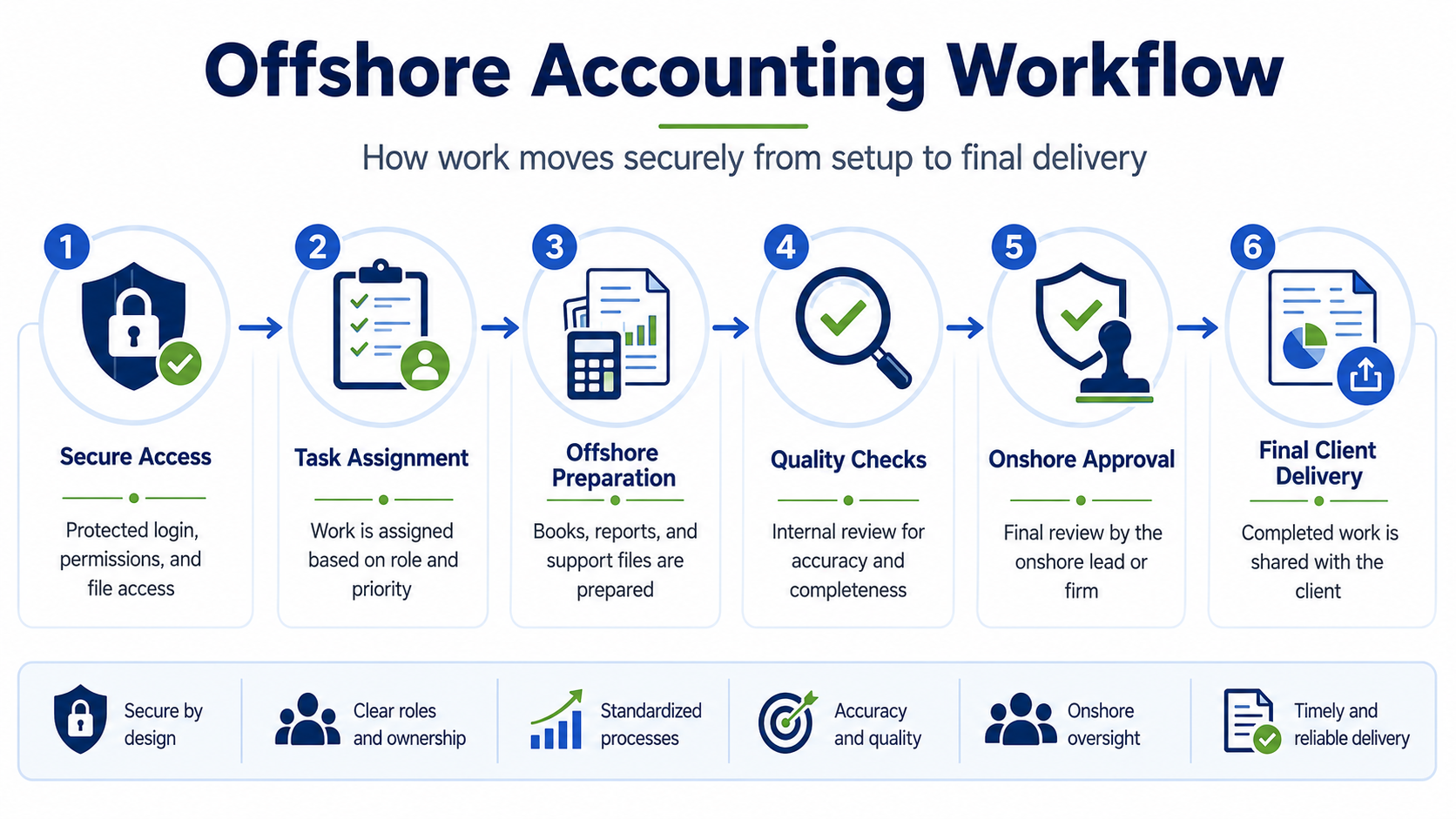
The firm is not only gaining a remote team member. It is gaining a more structured approach to task assignment, handoffs, quality review, communication, and continuity.
This is particularly valuable when partners and managers are already overloaded.
The right offshore accounting company should help the firm:
- Standardize recurring workflows
- Reduce avoidable review work
- Maintain written handoffs
- Track open items and exceptions
- Protect client data through controlled systems
- Add capacity without rebuilding the process for every new hire
Expert Insight
“CPA firms do not need more people to manage. They need a delivery structure that reduces pressure on partners and managers. The right offshore accounting partner should bring process control, accounting understanding, and continuity into the engagement.“
Shivangi Agrawal
Managing Director, CA, CPA (USA), SafeBooks Global
SafeBooks Global follows this process-led model. The focus is on secure access, documented workflows, review-ready output, and scalable support for U.S. CPA firms.
Check Your Workflow Readiness
Even the strongest offshore accounting partner needs clear input from the firm.
A remote model will struggle when recurring work depends on memory, scattered emails, or one employee explaining every exception.
Before assigning work, the firm should have documented procedures, a practice management system, clear rules for which work can move offshore, and a named onshore reviewer.
A useful test is whether a new domestic hire could follow the same documentation and produce acceptable work within a reasonable training period.
Creating a structured remote accounting workflow first will make onboarding, review, and performance measurement more reliable.
Reduce the Risks That Cause Offshore Engagements to Fail
Most offshore failures begin with small operating gaps.
A task is marked complete even though it is not review-ready. A team member becomes unavailable during a deadline. Client information is accessed through an unmanaged device. A replacement joins without proper handoff notes.
These risks can be reduced through clear completion standards, written handoffs, controlled pilots, secure access, and backup coverage.
For tax and audit work, the pilot should confirm that the team can follow procedures, identify exceptions, document open items, and prepare work for onshore review.
Firms considering audit support should understand what is included in a structured offshore audit support engagement.
Security Should Be Built Into the Model
Security should not depend on the habits of one individual.
The offshore provider should use secure virtual access, multifactor authentication, role-based permissions, encrypted connections, restricted downloads, activity logs, and documented access removal.
The provider should also explain who can access client data, which devices may be used, whether files can be stored locally, and how access is removed when a team member leaves.
SafeBooks Global’s approach to offshore accounting data security is designed around controlled access and process accountability.
Which Model Should Your CPA Firm Choose?
Choose a freelancer when the work is simple, temporary, and low risk.
Choose a staffing agency when the firm wants dedicated employees and has the internal management capacity to train and supervise them.
Choose an offshore accounting company when the firm needs dependable capacity, structured workflows, stronger security, review-ready output, and continuity.
For CPA firms that want to scale without adding more pressure to partners and managers, the offshore accounting company model is usually the most practical long-term option.
Build a More Reliable Offshore Accounting System
SafeBooks Global helps U.S. CPA and accounting firms build secure, process-led support across bookkeeping, tax, audit, and back-office operations.
The goal is not simply to provide a remote employee. It is to create a dependable accounting delivery system supported by clear workflows, controlled access, consistent communication, and review-ready work.
Explore SafeBooks Global’s offshore accounting services for CPA firms or schedule a discovery call to determine which workflows should move first and how the engagement should be structured.