

Why Dedicated Teams Work Better at Scale
A freelance bookkeeper can be a practical solution for clearing a backlog, completing a short project, or covering a temporary capacity gap.
The model becomes harder to manage when an accounting firm needs consistent bookkeeping across multiple clients, recurring monthly deadlines, documented review processes, and dependable backup coverage.
The real comparison is not simply between a freelancer and an offshore professional. It is between buying individual hours and building repeatable bookkeeping capacity.
Key Takeaways
- Freelancers can work well for short-term, specialized, or irregular bookkeeping needs.
- Dedicated offshore teams become more useful when work is recurring across multiple clients.
- Firms should compare continuity, review effort, security controls, and replacement support, not only hourly rates.
Quick Answer
Freelancers are often suitable for short-term assignments, specialist projects, and irregular bookkeeping volume.
A dedicated offshore bookkeeping team generally becomes more practical when an accounting firm needs recurring support across several clients. The model can provide greater continuity, standardized workflows, replacement support, common security controls, and a clearer path for adding capacity.
The right choice depends on workload consistency, management capacity, security expectations, and the amount of client-specific process knowledge the firm needs to retain.
What Is the Difference Between a Freelancer and a Dedicated Offshore Team?
A freelance bookkeeper usually works as an independent contractor and may support several businesses or accounting firms. The client firm is typically responsible for recruiting, testing, onboarding, supervision, system access, and replacement.
A dedicated offshore bookkeeping team consists of assigned professionals who work within the accounting firm’s systems, SOPs, close calendar, and documentation standards.
Depending on the agreement, the offshore provider may also support recruitment, HR, infrastructure, continuity, and replacement.
Offshore Bookkeeping vs. Freelancers
Evaluation Area | Freelance Bookkeeper | Dedicated Offshore Team |
Typical use | Projects or irregular volume | Recurring multi-client workflows |
Engagement structure | Individual contractor | Assigned professional or team |
Hiring and screening | Managed by the firm or marketplace | Usually supported by the provider |
Process consistency | Depends on the individual | Can be standardized across the team |
Review support | Usually arranged by the firm | May include a team lead or reviewer |
Absence coverage | Often limited | Backup may be available |
Replacement | Firm may need to restart the search | Provider may support replacement |
Knowledge continuity | Concentrated in one person | Supported through SOPs and team structure |
Security controls | Assessed individually | Common provider controls may apply |
Scalability | Requires additional individual hires | Capacity can be added within one model |
Note: Review layers, backup coverage, and replacement support are not automatic. Accounting firms should confirm exactly what is included in the engagement.
When a Freelance Bookkeeper May Be the Better Choice
Freelancers can work well when the scope is limited, clearly defined, and unlikely to expand significantly.
A freelance bookkeeper may be suitable for:
- A one-time bookkeeping cleanup
- A temporary backlog
- Short-term leave coverage
- A software migration
- A specialized industry assignment
- Low or irregular monthly volume
- A firm testing remote support for the first time
The accounting firm should still verify technical skills, references, availability, device controls, access procedures, and data-retention practices.
Why Dedicated Offshore Teams Work Better at Scale
1. Process Knowledge Does Not Sit With One Person
Recurring bookkeeping involves more than transaction coding.
Each client may have specific closing dates, recurring adjustments, reporting formats, vendor rules, open items, and review preferences.
When this knowledge sits with one individual, an unexpected absence or departure can interrupt delivery. A dedicated team can document knowledge through SOPs, checklists, examples, and shared workflow tools.
2. Workflows Can Be Standardized
A growing accounting firm needs consistent preparation across its client portfolio.
A dedicated offshore team can follow common standards for:
- Reconciliations
- File naming
- Supporting schedules
- Open-item tracking
- Month-end checklists
- Review-note resolution
- Client document follow-up
- Financial reporting preparation
Standardization reduces avoidable variation and makes files easier for senior accountants and managers to review.
3. Review-Ready Work Matters More Than Completed Tasks
A low hourly rate provides little value if senior accountants must rewrite the work.
Accounting firms should distinguish between a task marked complete and a file that is genuinely ready for review.
Useful performance measures include:
- First-pass review acceptance
- Review notes per file
- Rework time
- Reconciliation completion
- Open-item aging
- On-time close delivery
A structured team can be trained against the same quality measures across multiple clients.
4. Backup and Replacement Are Easier to Plan
Freelancers may provide excellent work, but an individual cannot offer automatic redundancy.
With a dedicated provider, firms may be able to arrange documented backup, cross-training, leave coverage, and replacement support. These terms should be confirmed before signing the agreement.
The benefit is not that turnover disappears. It is that continuity can be planned instead of addressed only after someone becomes unavailable.
5. Security Oversight Can Be More Consistent
Freelancers are not inherently insecure, and offshore providers are not automatically secure.
The difference is that a structured provider may apply common controls across devices, system access, employee screening, offboarding, and incident procedures.
Before granting access, ask:
- Who owns and manages the device?
- Can files be stored locally?
- Is multi-factor authentication required?
- Are access logs maintained?
- Who removes access after departure?
- How are security incidents reported?
- Does an independent security report cover the actual delivery environment?
The FTC Safeguards Rule requires covered organizations to maintain safeguards for customer information and oversee relevant service providers.
Tax and accounting practices should also maintain a Written Information Security Plan. IRS Publication 5708 provides a practical framework.
6. Adding Capacity Does Not Require Starting Again
A freelancer can be the fastest way to add the first few hours of bookkeeping support.
The challenge appears when the firm needs a second bookkeeper, a senior reviewer, additional busy-season coverage, or consistent support for another client group.
A dedicated team model allows capacity to be added within an existing operating structure instead of repeating recruitment, onboarding, access setup, and process training for every new hire.
Hourly Rate vs. Total Operating Cost
The lowest hourly rate is not always the lowest-cost option.
Accounting firms should also consider candidate screening, training, supervision, review, rework, access administration, replacement effort, and knowledge transfer.
Cost Area | Freelancer | Dedicated Offshore Team |
Candidate search | Usually managed by the firm | Often supported by the provider |
Initial training | Managed by the firm | Managed jointly through structured onboarding |
Review effort | Depends heavily on the individual | Can be standardized across assigned staff |
Absence coverage | Usually limited | May be included or arranged |
Replacement | Often requires a new search | Provider may support replacement |
Knowledge retention | Concentrated in one individual | Supported by SOPs and team documentation |
Scaling | Requires separate hiring | Capacity can be added within the existing model |
Freelancers may remain the more economical choice for limited assignments. Dedicated offshore teams can become more predictable when work is recurring and management requirements are spread across a larger client portfolio.
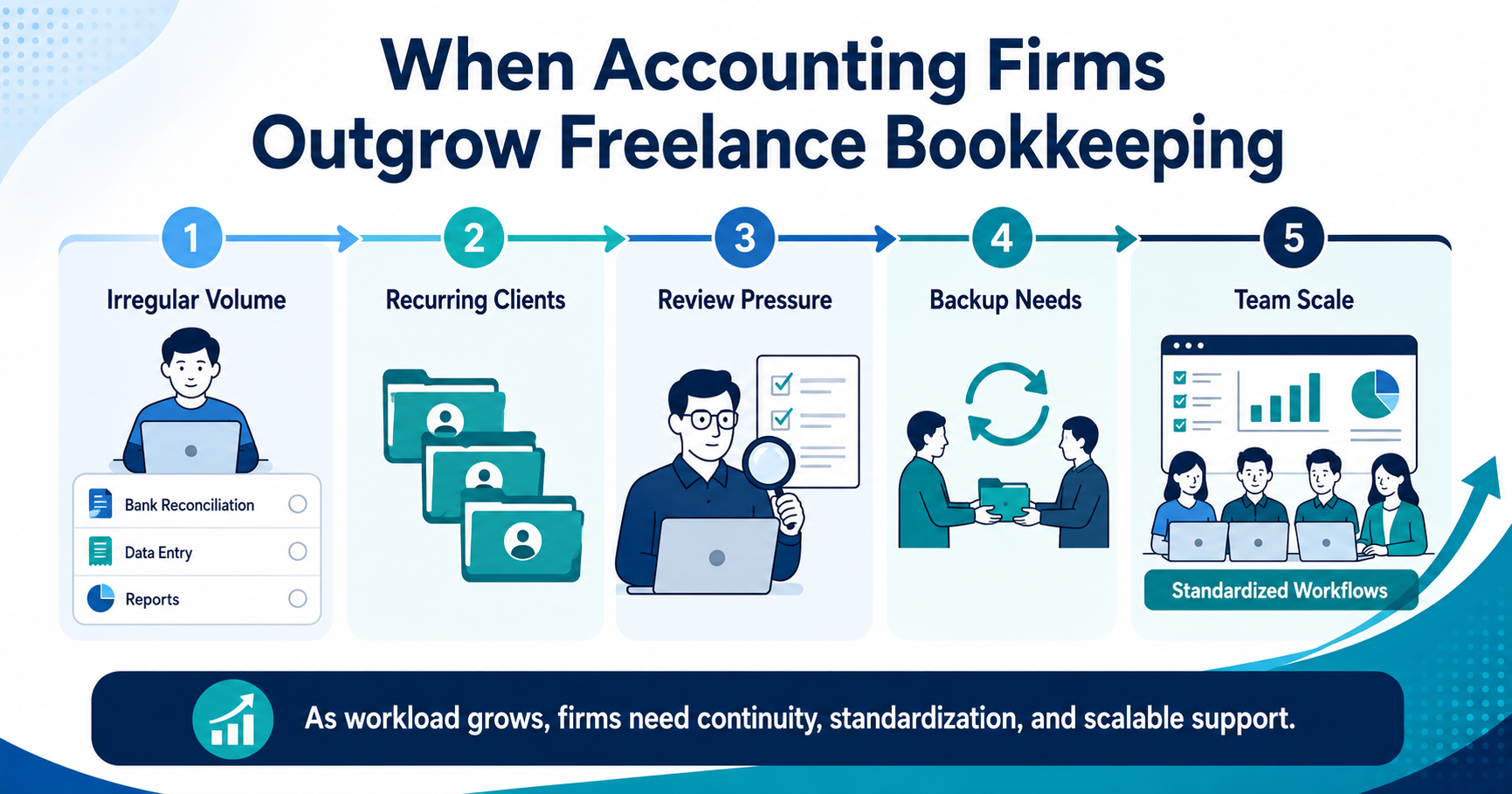
Signs Your Firm Has Outgrown Freelance Bookkeeping
A firm may need a more structured team when:
- Bookkeeping is recurring across several clients
- The same instructions are repeated every month
- Deadlines depend on one person’s availability
- Review notes are not retained consistently
- There is no backup during leave
- Different clients follow inconsistent workflows
- Senior reviewers spend excessive time correcting documentation
- Adding more volume requires another separate search
- The firm needs a team lead or reviewer layer
These are signs of an operating-model gap, not necessarily poor freelancer performance.
How to Move From a Freelancer to a Dedicated Team
The transition does not need to happen all at once.
- Select one recurring bookkeeping workflow.
- Document the SOP, close checklist, access rules, and expected output.
- Transfer a limited group of lower-complexity clients.
- Track review notes, rework, open items, and turnaround time.
- Add backup documentation and coverage.
- Scale only after quality becomes consistent.
The accounting firm should retain final review, client communication, approval authority, and professional judgment.
Expert Insight
“The hourly rate is only one part of bookkeeping cost. Firms also need to consider repeated training, review time, process inconsistency, and what happens when one person becomes unavailable. A dedicated team creates more value when the work is documented, measurable, and built around continuity.“
Anshul Agrawal,
Accounts Director, CA, SafeBooks Global
How SafeBooks Supports Scalable Bookkeeping
SafeBooks provides India-based bookkeeping and accounting support for U.S. CPA firms, accounting practices, EAs, tax professionals, and bookkeeping firms.
Support can include:
- Transaction recording and reconciliations
- Month-end close preparation
- AP and AR coordination
- Payroll input and reconciliation support
- Financial reporting preparation
- Document tracking
- Recurring back-office accounting workflows
Professionals work within the firm’s systems, SOPs, reporting calendar, and review structure.
SafeBooks Global Pvt. Ltd. is SOC 2 Type II certified across all five Trust Services Criteria:
- Security
- Availability
- Processing Integrity
- Confidentiality
- Privacy
Firms planning a transition can review the remote accounting workflow setup guide and the questions to ask before hiring a remote accounting team.
Final Takeaway
Freelancers can be effective for isolated projects, specialist assignments, and irregular bookkeeping needs.
Once an accounting firm manages recurring work across multiple clients, a dedicated offshore bookkeeping team can provide a stronger structure for continuity, standardized preparation, review, security oversight, and controlled growth.
The right time to move is not determined by firm size alone. It depends on whether individual freelance arrangements can still support the firm’s volume, deadlines, quality standards, and client commitments.
Contact SafeBooks Global to discuss dedicated offshore bookkeeping support for your accounting firm.