A solo preparer I know spent an entire summer migrating to an enterprise tax platform because it topped a “best software” list.
He files about 300 individual returns a year. By October, he was paying for tools he would never use, managing a workflow designed for a much larger firm, and missing the faster platform he had left behind.
He had purchased highly capable software and the wrong software at the same time.
That is the problem with tax software rankings. A firm handling complex partnerships, trusts, international reporting and multi-state returns is not shopping in the same market as a solo preparer completing mostly Form 1040 returns.
There is no single best tax software for CPA firms. Choose by return complexity first and firm size second.
How should a CPA firm choose tax software?
Start with the returns your firm prepares.
Complex Forms 1120, 1120-S, 1065 and 1041, multi-tier entities, international reporting and multi-state allocations require deeper calculations, diagnostics and review tools. Individual-heavy practices may benefit more from speed, straightforward data entry and predictable pricing.
Then consider:
- Number of preparers and reviewers
- Desktop, hosted or cloud deployment
- Multi-user access
- Review diagnostics
- Workflow and document integrations
- E-filing and organizer processes
- Pricing structure
- Remote and offshore access requirements
A larger feature list does not automatically mean a better fit. Every unused module adds cost, training and workflow complexity.
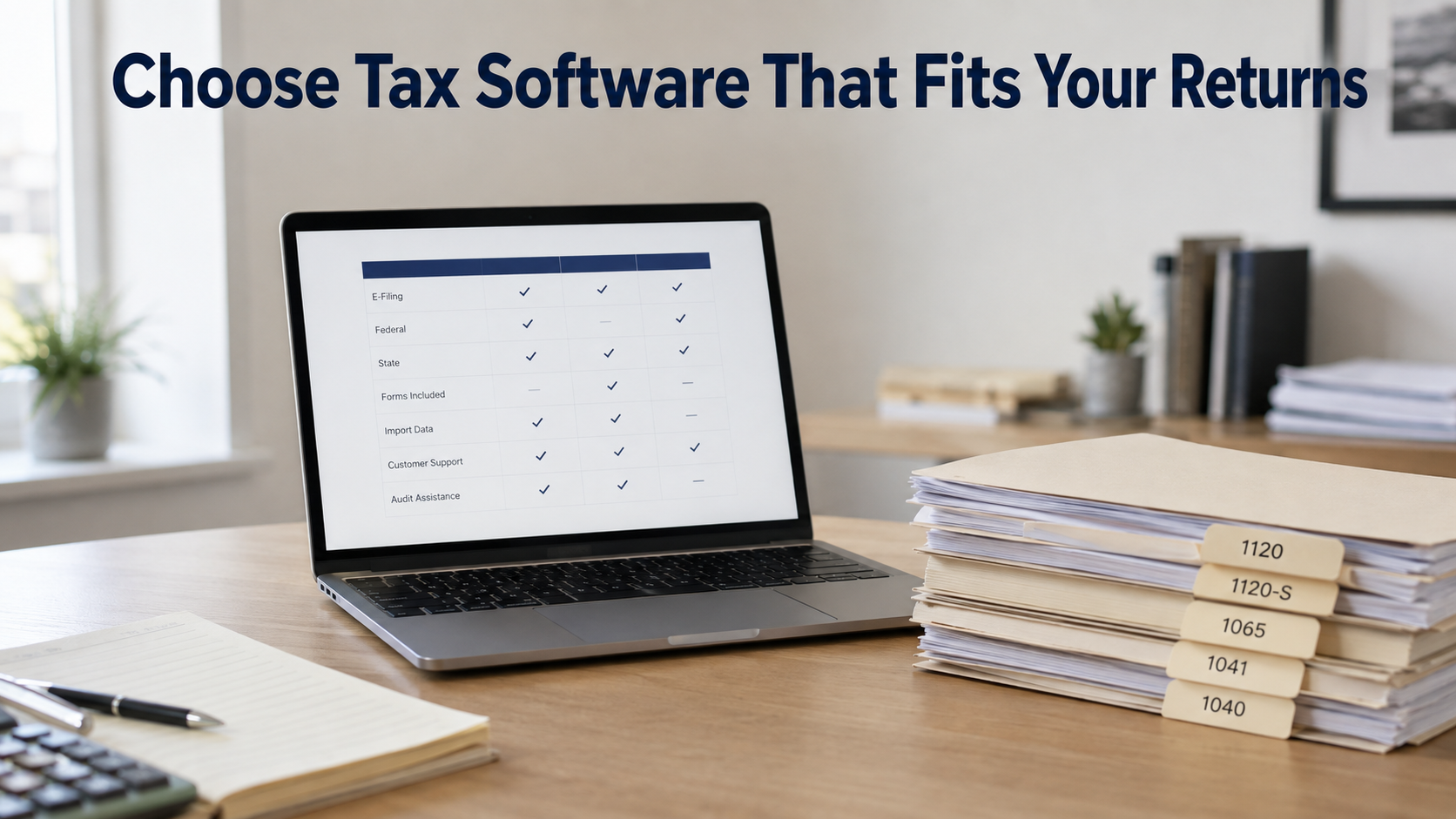
Which tax software tier fits your firm?
Return profile | Recommended tier | Platforms to consider |
Complex corporate, partnership, international and consolidated returns | Enterprise | CCH Axcess Tax, GoSystem Tax RS |
Mixed individual and complex business returns | Advanced professional | UltraTax CS, CCH ProSystem fx, Lacerte |
High-volume individual and standard business returns | Core professional | ProConnect, ProSeries, Drake |
Mostly straightforward individual returns | Budget-focused | ATX, TaxAct Professional |
Use this table to create a shortlist, not to make the final decision. Run realistic sample returns, involve preparers and reviewers in the trial, and test how the platform performs during a normal firm workflow.
Who owns the major professional tax platforms?
Four companies own most of the platforms CPA firms compare.
Owner | Major platforms |
Wolters Kluwer | CCH Axcess Tax, CCH ProSystem fx Tax and ATX |
Thomson Reuters | UltraTax CS and GoSystem Tax RS |
Intuit | Lacerte, ProConnect Tax and ProSeries |
Taxwell | Drake Tax and TaxAct Professional |
Ownership matters because tax software usually sits within a wider ecosystem. Research, portals, document management and workflow tools may integrate best with products from the same company. That can simplify implementation while increasing switching costs.
Pricing transparency also varies. Drake, TaxAct, ATX and the Intuit platforms publish prices or package information. Full CCH Axcess Tax, CCH ProSystem fx Tax, UltraTax CS and GoSystem Tax RS generally require a quote.
What are the best tax software platforms for CPA firms in 2026?
Pricing and product details were reviewed on August 24, 2026. Confirm current packages, features and terms with each provider before purchasing.
Platform | Best for | Deployment | Pricing |
Large firms with complex returns | Cloud | Quote | |
Enterprise and international work | Web-based | Quote | |
Established Wolters Kluwer firms | On-premise or hosted | Quote | |
Mid-sized and larger firms | Desktop with hosted options | Quote | |
Complex individual and business returns | Desktop or hosted | Published options | |
Cloud-first small and mid-sized firms | Cloud | Primarily per return | |
Individual-heavy small firms | Desktop or hosted | Published packages | |
High-volume, value-focused practices | Desktop or online | Published packages | |
Small forms-based practices | On-premise | Published packages | |
Solo and budget-focused practices | Desktop with cloud storage | Published packages |
Honest watch-outs
- CCH Axcess Tax: Its cost, setup and breadth may be excessive for smaller practices.
- GoSystem Tax RS: It is likely to be more platform than a small or individual-heavy firm needs.
- CCH ProSystem fx Tax: Firms should compare its longer-term deployment path with CCH Axcess.
- UltraTax CS: Its value is strongest when the firm adopts more of the Thomson Reuters ecosystem.
- Lacerte: Costs can increase with users, returns and additional services.
- ProConnect Tax: Per-return pricing requires careful modelling as volume grows.
- ProSeries: Highly complex entity or international work may exceed its ideal fit.
- Drake Tax: Deep research and enterprise workflow may require additional tools.
- ATX: Firms wanting a cloud-native workflow should evaluate deployment carefully.
- TaxAct Professional: It is less suited to highly complex or integrated firm workflows.
CCH Axcess vs UltraTax vs Lacerte vs Drake
Platform | Strongest fit | Main decision factor |
CCH Axcess | Large, complex and cloud-focused firms | Enterprise depth and integrated cloud workflow |
UltraTax CS | Mid-sized and larger firms | Thomson Reuters workflow integration |
Lacerte | Complex individual and business returns | Diagnostics and preparation efficiency |
Drake | High-volume, value-focused practices | Transparent pricing and return coverage |
CCH Axcess provides the deepest cloud-focused enterprise environment. UltraTax fits firms already using Thomson Reuters products. Lacerte balances return complexity with preparer efficiency. Drake prioritizes value, volume and transparent packaging.
The better comparison is not which platform has the most features. It is which platform fits the returns, people and processes already inside your firm.
Should your firm choose desktop or cloud tax software?
Cloud-native platforms such as CCH Axcess Tax and ProConnect support browser access without requiring the full application to run locally. GoSystem Tax RS is also web-based.
Desktop products can still support distributed teams when hosted in a controlled private environment. The important question is whether the setup provides reliable peak-season performance, secure access, role-based permissions, backups and user-level accountability.
Your Written Information Security Plan and FTC safeguards should reflect the actual deployment. Use SafeBooks’ tax firm data security checklist to review the setup before busy season.
Does tax software affect offshore tax preparation?
Yes, but the compliance point must be stated accurately.
Internal Revenue Code Section 7216 restricts how tax preparers use and disclose tax return information. When Form 1040 information is disclosed to a preparer outside the United States, the firm may need separate, affirmative, signed and dated taxpayer consent before providing access.
SSN masking reduces the sensitive information disclosed, but it does not automatically remove Section 7216 requirements. When an unmasked Social Security number will be disclosed outside the United States, the consent must include the applicable mandatory language.
A firm considering offshore preparation should confirm whether its platform supports:
- Client-level access restrictions
- SSN masking
- Unique preparer identities
- Multi-factor authentication
- Individual activity logs
- Immediate offboarding
SafeBooks’ Section 7216 offshore tax-preparation checklist explains the consent process in more detail.
Software prepares the return, but trained preparers still have to run it, resolve diagnostics and support review. SafeBooks works inside the platform a firm already uses, subject to the firm’s approved access and compliance process.
The right platform is not the one at the top of a generic ranking. It is the one that fits your return complexity, firm size, workflow, budget and staffing model.