In-House, Offshore, or Managed Accounting Support: Which Model Fits Your Firm?
Three tax seasons ago, I watched a managing partner nearly burn out his senior team.
He had hired two full-time bookkeepers to handle the seasonal surge. By February, one had resigned. The other could not keep pace. His CPAs, who should have been handling client discussions and higher-value review work, were completing bank reconciliations at 11 p.m.
He called and said something many firm leaders eventually ask:
“I don’t know whether I need more people or a different operating model.”
That is the real decision.
In-house, offshore, and managed accounting support can all increase capacity. The right choice depends on the type of work involved, how mature the firm’s processes are, and how much management responsibility the firm wants to retain.
Key Takeaway
In-house teams are best suited for client relationships, final judgment, and complex advisory work, while repeatable bookkeeping, tax preparation, audit support, and back-office tasks can often be handled offshore. Firms with mature processes may manage dedicated offshore employees directly, but managed accounting support is generally a stronger fit when the firm needs capacity, workflow controls, secure access, quality checkpoints, and continuity without building the entire delivery structure internally.
How the Three Accounting Support Models Differ
The decision should not begin with hourly cost. It should begin with ownership.
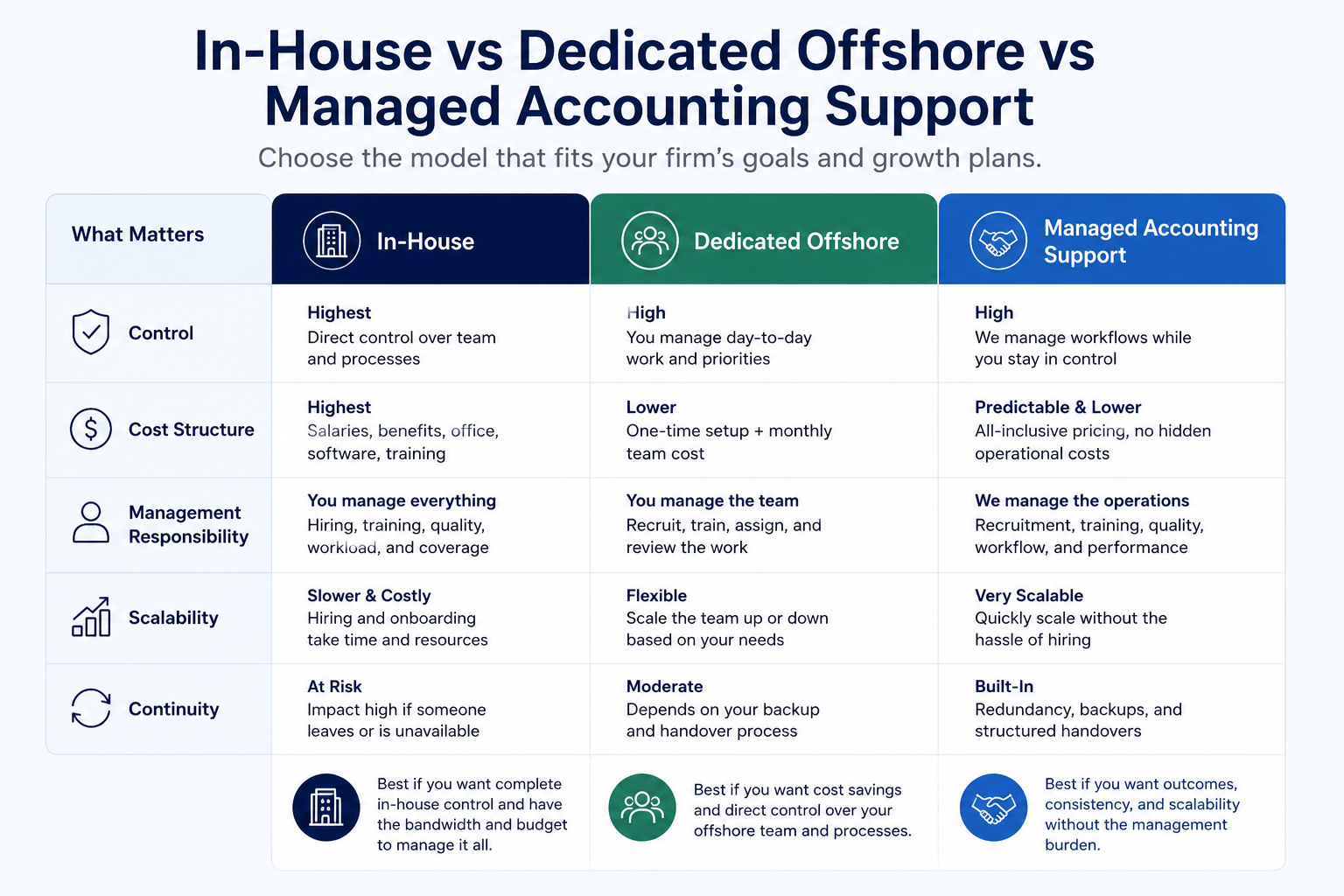
Decision area | In-house team | Dedicated offshore team | Managed accounting support |
Employment and supervision | Fully managed by the firm | Employment handled externally, daily work managed by the firm | Delivery supported through a defined service structure |
Workflow setup | Firm responsibility | Firm responsibility | Processes can be documented and standardized with the provider |
Quality control | Internal review | Internal review | Quality checkpoints can be built into delivery |
Scalability | Slower due to hiring time and fixed payroll | Easier to add remote headcount | Designed to expand through repeatable workflows and team support |
Continuity | Depends on internal staffing depth | Depends on provider replacement support | Backup and transition planning can be included |
Best suited for | Judgment-heavy and client-facing work | Firms with mature processes and strong remote managers | Firms needing capacity without building the full control layer alone |
An in-house model offers the greatest direct control. A dedicated offshore team can reduce staffing pressure, but the firm must still train, supervise, and review each person.
Managed accounting support goes further. It combines remote accounting capacity with process structure, workflow oversight, secure access, and defined handoffs.
For CPA firms whose partners and managers are already stretched, the managed model is often the most practical option.
Keep Judgment In-House and Move Repeatable Execution
Not every accounting task belongs in the same delivery model.
Tax planning, audit opinions, client advisory, final technical review, and relationship management should generally remain with experienced onshore professionals.
Repeatable work such as bookkeeping, reconciliations, document organization, tax preparation support, audit workpaper preparation, and routine back-office tasks can often be handled remotely when procedures and review standards are clear.
Some activities sit between the two. Payroll involving state-specific rules, complex sales tax matters, or unusual accounting treatments may be prepared remotely but should remain subject to onshore review and approval.
The strongest firms do not treat in-house and offshore support as competing options. They create a hybrid model in which each team handles the work that best matches its skills and responsibility level.
A structured offshore accounting operating system can help define those responsibilities before work begins moving between teams.
Decide Whether You Need People or Managed Delivery
A dedicated offshore employee may be the right choice when the firm has stable year-round volume, documented procedures, strong managers, and the time to supervise another team member.
Managed support is usually stronger when:
- Work volume changes during the year
- Managers do not have time to train every new hire
- Procedures vary between clients
- The firm needs backup coverage
- Review work is already consuming senior capacity
With managed support, the firm is not simply adding an offshore accountant. It is adding a delivery structure around the work.
That distinction matters. Hiring more people without improving the operating process may increase coordination rather than capacity.
Firms comparing models should review the differences between dedicated offshore staffing structures before deciding how much daily management they want to retain.
Test One Workflow Before Expanding
A firm should not move every bookkeeping, tax, or audit process at once.
Start with one repeatable workflow, such as monthly reconciliations, bookkeeping cleanup, tax organizer processing, or audit document preparation.
The pilot should measure:
- Cost per completed unit
- Time from assignment to review-ready delivery
- Errors or review notes across the first set of outputs
The goal is not perfection on day one. The goal is evidence that quality improves as feedback is applied.
If the same issue appears repeatedly, the problem may be the training or procedure rather than the remote team member. Correct it before increasing volume.
A remote accounting workflow setup should show how tasks are assigned, when they are ready for review, how exceptions are escalated, and who owns the next action.
Time-Zone Coverage Only Works With Strong Handoffs
Offshore accounting can shorten turnaround times because work continues outside U.S. business hours.
That advantage disappears when completed work waits several days for review.
The offshore team may finish a reconciliation overnight, but the process still stalls if the onshore reviewer does not respond to questions or clear review notes.
Each workflow needs a defined handoff deadline, a clear “ready for review” status, written open-item notes, and a short overlap window for urgent questions.
This is especially important during tax season and month-end close, when delays compound quickly.
A continuous close workflow can help spread preparation and review throughout the month instead of concentrating everything near the reporting deadline.
The Control Layer Determines Whether Offshore Support Works
Adding remote capacity without quality and security controls creates avoidable risk.
Before scaling, the firm should define review coverage, access permissions, exception thresholds, documentation standards, and replacement procedures.
Quality review should focus on patterns rather than isolated corrections. When the same error appears several times, update the SOP or training material instead of fixing each file individually.
Security should include virtual access, multifactor authentication, encrypted connections, role-based permissions, restricted downloads, activity logs, and immediate access removal when a team member leaves.
SafeBooks Global explains these requirements in its guide to protecting financial data in offshore accounting.
Expert Insight
“The best support model is the one that reduces the number of decisions senior staff must make about routine work. Clear workflows, defined review points, and controlled access allow CPAs to focus on exceptions and client judgment rather than daily production follow-up.“
Shivangi Agrawal
Managing Director, CA, CPA (USA), SafeBooks Global
Check Whether Your Firm Is Operationally Ready
No staffing model can compensate for undocumented processes.
Before deciding, identify the five activities consuming the most team hours. Classify each as judgment-based, client-facing, repeatable, or administrative.
Then ask whether another qualified accountant could complete the repeatable work using the firm’s existing instructions.
If the answer is no, document the workflow first.
The firm should also have a task management system with owners, due dates, status labels, and review stages. Email should not be the main system for managing recurring client work.
Firms can use SafeBooks Global’s guide to evaluating an offshore accounting partner to assess workflow readiness, provider controls, communication, and continuity.
Which Accounting Support Model Should You Choose?
Use an in-house model for work requiring client relationships, final judgment, firm leadership, and close supervision.
Use a dedicated offshore team when processes are mature, work volume is consistent, and the firm has managers available to direct the team.
Use managed accounting support when the firm needs remote capacity but does not want to build every process, security control, and continuity plan from the beginning.
For many growing CPA firms, the strongest answer is a hybrid model. Keep judgment, approval, and client relationships onshore. Move structured execution to a managed offshore team with documented workflows and review-ready delivery.
Build Capacity Without Adding More Management Pressure
SafeBooks Global helps U.S. CPA and accounting firms expand bookkeeping, tax, audit, and back-office capacity through a managed support model.
The engagement is built around clear task ownership, secure access, documented procedures, quality checkpoints, and consistent handoffs. This gives firms the advantages of offshore accounting without requiring partners to create the entire control structure alone.
Explore SafeBooks Global’s offshore accounting services for CPA firms or schedule a discovery call to identify which workflows should remain in-house and which can move into a managed delivery model.