
Offshore Bookkeeping in India: A Practical Guide for U.S. CPA Firms
It was 11 p.m. during busy season when a managing partner discovered that his offshore bookkeeping team had misclassified three months of inventory-related transactions for a major e-commerce client.
The bank reconciliations appeared complete, but the historical ledger was wrong. Year-end work had already started, and the onshore team had to reopen three monthly closes, rebuild supporting schedules, and explain the delay to the client.
The offshore provider had claimed extensive QuickBooks experience. What the firm had not tested was whether the assigned team understood the client’s chart of accounts, inventory flow, and review expectations.
That distinction matters.
Offshore bookkeeping in India can provide U.S. CPA firms with trained accounting capacity, extended production hours, and relief from recurring back-office work. But the model succeeds only when the firm defines the workflow, verifies the assigned team, controls data access, and retains clear review responsibility.
Key Takeaway
Offshore bookkeeping in India works best when CPA firms move repeatable processes such as transaction coding, reconciliations, AP and AR support, and monthly close preparation through documented workflows. The offshore team should prepare and flag exceptions, while the U.S. firm retains review, client communication, and final approval. A managed provider such as SafeBooks Global can reduce the burden of building these controls from the beginning.
Which Bookkeeping Work Should Move Offshore?
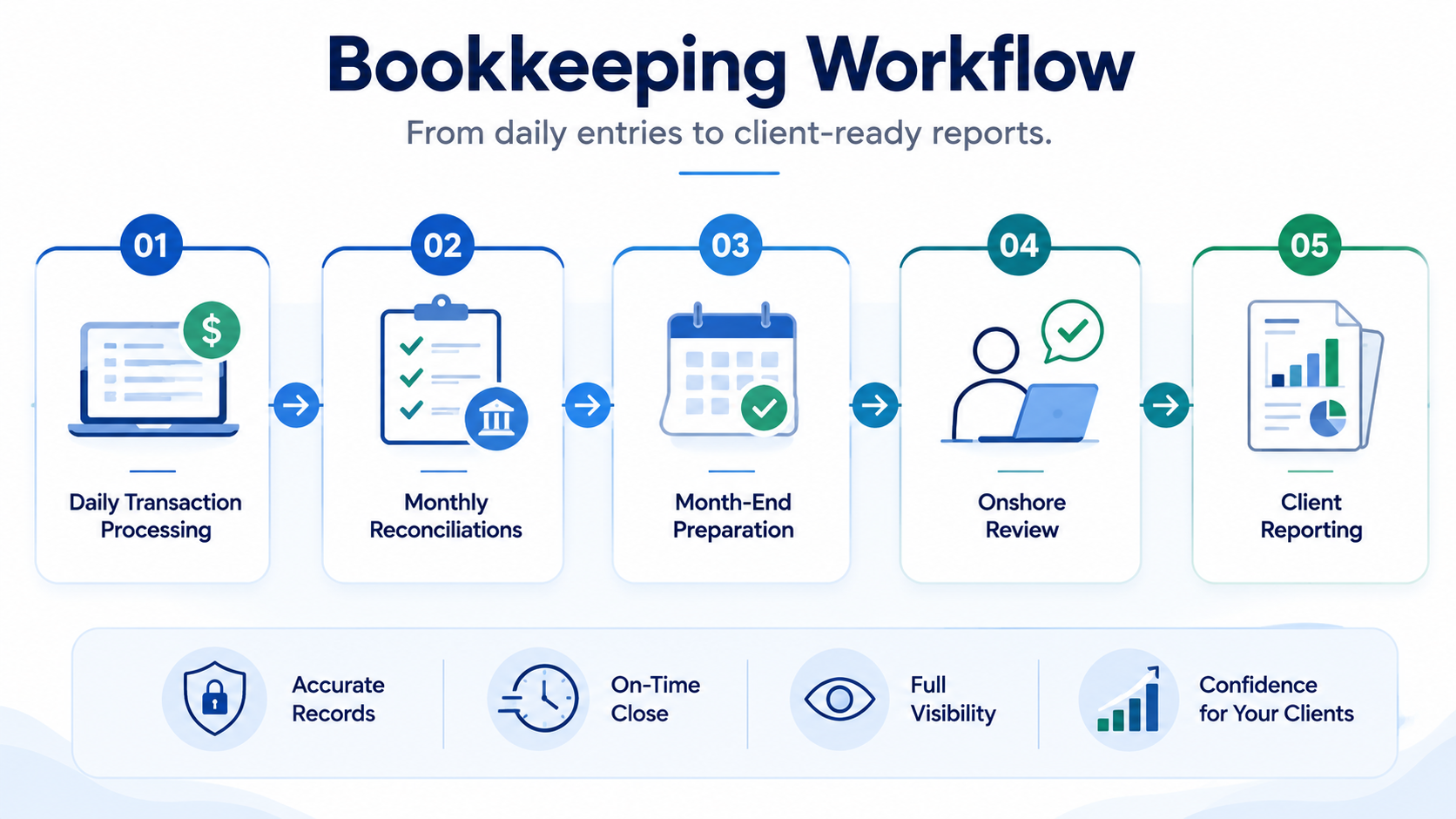
The goal is not to move every accounting task. It is to separate repeatable preparation from judgment and client responsibility.
Bookkeeping cycle | Suitable offshore activities | Responsibility retained by the U.S. firm |
Daily ledger maintenance | Transaction coding, bank-feed review, receipt matching, AP and AR updates | Approval of unusual classifications and client-specific decisions |
Monthly reconciliation | Bank and credit card reconciliations, clearing-account review, open-item tracking | Review of material variances and final reconciliation approval |
Month-end close | Schedule preparation, recurring entries, balance-sheet support, close checklist updates | Final adjustments, financial statement review, and client delivery |
Year-end readiness | Cleanup lists, missing-document tracking, account rollforwards, supporting schedules | Tax coordination, technical decisions, and year-end sign-off |
For many firms, the strongest model is hybrid. Offshore professionals handle structured bookkeeping production, while onshore accountants focus on exceptions, review, and client communication.
A structured offshore accounting operating system can help define that division before work begins moving between teams.
Define the Workflow Before Choosing a Provider
Offshore bookkeeping will not correct an unclear internal process. It usually exposes the weaknesses faster.
Before speaking with providers, identify three to five workflows that consume significant team time and can be documented clearly.
Each workflow should define the required source documents, chart-of-accounts rules, completion standard, turnaround time, review owner, exception threshold, and escalation process.
For example, a bank reconciliation procedure should explain how to handle stale checks, unmatched deposits, missing statements, intercompany transfers, and unexplained differences.
If those decisions still depend on one senior accountant’s memory, the process is not ready to scale.
A documented remote accounting workflow gives the offshore and onshore teams the same definition of complete, blocked, and ready for review.
Test the Assigned Bookkeeping Team
Do not evaluate only the provider’s leadership team or sales presentation.
Ask who will work on your clients, who will supervise the work, and who will provide backup coverage. Review the assigned professionals’ experience with U.S. bookkeeping, month-end close, your software stack, and the industries represented in your client base.
Then run a paid pilot using one real but controlled workflow.
A useful bookkeeping pilot might include several bank reconciliations, one month-end close file, and an intentionally incomplete client package. This allows the firm to test whether the team can complete the work, document open items, and challenge missing information.
The pilot should measure accuracy, turnaround time, review notes, exception handling, and the amount of onshore time required.
SafeBooks Global’s guide to vetting offshore accountants includes additional questions for evaluating the people who will perform the work.
Start With One Bookkeeping Cycle
Moving every client and workflow at once creates unnecessary risk.
Begin with one repeatable cycle, such as monthly bank reconciliations or AP and AR processing, for a limited group of clients.
During the first 30 to 60 days, review each file closely and record repeated issues. If the same classification or reconciliation error appears several times, update the procedure or training instead of correcting files individually.
A simple tracking system should show the assignment date, due date, work status, unresolved questions, reviewer, and final approval.
Do not expand until the team consistently produces review-ready work and identifies missing documents or unusual transactions without being prompted.
Firms can also compare their internal cost and review time using the remote accounting ROI calculator.
Prevent the 24-Hour Blocker Loop
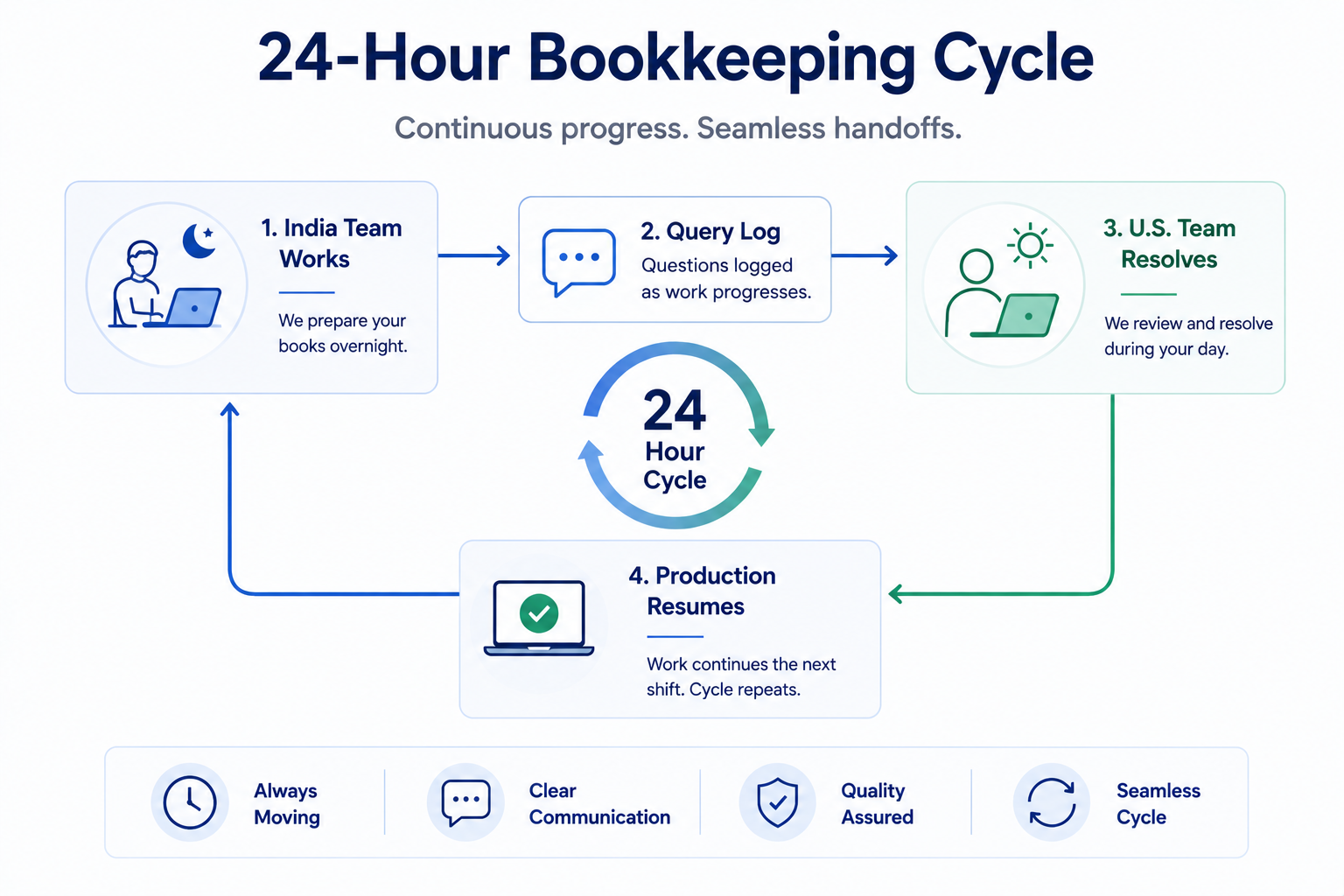
The time difference between India and the United States can support overnight bookkeeping production, but it can also turn a simple question into a full-day delay.
For example, an India-based bookkeeper may discover a broken bank feed at the beginning of the shift. If the issue is mentioned only in a message that the U.S. team sees at the end of the Indian workday, production may remain blocked until the following night.
The solution is a centralized asynchronous query log.
Every blocker should include the client, issue, supporting evidence, required decision, owner, and response deadline. The U.S. team can resolve questions during local business hours so work resumes when the India team returns.
A short overlap window should be reserved for urgent or complex items, but routine questions should remain documented inside the firm’s practice management system.
This structure also supports a continuous close workflow by preventing unresolved items from accumulating until month-end.
Expert Insight
“The value of time-zone coverage comes from disciplined handoffs, not the time difference alone. A clear query log allows the U.S. team to resolve exceptions during the day so the India team can continue production without losing another cycle.“
Anshul Agrawal,
Accounts Director, CA, SafeBooks Global
Protect Client Data at the Workflow Level
Security should be verified through the actual bookkeeping process.
The provider should demonstrate secure remote access, multifactor authentication, role-based permissions, restricted local storage, individual activity logs, and prompt access removal.
Client documents should remain inside approved systems. Personal email, uncontrolled file transfers, and local device storage should not become shortcuts during busy periods.
The provider should also explain which team members can access each client and how those permissions are reviewed.
SafeBooks Global’s guide to offshore accounting data security outlines the controls firms should review before providing access.
Watch for Warning Signs
Warning sign | What it may indicate | Required response |
Reconciliations are complete but contain repeated errors | Weak training or unclear client rules | Pause expansion and correct the SOP |
Missing documents are not flagged promptly | Poor escalation habits | Require blocker reporting through the query log |
Onshore review time remains high | Work is not arriving review-ready | Strengthen first-level quality checks |
Open items continue across multiple close cycles | Weak ownership and follow-up | Assign owners and response deadlines |
Files are shared outside approved systems | Security controls are not being followed | Stop access and investigate immediately |
These issues should be corrected before new clients or workflows are added.
Why Managed Offshore Bookkeeping Can Be Stronger
Hiring an individual offshore bookkeeper may work when the firm already has mature processes and managers available to supervise the role.
A managed provider is usually stronger when the firm needs workflow setup, quality follow-up, secure access, backup coverage, and scalable delivery.
SafeBooks Global provides remote bookkeeping support from India for U.S. CPA and accounting firms. The focus is on documented processes, controlled access, review-ready work, and clear accountability.
Review the questions to ask before hiring a remote accounting team or schedule a discovery call to identify the right bookkeeping workflow for a controlled pilot.