
How to Hire Offshore Accountants for Your CPA Firm
Hiring offshore accountants is no longer only a cost-saving decision for CPA firms.
For many firms, it has become a capacity, workflow, and client-service decision.
The pressure remains real, despite early signs of improvement in the accounting talent pipeline. The AICPA’s 2025 Trends Report found that accounting degree completions fell 6.6% to 55,152 in 2023-24. More recent data shows undergraduate accounting enrollment rose 5.7% in spring 2026 to 281,992 students. Meanwhile, the U.S. Bureau of Labor Statistics projects 5% employment growth for accountants and auditors through 2034, with about 124,200 openings each year. (AICPA & CIMA)
That gap is one reason more CPA firms are looking at offshore accounting support. But hiring offshore accountants without a proper vetting process can create new problems: rework, unclear communication, weak data controls, review delays, and inconsistent output.
The real question is not just, “Can we hire offshore accountants?”
The better question is, “Can we hire offshore accountants who fit our workflow, protect client data, and produce review-ready work?”
Key Takeaway: How Should CPA Firms Hire Offshore Accountants?
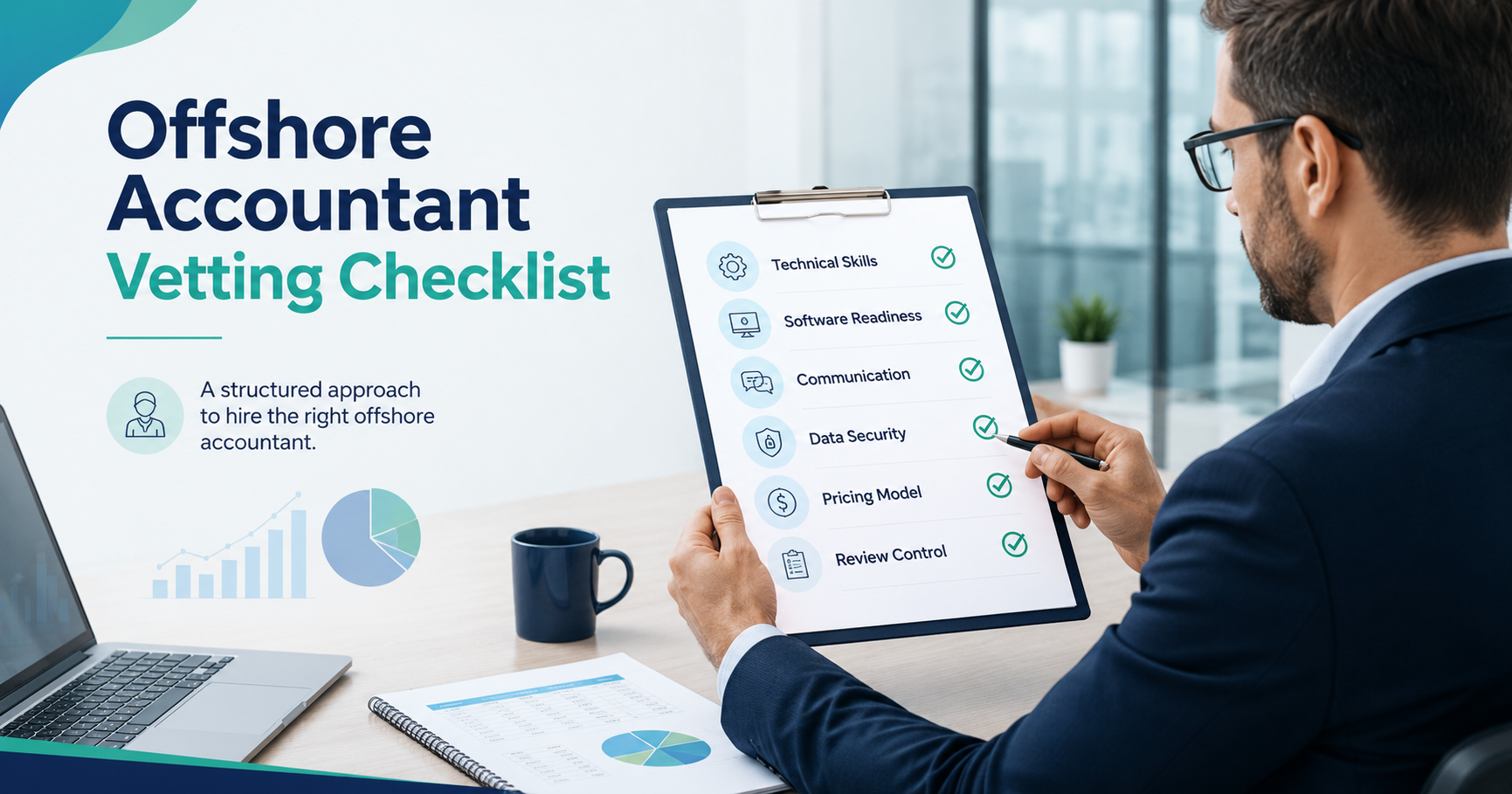
CPA firms should hire offshore accountants through a structured vetting process that checks role fit, technical skills, software readiness, data security, communication, pricing model, and review control. The best offshore accounting hiring guide starts with defining the work, testing real CPA firm tasks, setting secure access, documenting SOPs, and integrating the offshore team into the firm’s review process.
Step 1: Define the Work Before You Hire the Role
Many firms begin with the wrong question: “How many offshore accountants do we need?”
A better starting point is: “Which work should move offshore, and what does good output look like?”
Your CPA firm may need help with bookkeeping cleanup, monthly reconciliations, tax preparation support, workpaper preparation, audit documentation, sales tax filing support, payroll support, or back-office accounting tasks. Each of these roles requires a different vetting process.
For example, a bookkeeping support role should be tested on bank reconciliations, transaction coding, cleanup work, and month-end review support. A tax support role should be tested on source document organization, workpaper preparation, diagnostics, and review-note quality.
Offshore accountants work best when the work is structured, repeatable, documented, and reviewable. If your internal workflow is unclear, the offshore team will inherit the same confusion.
CPA firms that need recurring accounting support can review SafeBooks’ bookkeeping and accounting support for accounting firms to understand how offshore teams can fit into client accounting workflows.
Step 2: Decide What Should Stay Onshore
Offshore accountants can support a wide range of preparation and process-driven work, but the CPA firm must keep clear ownership of final judgment.
Offshore teams are usually well-suited for reconciliations, document organization, workpaper preparation, transaction coding, payroll support, sales tax support, accounts payable, accounts receivable, and preliminary tax preparation.
Final tax positions, advisory recommendations, client relationship management, final audit opinions, and complex planning decisions should remain with the firm’s senior onshore team.
This boundary protects quality and accountability. It also helps partners and managers spend more time on review, planning, client conversations, and higher-value advisory work.
For firms considering broader CPA firm offshore staffing, SafeBooks supports accounting firms with tax, audit, bookkeeping, and back-office workflows.
Step 3: Choose the Right Offshore Hiring Model
Before hiring, CPA firms should understand the main offshore accounting models. Each model has a different level of cost, control, security, and management effort.
Hiring Model | How It Works | Best Fit | Main Risk |
Direct offshore hire | The CPA firm recruits and manages the accountant directly | Firms with strong internal HR, IT, and training systems | More responsibility for payroll, compliance, IT, and supervision |
Managed offshore team | A partner provides trained offshore accountants with infrastructure and oversight | CPA firms that want capacity without building offshore operations from scratch | Requires clear SOPs and regular communication |
Transactional outsourcing | Work is assigned per return, per file, or per project | Seasonal overflow or limited-scope tasks | Less consistency across staff and client knowledge |
Automation-led support | Software handles basic workflow with human review | High-volume, standardized bookkeeping | Limited fit for judgment-heavy or custom work |
Cost should be reviewed carefully, but it should not be the only deciding factor. A low-cost offshore hire can become expensive if the firm spends too much time correcting work, managing security gaps, or explaining the same process repeatedly.
A better pricing review should include the full operating cost: recruitment, training, software access, secure IT setup, supervision, rework, management time, and review capacity.
Step 4: Vet Technical Skills With Real CPA Firm Work
A resume is not enough.
CPA firms should test offshore accountants with the same type of work they will actually handle. Generic accounting questions may show basic knowledge, but they do not show whether someone can work inside a CPA firm’s real review process.
If the role is bookkeeping-focused, test reconciliations, cleanup entries, expense coding, balance sheet review, and open-item notes.
If the role is tax-focused, test document intake, source document review, preparation support, diagnostics, and workpaper organization.
If the role is audit-focused, test documentation structure, support schedules, tick mark discipline, and review-ready file preparation.
The goal is to understand whether the offshore accountant can complete the task in a way that saves reviewer time.
A good technical test should show whether the candidate can identify missing information, avoid assumptions, document questions, and prepare clean workpapers.
Step 5: Check Software and Workflow Fit
A technically strong accountant can still struggle if they cannot work inside your firm’s systems.
Before hiring offshore accountants, check whether they are comfortable with your actual software stack. This may include QuickBooks Online, Xero, TaxDome, Canopy, CCH, Drake, Lacerte, UltraTax, Karbon, Microsoft Teams, SharePoint, Google Workspace, or other firm management tools.
The larger issue is workflow fit.
Your offshore accountant should know where tasks are assigned, how open items are tracked, when to ask questions, how review notes should be written, and when a file is ready for manager review.
This is where a ledger-plus-workflow system can help. In many CPA firm workflows, QuickBooks Online or Xero acts as the ledger, while tools such as Double, formerly Keeper, help manage review tasks, client questions, anomaly checks, and workflow visibility. When offshore accountants work inside this kind of system, firms can reduce scattered emails and give reviewers a clearer view of what is complete, what is pending, and what needs client input.
SafeBooks has discussed this issue in its blog on remote accounting workflow setup and firm management tools for offshore accounting workflows.
Step 6: Review Security, Access, and Client Data Controls
Security should be part of vetting from the beginning.
CPA firms handle tax returns, payroll records, bank statements, financial reports, personal identification details, and sensitive client documents. The IRS states that protecting client data is the law and points tax professionals to Publication 4557 for data security recommendations. The FTC Safeguards Rule also requires covered financial institutions, including tax preparation firms, to maintain an information security program with administrative, technical, and physical safeguards. (IRS)
Before assigning client work to an offshore accountant, your firm should ask how data access will be controlled. This includes multi-factor authentication, VPN or VDI access, role-based permissions, password management, file download restrictions, device controls, printing restrictions, USB restrictions, and audit logs.
This is also where the delivery model matters.
A freelancer working from a home office may not offer the same level of physical control as a structured work-from-office offshore accounting team. SafeBooks operates with office-based delivery teams in Ahmedabad, India, supported by physical supervision, controlled workstations, and restricted device access. This helps reduce risks around local downloads, printing, USB storage, and unsupervised client data handling.
For firms that want to understand SafeBooks’ approach in more detail, the blog on how SafeBooks protects client financial data is a useful supporting resource.
Step 7: Test Communication Before the First Live File
Communication issues usually appear when deadlines are close.
That is why communication should be tested before hiring. Ask the offshore accountant to prepare a sample open-item list, write review notes, summarize a reconciliation issue, or draft a client document request.
This test shows whether the person can communicate clearly, document context, and raise questions without creating confusion.
For CPA firms, communication is not only about English fluency. It is about accounting judgment, timing, and clarity. Offshore accountants should know when to pause, when to ask, when to escalate, and how to avoid assumptions.
This is especially important when hiring remote accountants for CPA firms because the team may not be sitting in the same office, time zone, or review meeting.
Step 8: Build Review Control Into the Hiring Process
Do not wait until work starts to define quality control.
Before hiring offshore accountants, decide how their work will be reviewed. Your firm should define who reviews the work, what checklist will be used, how feedback will be shared, what accuracy issues will be tracked, and when a file is considered review-ready.
A review-ready file should not simply mean that the preparer finished the task. It should mean the work is complete, documented, organized, and ready for the next reviewer.
For tax support, this may include organized source documents, cleared diagnostics, completed workpapers, and clear notes on unresolved items. For bookkeeping, it may include reconciled accounts, categorized transactions, variance notes, and open client questions. For audit support, it may include clean schedules, proper documentation, and support tied to the review checklist.
SafeBooks supports this through structured tax support for accounting firms, audit support, and back-office support for accounting firms.
Step 9: Plan Onboarding, Training, and Performance Tracking
Hiring is only the starting point.
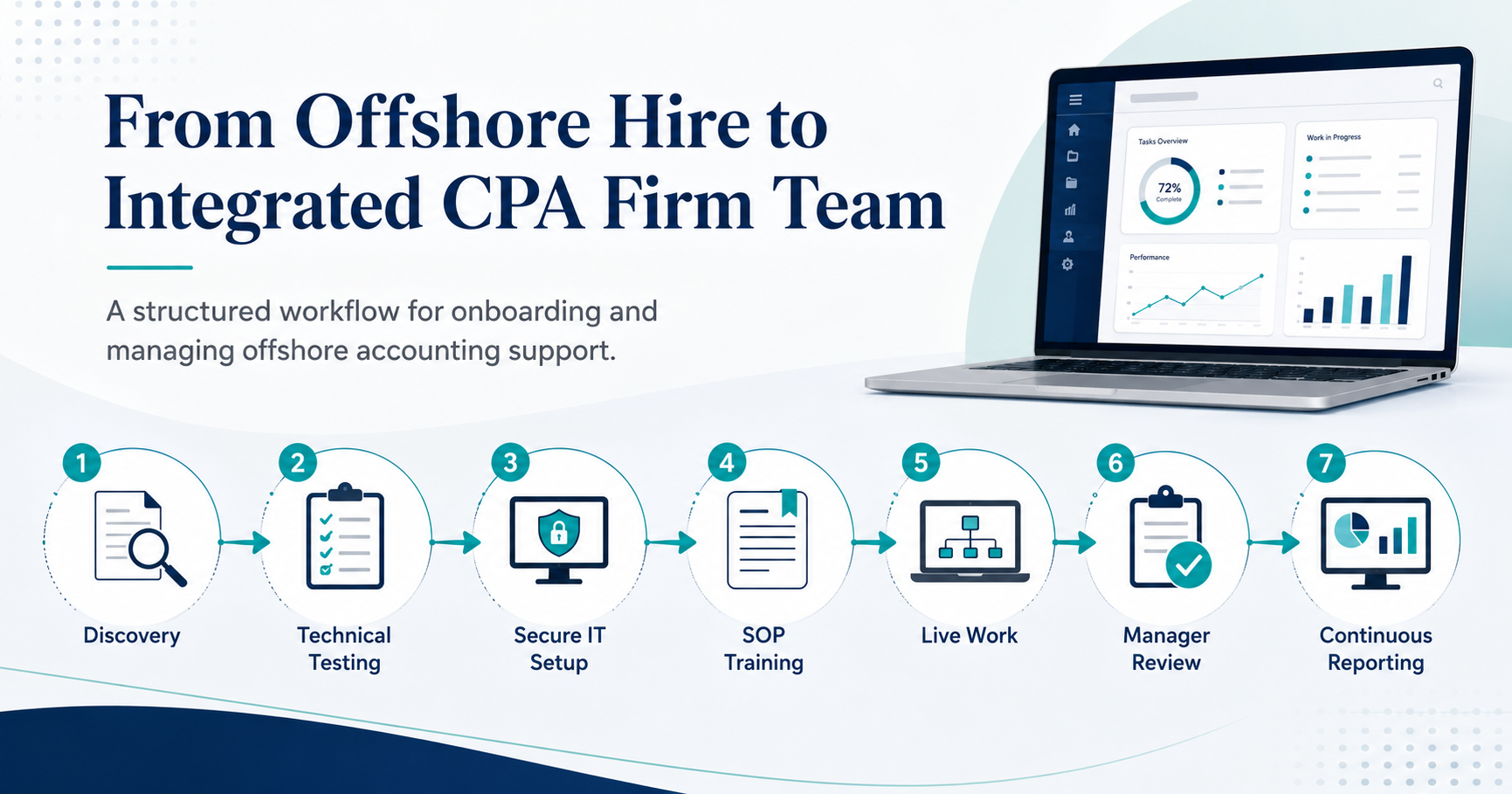
A strong offshore accounting hiring guide should include what happens after the accountant joins the workflow. Without proper onboarding, even a skilled offshore accountant may struggle to understand your firm’s templates, client expectations, review style, and communication habits.
Start with a small group of clients or a defined task category. Train the offshore accountant on your SOPs, folder structure, naming conventions, workpaper standards, deadlines, and escalation rules.
Then track performance through practical metrics. These may include turnaround time, first-pass review quality, number of open items, response time, rework volume, and reviewer feedback.
This helps the firm decide whether to expand the offshore role, provide more training, or adjust the workflow.
Step 10: Use AI and Automation Carefully
AI and automation can make offshore accounting teams more productive, but they do not remove the need for review.
In tax preparation, tools such as SurePrep 1040SCAN, CCH ProSystem fx Scan, and Intuit Link can support document intake, OCR-based data extraction, source document organization, and client document requests. Offshore tax accountants can help verify extracted data, organize workpapers, flag missing documents, and prepare files for domestic CPA review.
This changes the offshore role from basic data entry to verification, exception handling, and preparation support.
The same principle applies to bookkeeping. Automated rules, bank feeds, and workflow tools can speed up recurring tasks, but offshore accountants still need to review exceptions, document questions, and identify unusual transactions.
Automation should make the workflow clearer. It should not create a false sense of control.
Where SafeBooks Fits Into Offshore Accounting Hiring
SafeBooks Global helps CPA firms move beyond one-off hiring and build structured offshore accounting teams.
Instead of treating offshore accountants as temporary extra hands, SafeBooks helps firms align remote capacity with their existing software, SOPs, review standards, communication rules, and data security expectations.
This can include bookkeeping cleanup, monthly reconciliations, tax preparation support, audit documentation, sales tax support, payroll support, open-item tracking, and back-office accounting coordination.
The value is not only more capacity. It is capacity that your firm can actually manage, review, and scale.
CPA firms comparing providers can also review SafeBooks’ guide on how to evaluate an offshore accounting partner before making a decision.
Hiring Offshore Accountants Should Make the Firm Stronger
Offshore accounting can help CPA firms solve real capacity problems, but only when the hiring process is disciplined.
The right offshore accountant can support bookkeeping, tax preparation, reconciliations, audit documentation, sales tax filings, payroll support, and back-office workflows. The wrong hire can create rework, security gaps, communication delays, and more pressure on reviewers.
That is why CPA firms should vet for more than availability and cost.
They should review role fit, technical skill, software readiness, pricing model, communication, security controls, onboarding, and review discipline.
If your firm is planning to hire offshore accountants, SafeBooks Global can help you build a structured remote accounting team that supports your workflow without weakening review control. To discuss offshore accounting support for your CPA firm, Contact SafeBooks Global.