For many small businesses, accounting starts informally.
The owner, a spouse, or an office manager handles invoices, expenses, and bank statements alongside everything else.
That may work at first. But as transactions, payroll, vendors, and reporting needs grow, bookkeeping starts consuming more time and creating more complexity.
At that point, business owners often need something between doing it themselves and hiring a full in-house accounting team.
A virtual accounting department fills that gap by providing remote accounting support without the cost and complexity of building multiple internal roles.
Key Takeaway
A virtual accounting department is an external accounting team that manages bookkeeping and financial operations remotely, giving small businesses access to accounting support without hiring a full in-house accounting department.
What Is a Virtual Accounting Department?
A virtual accounting department is a remote team that handles a business’s recurring accounting needs.
Instead of hiring separate employees for bookkeeping, accounts payable, reporting, and accounting operations, a business works with a dedicated team that supports these functions remotely.
A virtual accounting department may help with:
- Bookkeeping
- Bank and credit card reconciliation
- Invoice and bill management
- Monthly financial reports
- Accounting cleanup
- Financial record organization
The business owner remains responsible for decisions while the accounting team helps keep financial information accurate and updated.
The goal is simple:
Give a growing business the support of an accounting team without requiring the business to build one internally.
How Is a Virtual Accounting Department Different From Hiring a Bookkeeper?
A bookkeeper can be a great solution for many small businesses.
However, as a company grows, accounting needs often become broader than one person can manage.
A business may need help with:
- Transaction recording
- Reconciliations
- Vendor payments
- Reporting
- Financial organization
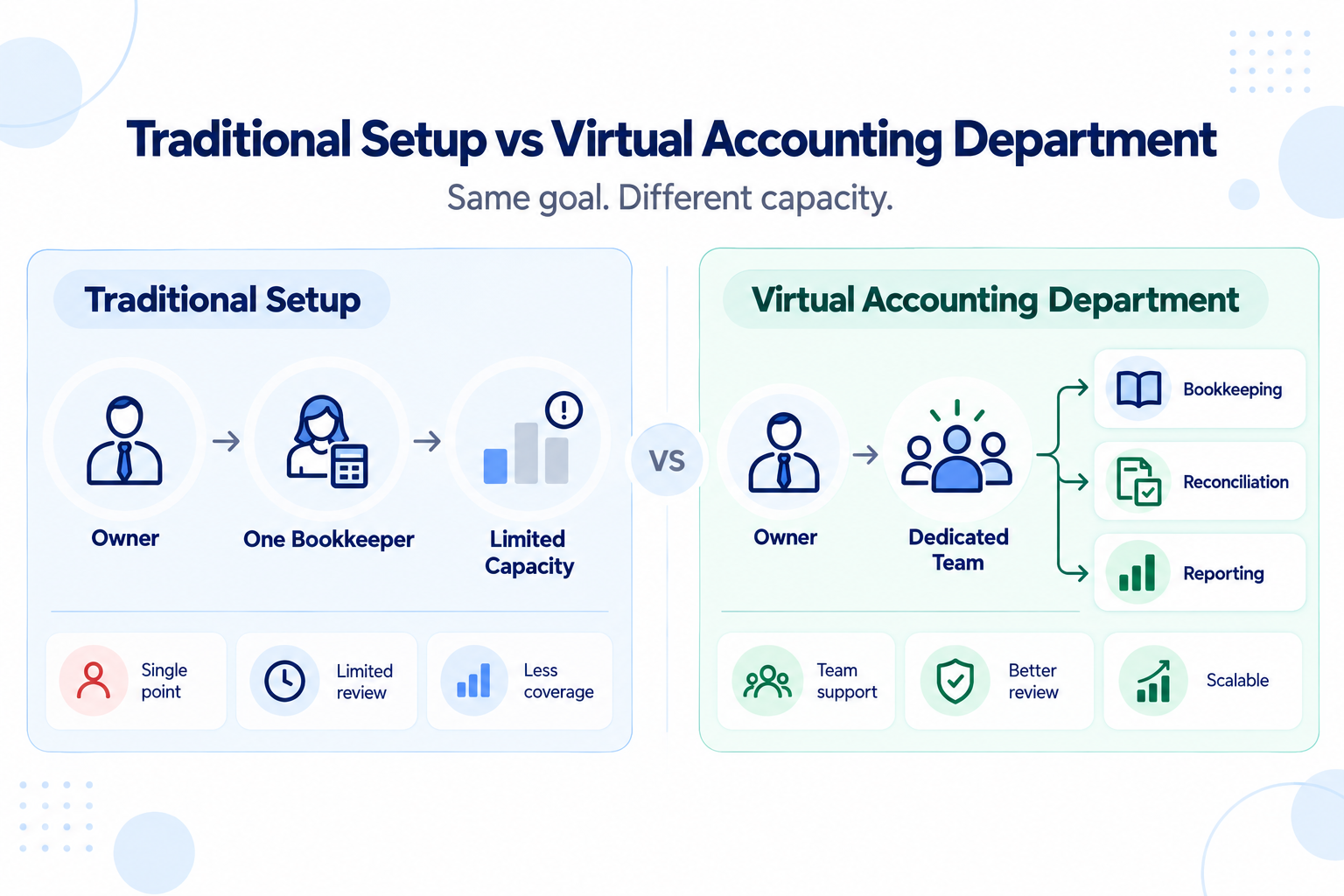
A virtual accounting department provides access to a team instead of relying on a single individual.
Category | In-House Bookkeeper | Virtual Accounting Department |
Support | One person | Dedicated accounting team |
Coverage | Limited when unavailable | Team-based support |
Skills | Individual expertise | Multiple accounting capabilities |
Scalability | Requires additional hiring | Can adjust as needs change |
Cost structure | Salary, benefits, and hiring costs | Service-based model |
For growing businesses, the advantage is flexibility.
They can access accounting support without immediately adding multiple full-time positions.
What Does a Virtual Accounting Department Actually Do Each Month?
A virtual accounting department works around the recurring financial activities that keep a business organized.
A typical month may include:
Reviewing Transactions
Income and expenses are reviewed to ensure financial records are updated correctly.
Reconciling Accounts
Bank and credit card accounts are matched with accounting records to identify missing or incorrect entries.
Managing Bills and Invoices
Vendor bills, customer invoices, and payment records are organized to improve visibility.
Preparing Financial Reports
Monthly reports help business owners understand:
- Revenue
- Expenses
- Cash flow
- Overall financial performance
The purpose is not only keeping records updated.
It is helping owners understand what is happening inside their business.
How Does a Business Stay in Control?
One of the biggest concerns business owners have is:
“If someone else handles my accounting, will I lose control?”
A professional virtual accounting setup is designed to work alongside the business owner.
The owner still controls:
- Payment approvals
- Financial decisions
- Business strategy
- Access permissions
The accounting team supports the process by maintaining records, preparing reports, and keeping financial information organized.
Businesses also work within secure accounting environments with controlled access and documented processes. Professional accounting providers may follow security frameworks such as SOC 2 and ISO 27001 aligned practices.
The goal is to provide support while keeping the business owner informed and involved.
When Does a Business Need a Virtual Accounting Department?
Many businesses reach a point where their existing bookkeeping process no longer supports their growth.
Common signs include:
- The owner spends evenings catching up on financial tasks
- Books are regularly behind
- Monthly reports are difficult to prepare
- Expenses and invoices are becoming harder to manage
- Tax season creates unnecessary stress
- Business decisions are made without clear financial information
A virtual accounting department helps businesses move from reactive bookkeeping to a more structured financial process.
What Does It Cost Compared to Hiring In-House?
Building an internal accounting team requires more than hiring a person.
Businesses also consider:
- Salary
- Employee benefits
- Recruitment costs
- Training time
- Software expenses
- Backup coverage
A virtual accounting department provides accounting support through a service model.
This allows businesses to access accounting expertise without immediately taking on the cost and responsibility of building a larger internal team.
The right choice depends on:
- Business size
- Transaction volume
- Accounting complexity
- Long-term goals
Who Is a Virtual Accounting Department Not For?
A virtual accounting department may not be the right fit for every business.
Companies that require a full-time finance leader physically present every day or highly specialized internal finance operations may prefer an in-house structure.
However, for many growing businesses, a virtual accounting department provides the accounting support needed to stay organized, maintain accurate records, and make better decisions.
How SafeBooks Global Helps Businesses With Virtual Accounting Support
SafeBooks Global works with US businesses that need reliable accounting support without building a full internal accounting department.
Our remote accounting team supports businesses with:
- Bookkeeping
- Account reconciliation
- Financial reporting preparation
- Accounting operations support
The goal is to help businesses maintain organized financial records, improve visibility, and spend more time focusing on growth.
Learn more about our business bookkeeping services.
Need Better Control Over Your Business Finances?
A virtual accounting department gives growing businesses the structure of an accounting team without the complexity of building one internally.
When financial records are maintained consistently, reports become more useful, decisions become clearer, and business owners gain better visibility into their operations.
Connect with SafeBooks Global through our contact page.