

Busy but Not Profitable: Why Your Billing Report and Your P&L Disagree
A dentist once told me she had the busiest year of her career.
Her chairs were full, her schedule was booked weeks ahead, and her billing report showed record numbers.
Then she asked, “So why does it still feel like there is never enough money?”
The answer was in the gap between billing and financial performance.
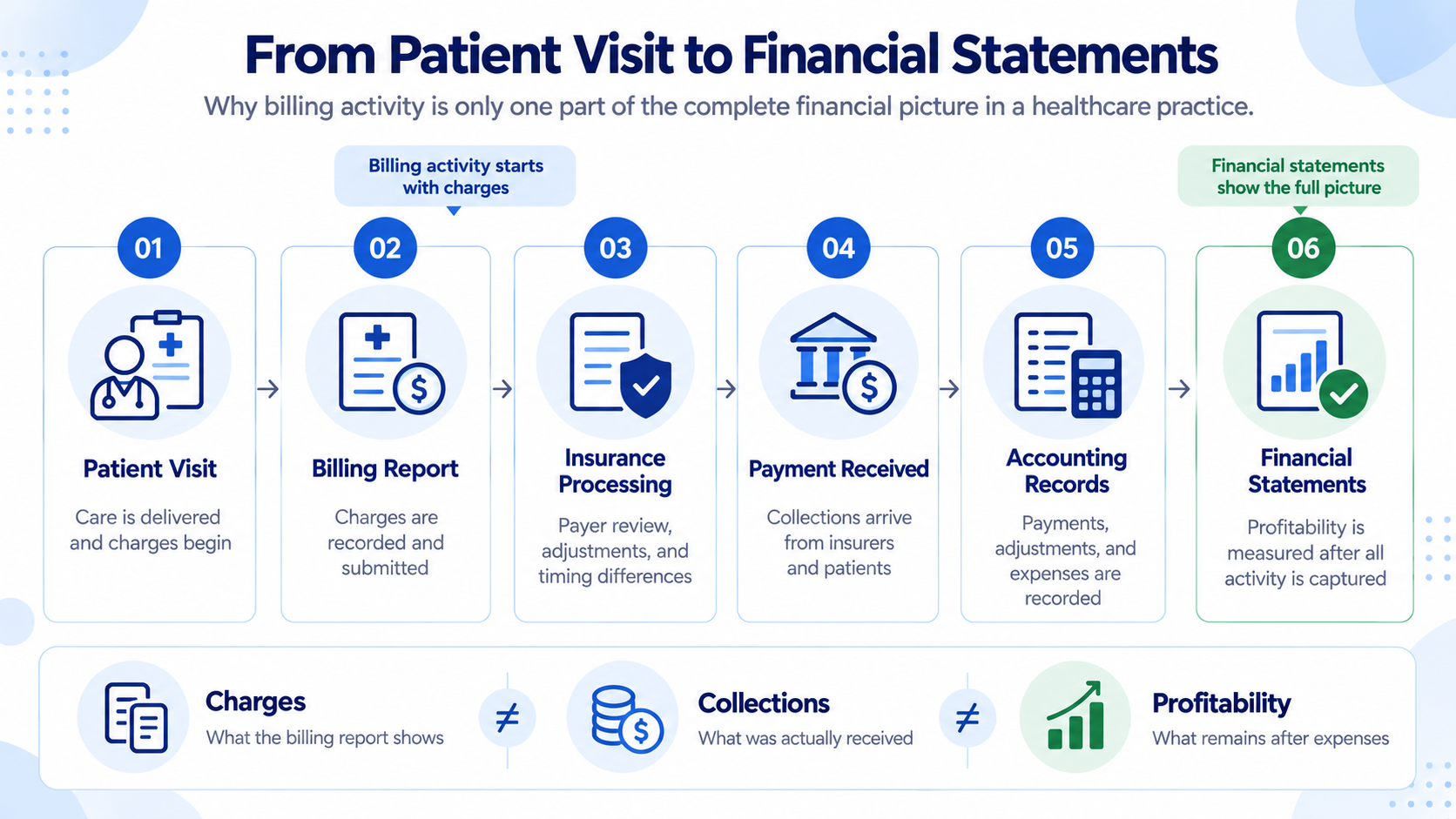
Her billing system showed what the practice charged. Her P&L reflected what the business actually generated after insurance adjustments, unpaid balances, collection timing, and operating costs.
The practice was busy, but busy does not always mean profitable.
For CPA firms serving healthcare practices, the real challenge is maintaining accurate monthly books that help owners understand that difference clearly.
Key Takeaway
A healthcare billing report shows what a practice charged, while financial statements show the financial outcome after adjustments, collections, expenses, and other accounting factors. CPA firms help healthcare clients by connecting billing activity with accurate financial reporting.
Why Does the Billing Report Show More Than the Practice Earned?
Healthcare businesses often track several different numbers.
A billing report usually shows the value of services provided and amounts submitted for payment.
Financial reporting shows the business impact after considering:
- Insurance adjustments
- Payments received
- Outstanding balances
- Operating expenses
These numbers are connected, but they are not the same.
For example:
A medical practice may bill $300 for a patient visit.
The insurance agreement may allow only $140.
The difference is not necessarily missing money.
It represents the adjustment between the amount charged and the amount expected to be collected.
A Simple Example: From Billed Amount to Collected Amount
Illustrative example:
Item | Amount |
Amount Billed | $300 |
Insurance Adjustment | ($160) |
Insurance Payment | $140 |
Remaining Patient Balance | $0-$20 |
Actual amounts vary depending on payer agreements, services provided, and practice type.
The billing report may highlight the $300 charge.
The financial records need to reflect the actual financial outcome.
This difference is why healthcare bookkeeping requires more than simply matching deposits.
Where Does the Difference Actually Go?
Healthcare practices deal with several factors that create gaps between billing activity and financial results.
Insurance Adjustments
Insurance companies may not pay the full billed amount.
Contractual adjustments reduce the amount recognized from the original charge.
Denied or Delayed Claims
Some claims may require additional review before payment.
This can delay collections and create differences between when services are provided and when money arrives.
Patient Balances
Not every amount billed to patients is collected immediately.
Outstanding balances can remain open for weeks or months.
Payment Timing
A practice may provide services today but receive payment later.
This timing difference can make a busy practice appear stronger operationally than it feels financially.
Why Can a Busy Practice Still Feel Short on Cash?
More appointments usually sound like good news.
But growth also brings additional costs.
A practice may increase:
- Patient volume
- Staff requirements
- Equipment needs
- Administrative workload
- Facility expenses
At the same time, collections may not increase at the same speed.
A healthcare provider may see more patients and generate more billing activity while still experiencing cash flow pressure.
This is why owners need more than a billing report.
They need financial information that explains:
- What revenue is coming in
- What expenses are increasing
- Whether growth is improving profitability
Why Do These Numbers Confuse CPA Firms Too?
Healthcare practices often use different systems for different parts of the business.
For example:
- Scheduling systems track appointments
- Billing systems track claims
- Payment systems track collections
- Accounting systems track financial records
The challenge for CPA firms is connecting these pieces into one clear financial picture.
Without consistent monthly processes, firms may spend additional time:
- Reviewing reports manually
- Explaining differences to clients
- Cleaning up records before year-end
- Rebuilding financial information during tax season
The issue is not that the data does not exist.
The issue is bringing the data together correctly.
What Should Healthcare Clients See From Their Books Every Month?
Healthcare owners do not only need reports.
They need clarity.
Useful financial reporting helps them understand:
- Revenue trends
- Collection patterns
- Operating expenses
- Cash flow
- Practice performance
A practice owner should be able to answer:
“Is the business actually becoming more profitable?”
Not just:
“Did we see more patients this month?”
For CPA firms, this creates a stronger advisory relationship.
The firm becomes the partner helping clients understand their business, not just preparing financial statements.
Why Healthcare Bookkeeping Requires More Attention Than Standard Businesses
Healthcare practices have unique financial workflows.
They may manage:
- Insurance payments
- Patient payments
- Multiple providers
- Payroll complexity
- Equipment expenses
- Practice-specific costs
The bookkeeping challenge is not only recording transactions.
It is understanding what each number represents and how it affects the overall financial picture.
The same challenge applies across:
- Medical practices
- Dental offices
- Therapy clinics
- Other healthcare providers
How Can CPA Firms Support Healthcare Clients Without Overloading Their Team?
Healthcare clients need consistent bookkeeping support throughout the year.
However, CPA firms also need to protect internal capacity.
The highest-value work for CPA firms includes:
- Client advisory
- Financial review
- Tax planning
- Strategic conversations
Recurring accounting tasks can be supported through a dedicated accounting team.
This includes:
- Monthly bookkeeping
- Account reconciliation
- Financial reporting preparation
- Cleanup support
The goal is not replacing the CPA relationship.
The goal is helping firms maintain accurate books while creating more time for advisory work.
How SafeBooks Global Supports Healthcare Accounting Workflows
SafeBooks Global helps US CPA firms manage recurring bookkeeping requirements for healthcare clients.
Our support helps firms with:
- Healthcare bookkeeping workflows
- Account reconciliation
- Monthly close support
- Financial reporting preparation
SafeBooks Global works as an extension of CPA teams, helping manage recurring accounting tasks while firms focus on client relationships and advisory services.
We follow structured security practices and work within secure client environments, including SOC 2 aligned processes.
Learn more about our accounting firm support services.
For businesses looking for bookkeeping assistance, explore our business bookkeeping services.
Need Clearer Financial Visibility for Healthcare Clients?
A full schedule tells a practice owner how busy they are.
Clean financial reporting tells them whether that growth is creating a stronger business.
CPA firms that help healthcare clients connect billing activity with financial performance become more valuable long-term advisors.
SafeBooks Global supports CPA firms with dedicated accounting support designed to improve bookkeeping consistency and reporting visibility.
Connect with SafeBooks Global through our contact page.