Why Your Toast Deposit Never Matches Your POS Sales Report
A restaurant client sends their monthly financial information for review.
Your team checks the numbers:
Toast POS Sales Report: $42,300
Bank Deposits Received: $38,900
The client asks:
“Why are we missing $3,400?”
A staff accountant starts reviewing transactions, checking deposits, and comparing payment reports.
After hours of investigation, the answer is usually simple:
The money is not missing.
The POS report and the bank deposit are showing two different stages of the transaction.
The POS system shows what the restaurant sold.
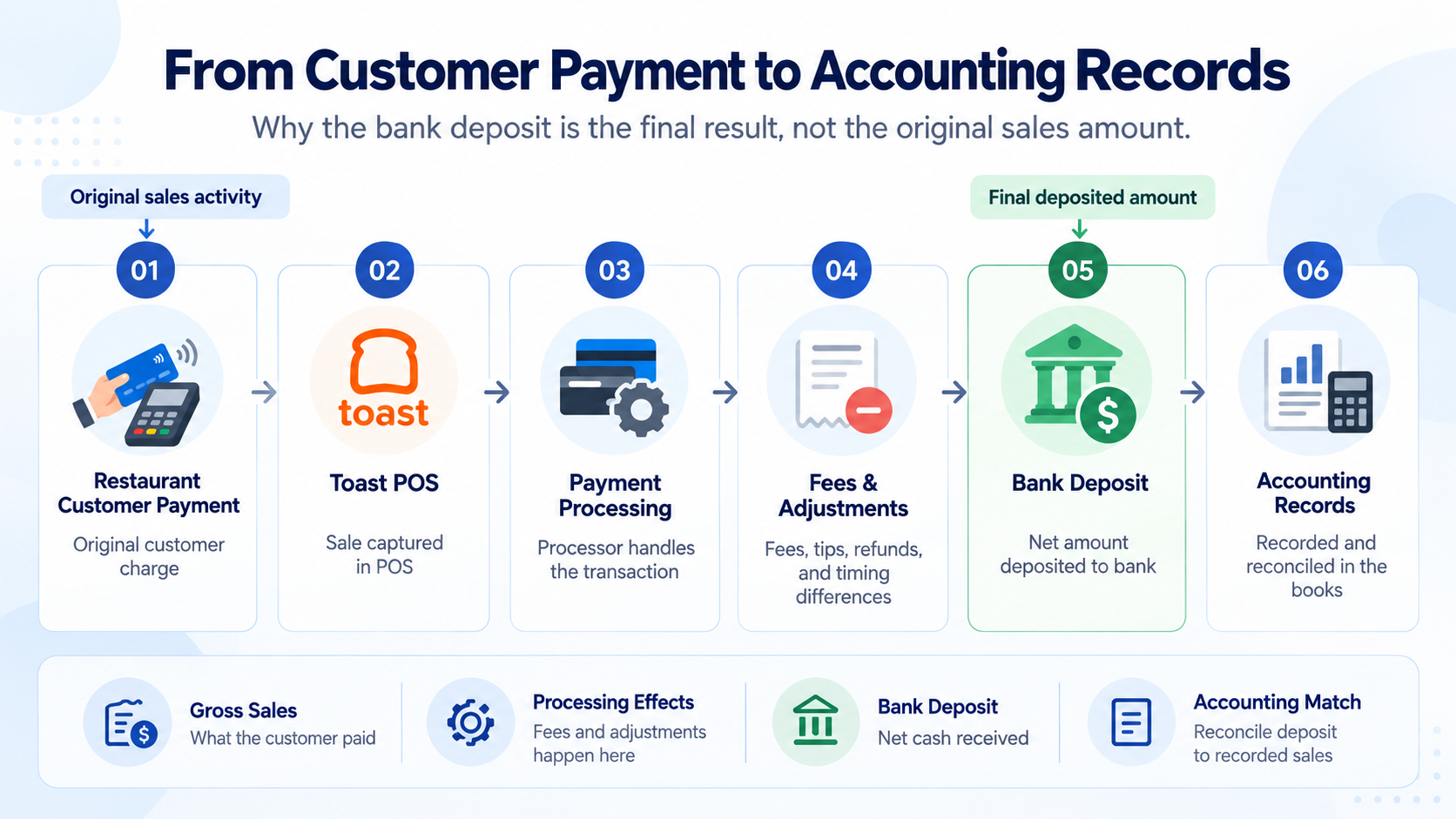
The bank account shows what was finally deposited after fees, adjustments, and settlement timing.
For CPA firms managing restaurant clients, understanding this difference is important because these reconciliation issues appear month after month.
Key Takeaway
Toast deposits do not match POS sales reports because they represent different parts of the payment process. POS reports show restaurant sales activity, while deposits reflect the final amount received after processing fees, tips, refunds, and settlement adjustments.
Why Are Toast Deposits Different From POS Sales Reports?
Restaurant transactions go through multiple steps before money reaches the bank.
A POS system like Toast records customer activity, including:
- Food and beverage sales
- Discounts
- Taxes
- Tips
- Payment methods
- Refunds
The bank account shows the final settlement amount.
Between the customer payment and the bank deposit, several adjustments can happen:
- Payment processing fees
- Refunds
- Chargebacks
- Tip handling
- Cash payments
- Settlement timing differences
This is why a restaurant’s sales report and bank deposits are not expected to match exactly.
A Toast deposit is the final settlement amount after adjustments, while the POS report reflects the sales activity recorded at the time of purchase.
Where Does the Difference Between Toast Sales and Deposits Come From?
1. Payment Processing Fees
One of the most common reasons for differences is payment processing fees.
For example:
Transaction Details | Amount |
Restaurant Card Sales | $20,000 |
Processing Fees | ($600) |
Final Deposit | $19,400 |
The restaurant generated $20,000 in sales, but the bank received a lower amount after processing fees.
For CPA firms, the important point is that:
- Revenue should reflect sales activity
- Processing fees should be recorded separately
- Deposits should not be treated as total revenue
Recording only bank deposits can make restaurant financial reports inaccurate.
2. Tips Create Additional Complexity
Tips are another common reason restaurant books become difficult to reconcile.
A customer may pay:
Item | Amount |
Food Bill | $100 |
Card Tip | $20 |
Total Payment | $120 |
Toast records the complete transaction.
However, many restaurants pay employee tips through cash payouts at the end of shifts.
This creates differences between:
- POS activity
- Cash balances
- Bank deposits
- Payroll records
Without proper tracking, teams may spend hours investigating differences that are part of normal restaurant operations.
3. Sales Tax, Refunds, and Other Adjustments
Restaurant transactions often include amounts that affect deposits but are not restaurant revenue.
Examples include:
- Sales tax collected from customers
- Customer refunds
- Chargebacks
- Payment adjustments
These amounts need proper classification to maintain accurate financial reporting.
Sales tax collected, for example, is generally recorded as a liability because the restaurant collects it on behalf of the relevant tax authority.
4. Deposit Timing Differences
Another common issue is timing.
The date a customer makes a payment may not be the same date the money appears in the bank.
For example:
- Friday sales
- Saturday sales
- Sunday sales
may appear as one combined deposit on Monday.
This creates differences between:
- POS business date
- Payment settlement date
- Bank deposit date
For CPA firms, these timing differences are especially important during month-end close.
5. Multiple Payment Channels
Restaurants rarely operate through one payment source.
A single restaurant may receive payments through:
- Toast POS
- Online ordering
- DoorDash
- Uber Eats
- Gift cards
- Cash payments
Each channel follows a different settlement process.
For example, delivery platforms may show the full customer order value but send the restaurant a payout after deducting commissions and fees.
Without a structured process, these differences create additional review work.
The $42,300 Toast Sales Report: Why Did Only $38,900 Reach the Bank?
A simple reconciliation can explain the difference.
Description | Amount |
Gross Toast POS Sales | $42,300 |
Less: Cash Sales Not Deposited | ($1,800) |
Less: Processing Fees | ($650) |
Less: Refunds and Adjustments | ($250) |
Less: Cash Tips Paid Out | ($500) |
Less: Settlement Timing Difference | ($200) |
Final Bank Deposit | $38,900 |
The difference is not missing revenue.
Each adjustment represents a separate part of the restaurant’s payment process.
This is why restaurant bookkeeping requires more than matching deposits.
Why Restaurant Bookkeeping Takes More Time Than Expected
From the outside, restaurant bookkeeping may appear straightforward.
But CPA firms managing restaurant clients often deal with:
- High transaction volume
- Multiple payment systems
- Daily sales reports
- Tip tracking
- Sales tax requirements
- Deposit matching
- Client questions
The challenge is not entering transactions.
The challenge is making sure every transaction connects correctly from the POS system to the final financial statements.
For accounting firms, these recurring reconciliation tasks can consume valuable team hours that could otherwise be spent on:
- Tax planning
- Advisory services
- Client relationships
- Higher-value accounting work
How CPA Firms Can Improve Restaurant Accounting Workflows
Improving restaurant bookkeeping starts with having a consistent process.
Standardize Reconciliation
A clear workflow helps teams review:
- POS sales reports
- Payment settlements
- Bank deposits
- Adjustments
This reduces unnecessary investigation and improves month-end consistency.
Use the Right Accounting Workflow
Many CPA firms use accounting platforms such as QuickBooks to manage restaurant clients.
However, simply matching deposits to revenue can create inaccurate books.
A proper process should connect:
- Sales activity
- Payment settlements
- Fees
- Adjustments
Maintain Clear Documentation
Restaurant accounts often involve multiple systems and team members.
Documented processes make it easier to maintain consistency as client needs grow.
How SafeBooks Global Helps CPA Firms Manage Restaurant Clients
Managing restaurant bookkeeping internally can become challenging as client volume increases.
SafeBooks Global supports US CPA firms with accounting workflows designed for recurring client needs, including:
- Bookkeeping support
- Reconciliation assistance
- Month-end close support
- Accounting operations support
Our goal is to help CPA firms reduce repetitive accounting workload while maintaining accuracy and consistency across restaurant accounts.
Learn more about our accounting firm support services.
For businesses needing bookkeeping assistance, explore our business bookkeeping services.
Need Help Managing Growing Restaurant Accounts?
Restaurant bookkeeping becomes easier when sales activity, payment settlements, and financial records follow a structured process.
SafeBooks Global helps CPA firms handle recurring bookkeeping challenges while allowing internal teams to focus on review, advisory services, and client relationships.
Connect with SafeBooks Global through our contact page.