How Remote Accounting Teams Support CFOs and Financial Decision-Making
A CFO once told me, only half joking:
“I am the most expensive bookkeeper this company has ever hired.”
The company had brought him in to improve financial strategy, build better forecasts, and guide growth decisions.
Instead, the first two weeks of every month were spent on reconciliations, fixing accounting issues, reviewing missing transactions, and trying to get the monthly close completed.
The strategy work still happened.
It just happened late at night, after the accounting problems were solved.
This is a common challenge in growing companies.
The finance leader is expected to answer important questions:
- Can we afford this expansion?
- Are margins improving?
- How much cash do we have available?
- Are we ready for investors or lenders?
But those decisions depend on something that often gets overlooked:
Reliable financial data.
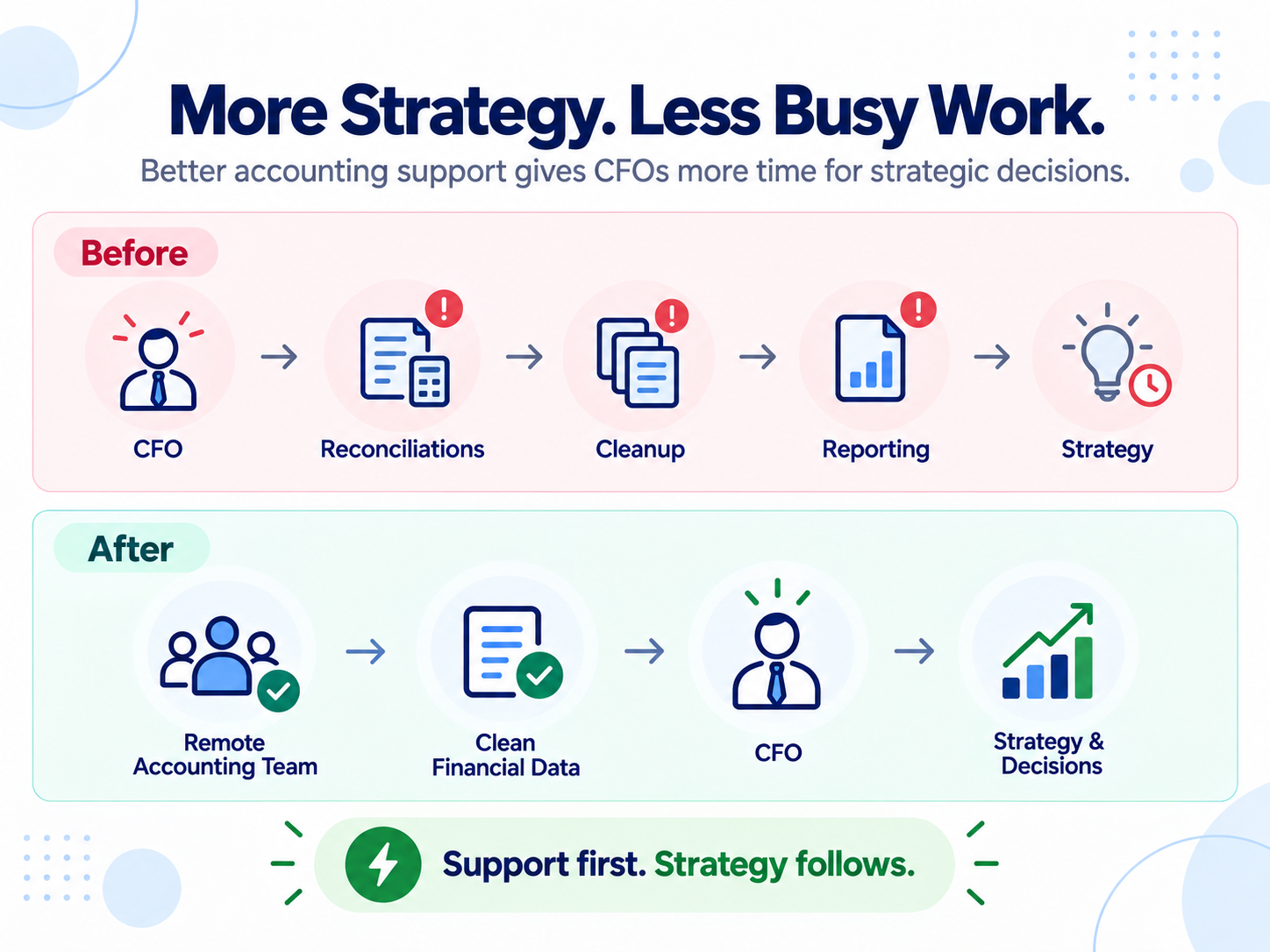
A remote accounting team does not replace the CFO’s judgment.
It supports the accounting foundation that allows the CFO to spend more time on strategy, forecasting, and business decisions.
Key Takeaway
A remote accounting team supports CFOs by handling recurring accounting operations such as bookkeeping, reconciliations, and monthly close, allowing finance leaders to focus on strategy, forecasting, and decision-making.
Why Do CFOs End Up Buried in Day-to-Day Accounting?
In many growing businesses, finance teams are built gradually.
At first, one person manages everything.
Then the company grows.
More customers.
More transactions.
More vendors.
More financial complexity.
The finance team expands, but often not at the same pace as the business.
As a result, CFOs frequently become the final checkpoint for every accounting issue.
They review:
- Unfinished reconciliations
- Incorrect entries
- Delayed reports
- Missing financial information
This happens even when the CFO’s highest-value work is elsewhere.
A CFO’s role is to help the business make better decisions.
That requires time for:
- Forecasting
- Financial planning
- Growth analysis
- Risk management
- Leadership discussions
When too much time is spent fixing accounting operations, strategic work gets pushed aside.
What Does a Remote Accounting Team Take Off a CFO’s Plate?
A remote accounting team handles the recurring execution that keeps financial operations running smoothly.
This can include:
Bookkeeping Support
Maintaining accurate financial records by organizing income, expenses, and transactions.
Account Reconciliation
Reviewing bank and credit card accounts to ensure financial records match actual activity.
Accounts Payable and Receivable Support
Helping organize invoices, payments, and outstanding balances.
Monthly Close Support
Supporting the process of reviewing and finalizing monthly financial records.
Financial Reporting Preparation
Preparing accurate financial information that CFOs can review and use for decision-making.
A remote accounting team typically works within the company’s existing systems, such as QuickBooks Online, Xero, or other accounting platforms.
The goal is not to take ownership away from finance leadership.
The goal is to give CFOs a reliable execution layer.
CFO Focus vs Remote Accounting Team Support
CFO Owns | Remote Accounting Team Supports |
Financial strategy | Bookkeeping execution |
Forecasting and planning | Account reconciliation |
Business decisions | Monthly close support |
Board and investor conversations | Financial data preparation |
Performance analysis | Accounting operations |
The CFO remains responsible for understanding the business and making decisions.
The remote accounting team helps ensure those decisions are supported by accurate information.
How Does a Remote Accounting Team Improve Financial Decision-Making?
Good decisions require timely information.
A CFO reviewing outdated numbers may miss important changes in:
- Cash flow
- Expenses
- Revenue trends
- Profitability
When accounting processes are consistent, CFOs gain better visibility.
For example:
A timely monthly close allows a CFO to identify rising costs early.
A delayed close may reveal the same issue several months later.
The difference is not just reporting speed.
It is decision quality.
Reliable financial information helps CFOs:
- Build stronger forecasts
- Prepare better budgets
- Explain performance to leadership teams
- Support fundraising or lending discussions
Does a CFO Lose Control or Visibility With a Remote Team?
No.
A remote accounting team supports the CFO’s process.
The CFO continues to control:
- Financial standards
- Review processes
- Approvals
- Business decisions
The accounting team supports execution.
A professional remote accounting setup includes:
- Controlled system access
- Defined workflows
- Regular communication
- Clear reporting processes
Many professional accounting providers follow security frameworks such as SOC 2 and ISO 27001 aligned practices to support secure handling of financial information.
The purpose is to create additional capacity while maintaining visibility.
When Does a Remote Accounting Team Make More Sense Than Another Hire?
An internal finance hire can be the right choice for many businesses.
For example, companies may prefer an in-house employee when they need:
- Daily physical presence
- Deep internal company knowledge
- A dedicated finance leader on-site
However, a remote accounting team can be valuable when the challenge is accounting capacity.
Common situations include:
- The finance team is overloaded
- Monthly close takes too long
- The company is growing quickly
- Hiring locally is taking longer than expected
- CFOs need more time for strategic work
The decision depends on the company’s needs, structure, and long-term goals.
How Do Fractional CFOs Use Remote Accounting Teams?
Fractional CFOs often support multiple companies at the same time.
Their value comes from helping businesses with:
- Financial strategy
- Forecasting
- Planning
- Decision support
However, strategic advice depends on reliable accounting information.
A remote accounting team provides the execution layer underneath.
This allows fractional CFOs to spend more time analyzing performance and advising leadership instead of chasing accounting tasks.
Together, the fractional CFO and remote accounting team create a stronger finance function for growing businesses.
How SafeBooks Global Supports CFOs and Finance Teams
SafeBooks Global works with US businesses that need reliable accounting support without adding unnecessary pressure on internal finance teams.
Our remote accounting support helps with:
- Bookkeeping
- Account reconciliation
- Monthly close support
- Financial reporting preparation
- Accounting operations
The goal is to create a consistent accounting foundation so CFOs can focus on planning, analysis, and growth.
Learn more about our services.
Give Your CFO More Time for Strategy
A CFO’s value is not measured by how many reconciliations they complete.
It is measured by the quality of decisions they help the business make.
When accounting operations run consistently, finance leaders get better information, more time, and greater confidence in their decisions.
If your finance team spends too much time fixing numbers instead of using them, a remote accounting team can help create the capacity you need.
Connect with SafeBooks Global through our contact page.