
How CPA Firms Can Reduce Partner Review Time With Offshore Teams
It is 11:47 p.m. during busy season, and a partner is reviewing a workpaper submitted six hours earlier.
The fixed asset schedule does not tie out. The formatting differs from the approved example. A review note is missing. The partner corrects everything in 20 minutes because explaining it feels slower.
Now multiply those 20 minutes across 40 clients and several weeks of tax season.
The offshore team may not be the core problem. The review structure usually is.
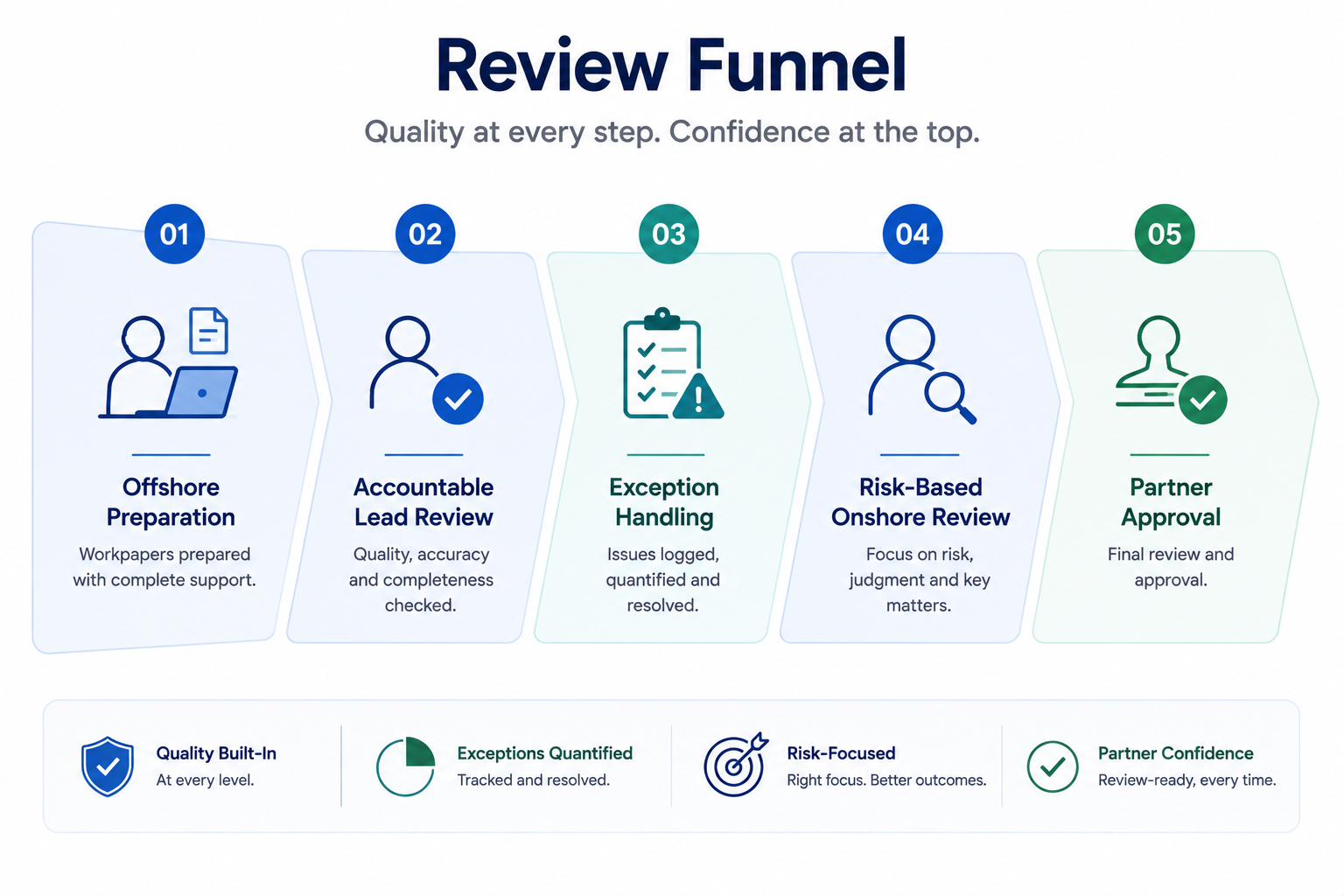
When partners remain the first meaningful quality-control layer, offshore accounting increases production capacity but does not release senior time. The firm must define review-ready work, add an accountable first-level reviewer, and match the depth of partner review to the risk of each engagement.
Key Takeaway
CPA firms can reduce partner review time by defining exactly what completed work should include, routing every file through an accountable lead reviewer, setting client-specific materiality and exception thresholds, and reserving partner attention for judgment and material risks. The goal is not to remove final review. It is to prevent partners from repeatedly correcting tie-outs, formatting, documentation, and routine exceptions that should have been resolved earlier.
Identify What Partners Are Correcting
Before rewriting procedures, review recent partner comments and group them by cause.
Common categories include incomplete tie-outs, inconsistent formatting, missing cross-references, unsupported adjustments, unclear open items, and repeated client-specific errors.
This distinction matters because not every review note requires additional technical training. Many are workflow failures.
If partners repeatedly correct presentation or completion issues, the firm lacks a clear acceptance standard. If they repeatedly answer routine questions, the escalation rules are weak. If they are resolving complex technical matters, the work may have reached the correct reviewer.
Use the review history to identify the four or five issues consuming the most partner time. These should become the first priorities in the revised remote accounting workflow.
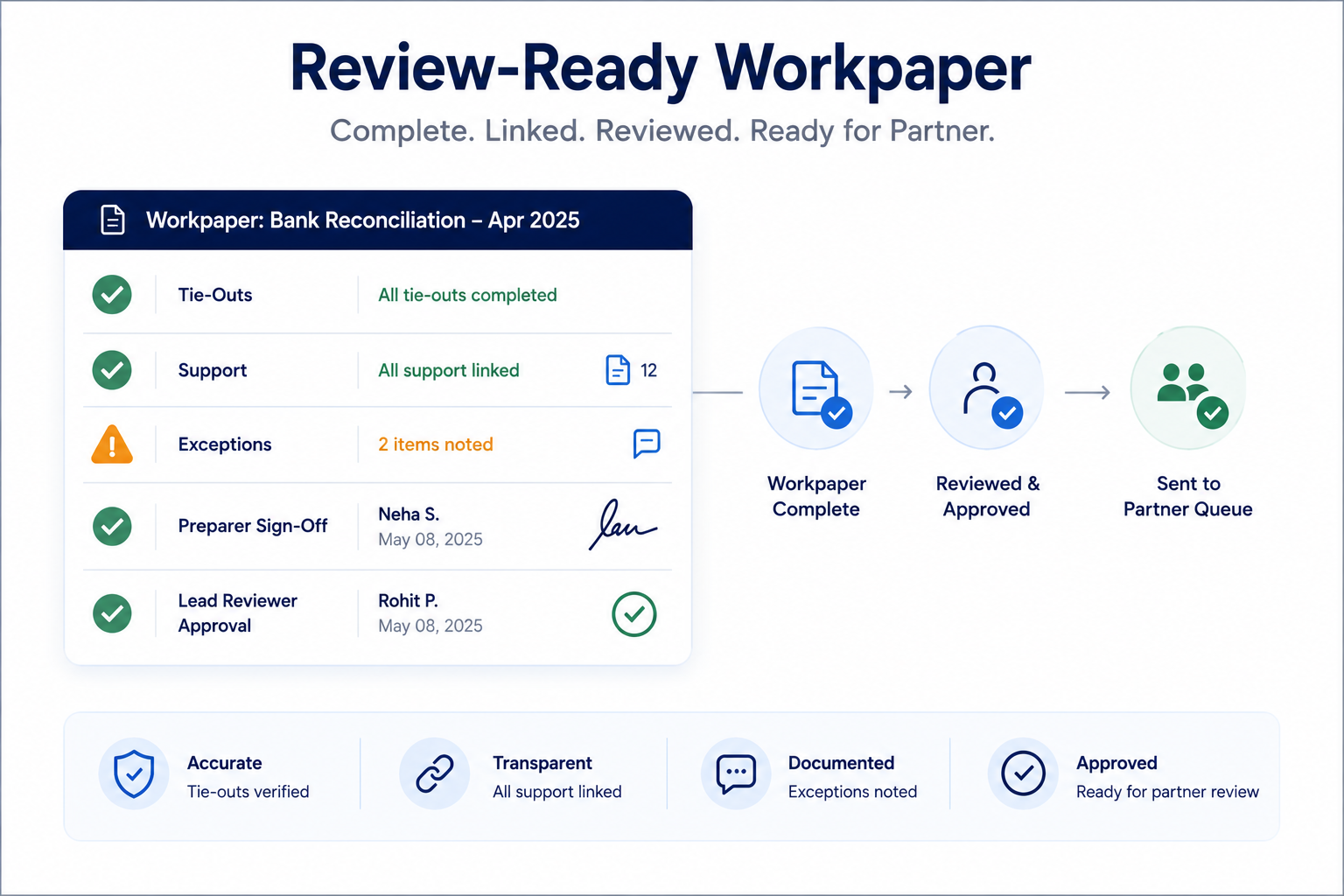
Define “Ready for Partner Review”
A checklist is not enough when it only says “complete reconciliation” or “prepare workpaper.”
For every recurring workflow, define the expected format, required tie-outs, supporting documentation, cross-references, open-item notes, escalation rules, and sign-off requirements.
Use files that partners previously approved without revision as reference examples. These show the required standard more clearly than written instructions alone.
The definition should also reflect client differences. A stable bookkeeping client should not use the same playbook as a multi-entity engagement with intercompany activity.
Client or workflow playbooks should explain what normal activity looks like, which issues require escalation, and which supporting schedules must be included.
Make the Lead Reviewer a Real Quality Gate
Sending preparer output directly to a partner defeats the purpose of an offshore delivery model.
An experienced offshore lead should review every file first. Their scope may include formatting, tie-outs, checklist completion, supporting schedules, dates, cross-references, and compliance with the approved playbook.
Technical judgments and final approval remain with the U.S. firm.
The workflow should follow three visible stages:
Prepared → Cleared by Lead Reviewer → Ready for Partner Review
However, adding the stage alone is not enough. A lead reviewer employed by the same delivery team may feel pressure to keep work moving, assuming the partner will catch anything missed.
To prevent the lead review from becoming a rubber stamp, track a Lead Defect Capture Rate.
When a file marked ready for partner review contains a broken tie-out, wrong period, missing schedule, or incomplete support, record the defect against the lead review checkpoint. This creates ownership for the quality gate rather than placing every failure back on the preparer.
The lead reviewer should also return files with specific correction notes. Comments such as “please fix” do not explain what failed or prevent repetition.
A structured offshore accounting operating system helps clarify who prepares, who reviews, and who owns errors at each stage.
Set Materiality and Exception Rules
Risk-based review fails when the offshore team does not know which differences matter.
Without clear thresholds, remote staff may send every minor discrepancy to the partner or ignore something significant because they are uncertain.
Each client playbook should define materiality and escalation parameters appropriate to that engagement.
For example, the procedure may instruct the team to clear routine differences below an approved amount while documenting and escalating anything above that threshold. A percentage-based rule may also be appropriate when transaction volume varies significantly.
The numbers should be determined by the firm based on the client, engagement, and professional requirements. They should not be copied across every account without review.
Review tier | Typical profile | Partner review |
High risk | New client, unusual transactions, complex ownership, major changes | Full technical and financial review |
Medium risk | Established client with defined judgment areas or material exceptions | Focused review of specified risk areas |
Low variation | Stable activity, clean prior results, no unusual changes | Exception-based review after lead approval |
Risk tiers and materiality rules should be visible in the firm’s practice management workflow so both teams understand the review expectation.
Protect Fixed Review Windows
The time-zone advantage disappears when completed offshore work remains untouched for several days.
Partners and senior reviewers should have a protected daily window for clearing review-ready files. A consistent morning block is usually more effective than reviewing between calls or late at night.
The offshore submission cutoff, onshore review period, and response expectations should be documented.
Questions should also remain separate from completed files. A centralized exception log allows the onshore team to resolve blockers without searching through emails and chat messages.
This structure supports a continuous close process by keeping reconciliations, exceptions, and review notes moving throughout the month.
Stop Shadow Auditing
Some firms add an offshore lead reviewer but still fail to release onshore capacity.
Senior accountants quietly recheck every calculation, supporting document, and workpaper because they do not yet trust the offshore process. This shadow auditing creates two complete review layers and removes the capacity benefit the firm expected.
The behavior is usually caused by inconsistent quality, unclear accountability, or lack of visibility into the lead review process.
Do not instruct onshore reviewers to “trust the team” without evidence. Build confidence through defect metrics, random file testing, transparent review logs, and clear ownership when errors pass through the lead gate.
Once the process demonstrates stable quality, onshore review should move toward the approved risk-based protocol instead of continuing as a full parallel audit.
Turn Review Notes Into Process Improvements
Review comments should become operational data.
Track recurring issues by workflow, client segment, preparer, lead reviewer, and root cause. When one error appears repeatedly, update the SOP or provide focused training using real examples.
General quality meetings rarely correct specific process failures. A short session on one recurring reconciliation, classification, or workpaper issue is more useful.
Monitor partner review time, first-pass acceptance, lead defect capture, repeated review notes, and files returned to preparation.
The right firm management tools for offshore teams can make these trends visible without creating another manual report.
Expert Insight
“Partner review time falls when accountability is assigned at every stage. Preparers should own completion, lead reviewers should own first-level quality, and partners should focus on judgment, material exceptions, and client impact.“
Shivangi Agrawal
Managing Director, CA, CPA (USA), SafeBooks Global
Signs the Review Model Still Needs Work
The workflow needs attention when partner review notes continue rising, basic defects pass through lead review, or low-variation clients still require significant senior time.
Another warning sign is shadow auditing. When onshore seniors silently recheck every offshore deliverable, the firm is paying for duplicate review and receiving little capacity benefit.
Correct the process before adding more offshore staff or clients.
A structured offshore partner evaluation should confirm whether the provider can support lead review accountability, measurable quality reporting, workflow continuity, and ongoing improvement.
Build Review-Ready Delivery Into the Engagement
Reducing partner review time requires more than adding offshore preparers. The delivery model must include acceptance standards, accountable first-level review, quantified exception rules, visible risk tiers, and protected review windows.
SafeBooks Global helps U.S. CPA and accounting firms build this structure across bookkeeping, tax support, audit support, and back-office workflows.
The focus is on review-ready delivery so partners spend less time correcting routine issues and more time on technical judgment, client relationships, and advisory work.
Explore SafeBooks Global’s offshore accounting support for U.S. firms or schedule a discovery call to identify where partner review time is being lost and how the workflow can be improved.