How Capacity Models Are Changing
A CPA firm acquires three smaller practices. Client volume increases immediately, but its accounting systems, review procedures, and staffing responsibilities remain fragmented.
That is where post-acquisition integration becomes an operational challenge.
For PE-backed CPA firms, adding revenue through acquisitions is only one part of growth. The combined organization must also manage preparation costs, reviewer capacity, and consistent service delivery.
The question is no longer how many accountants a firm can hire, but how much reliable capacity it can build across acquired practices.
Offshore accounting teams are increasingly relevant to that discussion.
Private Equity Is Accelerating CPA Firm Consolidation
According to IFAC’s March 2026 research, more than 1,000 accountancy firms worldwide experienced private equity investment over the preceding decade.
Fewer than 200 initial investments facilitated nearly 900 subsequent acquisition transactions.
IFAC’s updated analysis reports that in 2025, each direct PE investment resulted in approximately 7.3 additional transactions.
This acquisition activity introduces pressure to integrate different operating systems, improve efficiency, and maintain consistent professional standards.
For accounting firm leadership, capacity planning becomes a group-wide responsibility rather than an individual office decision.
What PE Ownership Changes for Accounting Teams
Three pressures influence staffing decisions following acquisitions.
Integration speed: Acquired practices may use different tax software, documentation standards, and review procedures. Aligning them requires time and experienced personnel.
Operating performance: Leadership needs visibility into cost per engagement, reviewer utilization, and delivery consistency across offices.
Staffing capacity: Additional clients can increase preparation volumes faster than the organization can recruit and train qualified accountants.
These pressures explain why shared accounting delivery models are worth evaluating, particularly for recurring bookkeeping and tax preparation activities.
Are PE-Backed Accounting Firms Actually Using Offshore Teams?
Yes. A documented example is Ascend, a PE-backed accounting platform supported by Alpine Investors.
In September 2025, Ascend announced that Miami-based KSDT had joined its platform, bringing five offices, 29 partners, and 276 professionals.
The announcement specifically stated that KSDT’s India team would integrate into Ascend’s offshore captive operation, Sentient Solutions for Accounting, based in Hyderabad.
This demonstrates how an existing offshore capability can become part of a larger accounting platform’s acquisition integration strategy.
It does not establish that every PE-backed firm follows the same model.
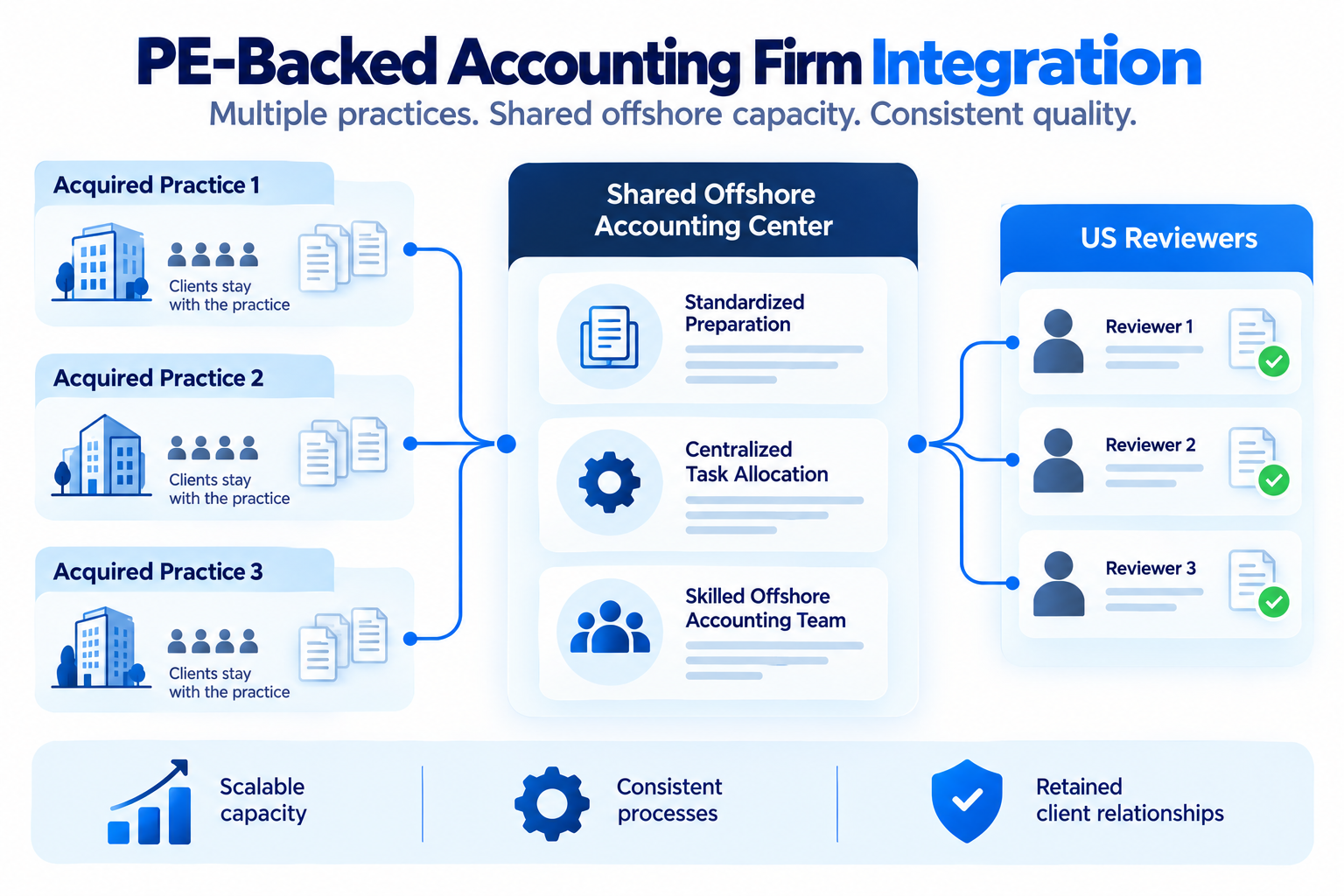
Traditional Staffing vs. Shared Offshore Capacity
Operating factor | Office-based model | Shared offshore model |
Staffing | Individual office recruitment | Group-level capacity planning |
Work allocation | Office-specific workload | Tasks distributed across practices |
Documentation | Different local procedures | Common workpaper standards |
Review | Local reviewer availability | Shared preparation with assigned reviewers |
Acquisition integration | Separate onboarding processes | Reusable workflows across offices |
Centralization is not automatically more efficient. Its success depends on the quality of standardized procedures, supervision, and communication.
What SafeBooks’ Multi-Office Case Study Shows
SafeBooks Global published a case study involving a regional CPA firm operating across three locations.
Its audit and tax teams followed inconsistent documentation and review procedures.
SafeBooks’ described approach included PPC audit checklists, DataFlow for structured tax document collection, standardized file structures, and unified operating procedures.
The case study reports more consistent workflows, reduced review effort, and easier onboarding.
The client is not identified as PE-backed, and the case study does not establish a specific offshore staffing arrangement.
Its relevance lies in demonstrating the operational groundwork that can make shared delivery more manageable.
Read the SafeBooks multi-office workflow standardization case study.
How to Build an Offshore Capacity Model After Acquisition
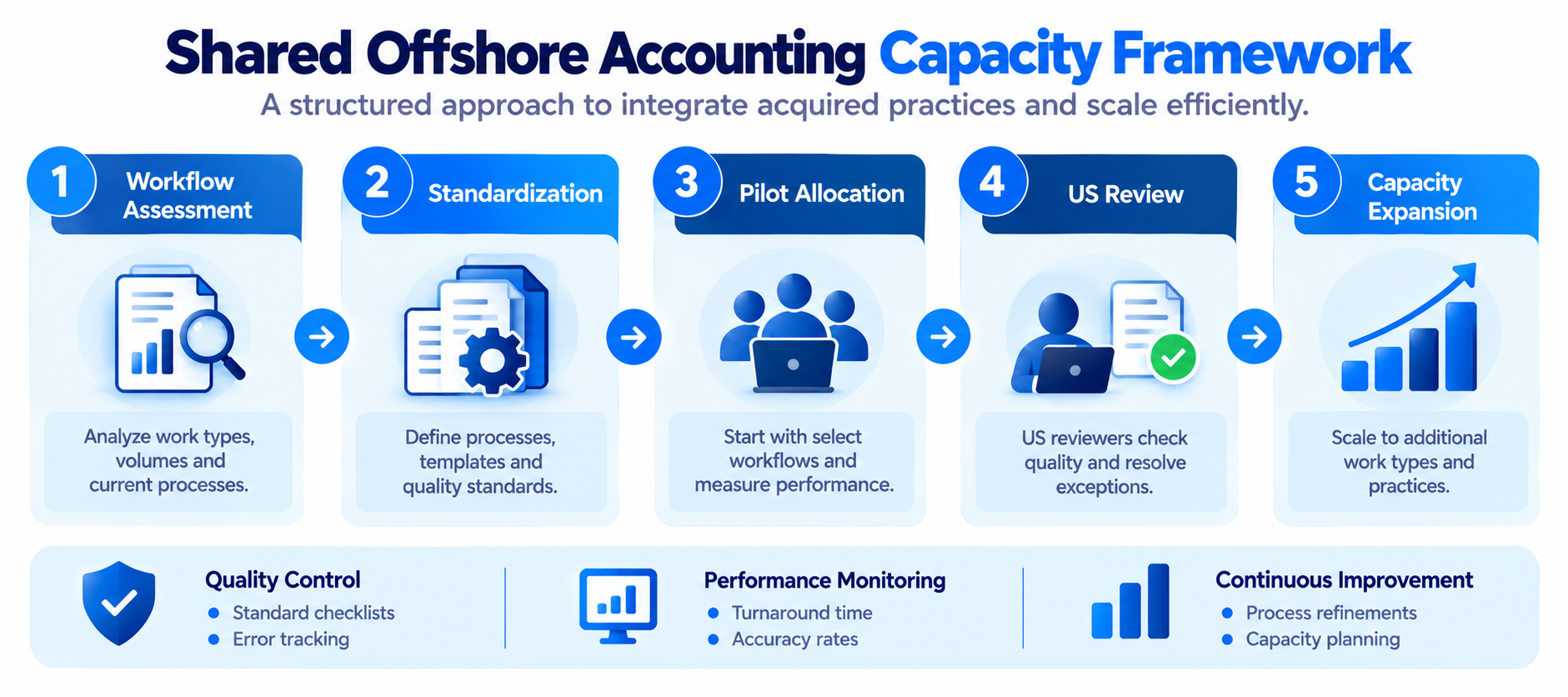
Consider a hypothetical PE-backed accounting group serving 300 recurring bookkeeping clients across three acquired practices.
Rather than transferring every account, the group could start with 20–30 clients using similar accounting software and reconciliation procedures.
A structured pilot would involve:
- Documenting existing accounting processes and software differences.
- Establishing standard workpapers and review checkpoints.
- Assigning selected clients to a shared offshore preparation team.
- Measuring completion time, review hours, and correction rates.
- Expanding only after the workflow meets agreed quality standards.
The objective is to make additional capacity repeatable rather than creating another team with separate procedures.
What Can Go Wrong With Centralized Offshore Delivery?
Several risks deserve attention.
Employee turnover can disrupt processes that depend on individual knowledge. Different software systems can delay integration, while insufficient reviewer capacity can create backlogs despite additional preparation staff.
Centralization also expands the importance of client-level access controls.
Where offshore professionals access taxpayer return information, firms must assess applicable IRC Section 7216 disclosure and consent requirements. Permissions, confidentiality procedures, and client records should be managed across all participating practices.
For audit and attest practices, independence obligations require separate consideration.
IFAC’s research indicates that most PE transactions do not involve audit firms. The IESBA’s July 2025 Staff Alert also identifies potential confidentiality, ethical culture, and independence implications of PE investment.
These responsibilities remain relevant even when preparation activities are outsourced.
How SafeBooks Supports Multi-Practice Accounting Capacity
For an accounting group integrating acquired practices, the first challenge may be standardizing recurring preparation work across offices.
SafeBooks Global supports US accounting firms through offshore accounting services, tax preparation support, and audit support.
Offshore professionals can assist with reconciliations, supporting schedules, and standardized workpaper preparation under approved client procedures.
Designated US professionals retain responsibility for technical judgments, review, and client relationships.
Final Takeaway
PE-backed CPA firms need operating capacity that can keep pace with acquisitions.
The priority is not simply adding offshore headcount. It is establishing consistent workflows, clear review responsibilities, and measurable performance across acquired practices.
Before the 2027 busy season, identify one recurring workflow shared by multiple offices and test whether a centralized preparation model can deliver it consistently.
Contact SafeBooks Global to discuss offshore accounting capacity for your growing CPA practice.