
Hourly vs Monthly Bookkeeping Support
Which Is Better for CPA Firms?
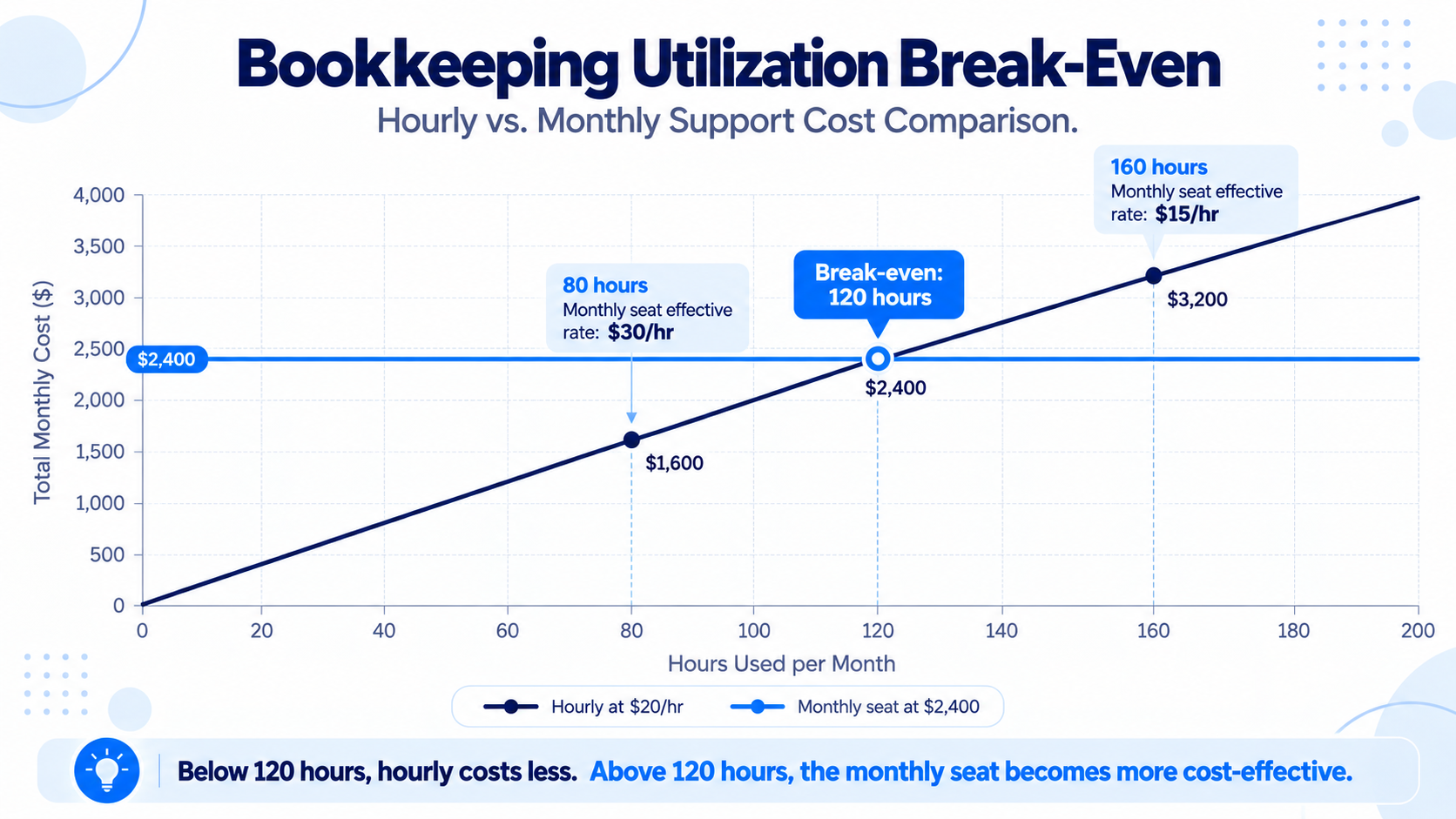
A CPA firm needs 80 hours of bookkeeping support monthly. At a hypothetical $20 hourly rate, that costs $1,600. A $2,400 monthly arrangement costs $800 more.
But when workload reaches 140 hours, hourly support rises to $2,800 while the monthly fee remains $2,400.
The decision comes down to how much bookkeeping capacity the firm actually uses, not the advertised hourly rate.
For CPA firms planning 2027 staffing, reviewing recurring workload and seasonal fluctuations can prevent unnecessary commitments.
Hourly vs Monthly Bookkeeping: What Changes?
Factor | Hourly support | Monthly support |
Billing | Hours purchased | Fixed monthly fee |
Best suited for | Variable workloads | Consistent recurring work |
Capacity | Flexible, subject to availability | Contracted monthly capacity |
Continuity | Depends on staffing arrangement | Often dedicated |
Main risk | Rising costs at high volume | Paying for unused hours |
Both models can support transaction coding, reconciliations, AP/AR processing, and monthly close preparation.
The difference is how firms purchase and manage that capacity.
What Is the Break-Even Point?
Finsmart Accounting publicly advertises bookkeeping seats at $20 hourly and $2,400 monthly. However, package terms and available hours must be confirmed directly.
To avoid assuming those packages are interchangeable, the following example uses hypothetical pricing of $20 per hour versus a $2,400 monthly fee for up to 160 hours.
Monthly hours used | Hourly cost | Monthly fee | Effective monthly-seat rate |
40 | $800 | $2,400 | $60/hour |
80 | $1,600 | $2,400 | $30/hour |
120 | $2,400 | $2,400 | $20/hour |
160 | $3,200 | $2,400 | $15/hour |
The break-even point is 120 utilized hours.
At 80 hours, the monthly arrangement effectively costs $30 per hour. At 160 hours, that falls to $15.
Unused capacity is therefore the biggest financial risk of a monthly commitment.
When Part-Time Bookkeeping Makes More Sense
Consider a CPA firm managing 12 small-business clients requiring 60 hours of recurring bookkeeping monthly.
At the hypothetical $20 rate, that workload costs $1,200 monthly.
A full-time monthly seat costing $2,400 would double the expense without necessarily providing additional value.
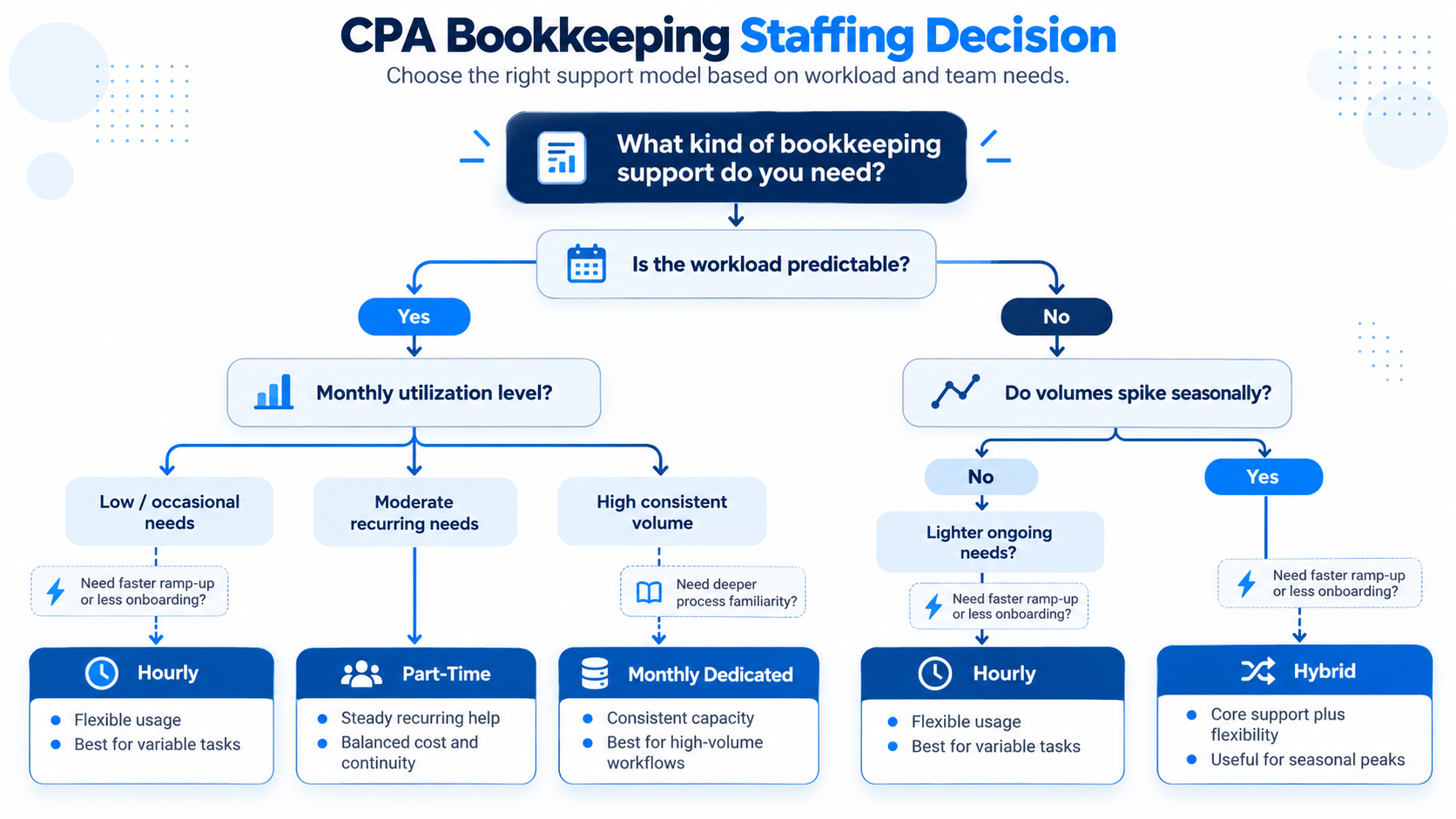
Part-time support is worth evaluating when the work is predictable but insufficient to occupy a full-time professional.
The important requirement is continuity: recurring clients benefit when the same bookkeeper understands their accounts, procedures, and deadlines.
The Hybrid Model: Monthly Baseline Plus Hourly Overflow
Some CPA firms need steady support throughout the year but additional capacity during tax season and year-end close.
Consider a firm requiring 100 hours monthly, increasing to 140 hours during three peak months.
Using hypothetical rates:
Annual staffing model | Calculation | Annual cost |
Hybrid | 9 × $2,000 + 3 × $2,800 | $26,400 |
Monthly dedicated | 12 × $2,400 | $28,800 |
The hybrid saves $2,400 annually under these assumptions.
Its advantage comes from avoiding unused full-time capacity during quieter months, not from being cheaper during peak periods.
However, seasonal overflow may involve a different professional. Firms should budget for handoffs, client-specific training, and additional review.
Why the First 90 Days Matter
A new bookkeeper must learn the firm’s accounting software, client procedures, reconciliation formats, and reporting deadlines.
SafeBooks’ published offshore accounting ROI guide identifies the first 90–120 days as a period when onboarding and review costs may remain elevated.
Rather than assuming a fixed ramp-up timetable, firms should track weekly output and reviewer corrections.
The lowest service fee may not produce the lowest total cost if US managers spend excessive time correcting work.
For a fuller calculation, see Offshore Accounting ROI for CPA Firms.
How SafeBooks Structures Bookkeeping Support
SafeBooks Global offers project-based support and part-time or full-time professionals assigned to CPA firms.
Its published engagement structure includes per-staff FTE/PTE pricing, with onboarding covering workflow review, SOP alignment, and staff assignment.
For the 12-client example, an engagement could assign recurring bank reconciliations, transaction coding, and monthly close schedules to a part-time professional.
The CPA firm’s designated reviewer would approve completed work and resolve technical exceptions.
SafeBooks’ remote bookkeeping services also support recurring reconciliations, catch-up bookkeeping, and backend accounting tasks.
Actual staffing hours, fees, and seasonal overflow arrangements should be confirmed in the proposal.
Final Takeaway
Hourly bookkeeping protects flexibility. Monthly support can reduce the effective cost of consistently utilized capacity. Part-time and hybrid arrangements help firms avoid unnecessary full-time commitments.
Before choosing a model, calculate three months of actual bookkeeping hours, identify seasonal peaks, and measure unused capacity.
Contact SafeBooks Global to discuss the right bookkeeping support structure for your CPA firm.