

In May, a business owner was considering two new hires.
Revenue was growing, the team was stretched, and expansion seemed justified.
Then came one question:
“Which month are your latest financial reports from?”
February.
The owner was making a May decision using three-month-old numbers.
The issue was not effort. The accounting team was also handling payroll, invoices, vendor questions, and daily operations, so month-end reporting kept getting pushed back.
A slow close does more than delay reports. It delays the decisions that depend on them.
Monthly close outsourcing helps businesses build a consistent process and access accurate financial information while it is still useful.
Key Takeaway
Monthly close outsourcing helps businesses finalize financial records faster by using a dedicated accounting team to manage bookkeeping updates, reconciliations, and financial reporting preparation.
What Does “Closing the Books” Actually Mean?
Closing the books means finalizing a month’s financial records so the business has accurate, reconciled reports for that month.
In simple terms, it means making sure the financial picture is complete.
A monthly close process helps confirm that:
- Income has been recorded properly
- Expenses are captured
- Bank and credit card accounts are reviewed
- Financial reports reflect the actual business activity
The goal is not simply finishing accounting work.
The goal is giving business owners reliable information they can use.
Why Do Small Businesses Close Books Late?
Many businesses struggle with delayed financial reports for the same reason:
The accounting process depends on too few people.
A bookkeeper or office manager may be responsible for:
- Recording transactions
- Managing invoices
- Following up on payments
- Handling payroll tasks
- Answering operational questions
As the business grows, these responsibilities become harder to manage together.
Other common reasons for delayed closes include:
- Missing receipts or documents
- Unreconciled bank accounts
- Multiple software systems
- Expenses recorded late
- Lack of a consistent monthly process
The issue is usually not the effort of the person handling the books.
The issue is that the process has outgrown the setup.
What Does a Slow Close Cost a Business?
When financial reports arrive late, businesses often make decisions using incomplete information.
A delayed close can affect:
Hiring Decisions
A business may add employees without having a clear view of current profitability.
Spending Decisions
Without updated numbers, owners may not know where costs are increasing.
Cash Flow Planning
Late reports can hide upcoming cash challenges.
Financing Opportunities
Banks, lenders, or investors may request current financial information. Delayed reporting can slow those conversations.
The biggest cost of a slow close is not the late report itself.
It is the decisions made without knowing the full picture.
Slow Close vs Consistent Monthly Close
Category | Slow Close | Consistent Monthly Close |
Report timing | Weeks or months later | Delivered on a predictable schedule |
Decision making | Based on older information | Based on current financial data |
Team dependency | Often depends on one person | Supported by a structured process |
Financial visibility | Limited understanding of performance | Clear view of business results |
A faster close gives owners confidence that the numbers they are reviewing reflect what is actually happening in the business.
How Does Monthly Close Outsourcing Speed Things Up?
Monthly close outsourcing allows businesses to work with an external accounting team that manages recurring accounting activities.
Instead of waiting until the end of the month to start reviewing records, a dedicated team follows a consistent process.
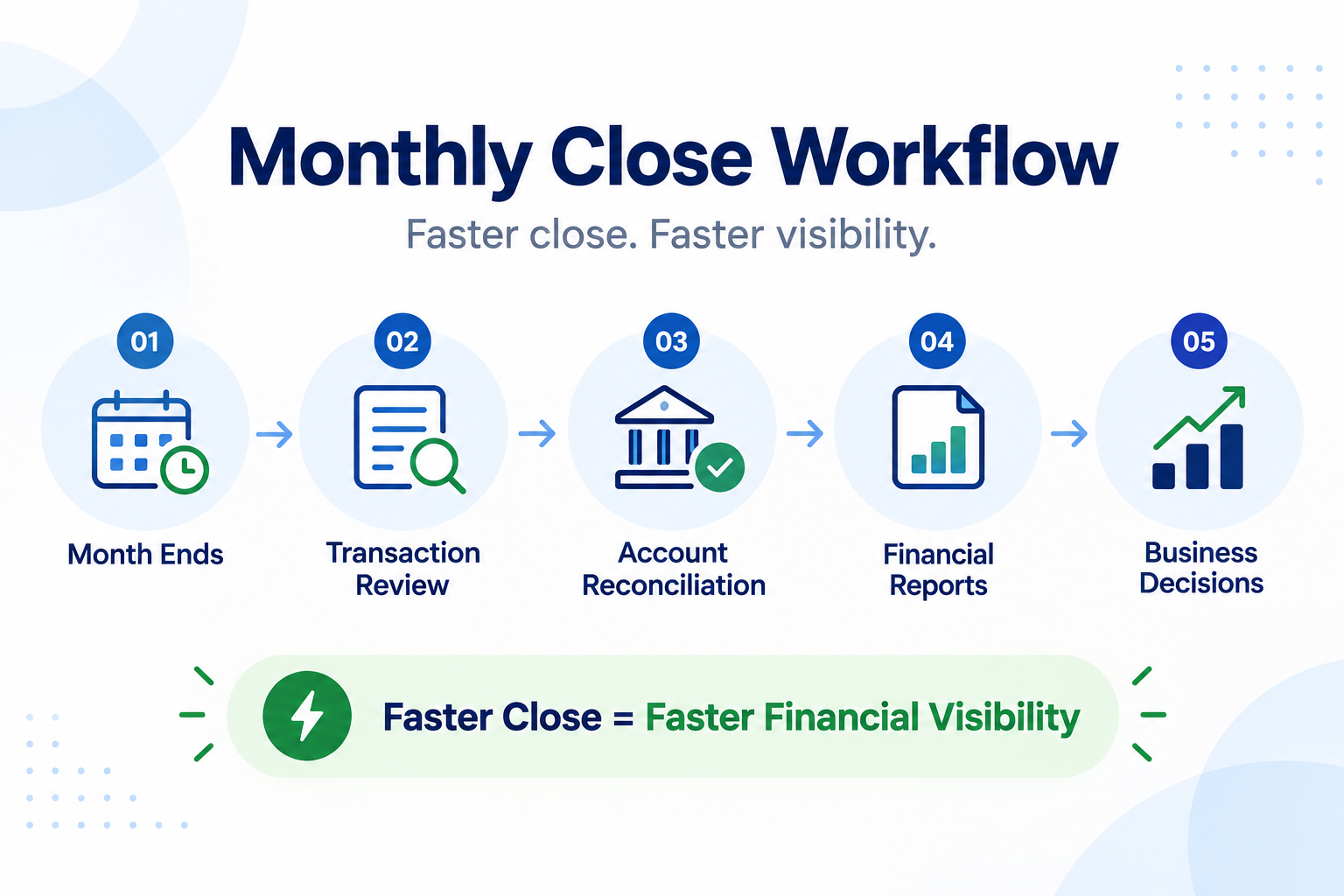
A typical workflow may include:
Transaction Review
Income and expenses are reviewed to ensure records are updated correctly.
Account Reconciliation
Bank and credit card accounts are matched with accounting records.
Account Review
Unusual transactions, missing information, or inconsistencies are identified.
Financial Reporting
Updated reports are prepared to help owners understand business performance.
The business receives a more predictable accounting process instead of a last-minute cleanup exercise.
How Does a Monthly Close Process Work?
A simple monthly rhythm may look like this:
Timeline | Activity |
Beginning of month | Review previous month transactions and collect missing information |
First phase | Complete reconciliations and update accounting records |
Middle of month | Review accounts and resolve outstanding items |
Final phase | Prepare financial reports and provide business insights |
The exact timeline depends on the size and complexity of the business.
The important part is consistency.
How Fast Can a Business Close Its Books?
The timeline depends on the current condition of the books.
Businesses with organized records and established processes can usually move faster.
Businesses that have delayed reconciliations, outdated records, or cleanup requirements may need initial work before reaching a consistent monthly close.
The goal is not simply closing faster once.
The goal is building a process that works every month.
What Stays With the Business Owner?
One common concern about outsourcing accounting is losing control.
A professional monthly close process keeps the owner involved.
The business owner continues to control:
- Payment approvals
- Financial decisions
- Business strategy
- Access permissions
The accounting team supports the process by managing recurring accounting work and preparing reports.
Businesses maintain ownership of their financial information while gaining additional accounting support.
Professional accounting providers also use secure systems, controlled access, and structured processes. Some providers follow security frameworks such as SOC 2 and ISO 27001 aligned practices.
How SafeBooks Global Helps Businesses With Monthly Close Support
SafeBooks Global helps US businesses maintain consistent accounting processes without building a larger internal finance team.
Our remote accounting support helps businesses with:
- Monthly bookkeeping
- Account reconciliation
- Financial reporting preparation
- Accounting operations support
The goal is to help businesses keep financial records organized, improve reporting consistency, and make decisions using updated information.
Learn more about our business bookkeeping services.
Need Financial Reports You Can Actually Use?
The value of a monthly close is not the report itself.
It is making decisions with numbers that are current and reliable.
Businesses that close their books consistently can identify challenges earlier, plan better, and understand their financial performance with greater confidence.
If your books are finishing weeks after the month ends, a structured accounting process can help.
Connect with SafeBooks Global through our contact page.