

The Real ROI of Offshore Accounting for CPA Firms
Three months into our first offshore engagement, I pulled up the firm’s numbers and felt my stomach drop.
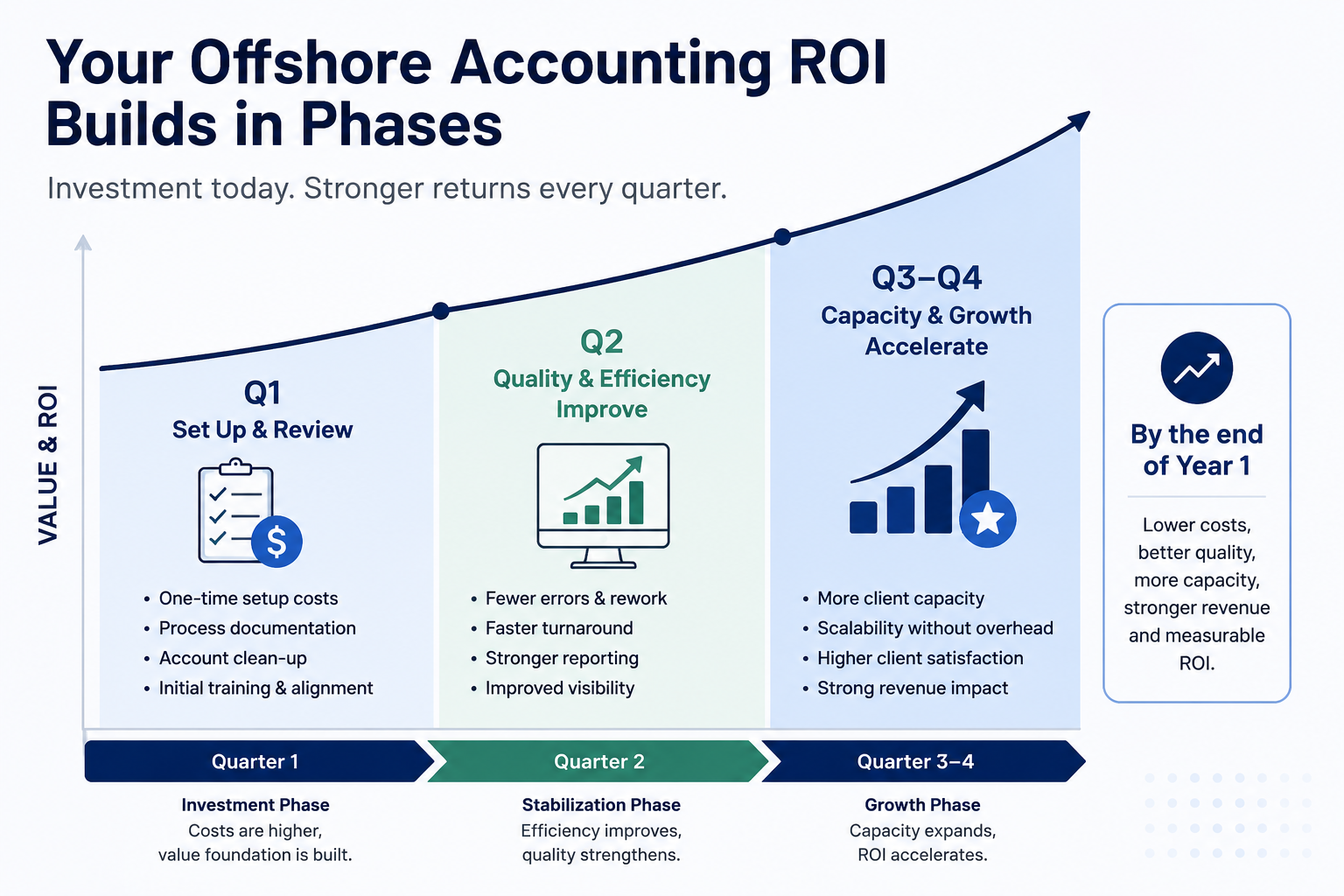
Revenue per full-time employee had fallen.
We had added two offshore team members. Labor costs were lower, routine work was moving faster, and our senior staff had fewer production tasks on their desks. Still, one of the metrics every managing partner watches was heading in the wrong direction.
My first thought was that the offshore experiment had failed. But as I looked more closely, I realized the numbers were not lying. We were simply measuring the wrong things, too early.
The real ROI of offshore accounting includes cost savings, faster delivery, reduced hiring pressure, stronger workflows, more senior capacity, and the revenue created when partners spend more time on advisory work.
Key Takeaway
In-house teams are best for client relationships, final judgment, and complex advisory work, while repeatable bookkeeping, tax preparation, audit support, and back-office tasks can often be handled offshore. Firms with mature processes may manage dedicated offshore employees directly, but managed accounting support is usually the stronger option when the firm needs secure access, workflow controls, quality checkpoints, continuity, and scalable capacity without building the entire delivery structure internally.
Why Offshore Accounting ROI Can Look Weak at First
Offshore accounting can create a temporary denominator problem.
The firm adds headcount immediately, but the revenue benefit takes longer to appear. During the first few months, the offshore team is learning, managers are reviewing more work, and the capacity created by the new team has not yet produced additional revenue.
Revenue per employee may therefore fall even while the firm’s operating model is improving.
A better approach is to measure offshore accounting across four areas:
ROI area | What to measure | Why it matters |
Direct savings | Loaded onshore cost compared with total offshore cost | Shows the immediate financial benefit |
Capacity | Senior and partner hours released from production work | Shows whether the firm is gaining usable time |
Delivery | Turnaround time, close time, backlog, and review completion | Shows whether workflows are becoming more efficient |
Revenue impact | Advisory revenue, client capacity, realization, and partner income | Shows whether released capacity is creating growth |
These measures should be reviewed together. Hourly cost and revenue per employee provide only part of the picture.
Calculate the Full Cost, Not the Brochure Rate
The comparison often starts with offshore hourly rates versus U.S. salaries. That is useful, but incomplete.
The onshore calculation should include salary, benefits, payroll taxes, recruitment, training, software, paid time off, management time, and turnover risk.
The offshore calculation should include the service fee, secure access, software licenses, onboarding, quality review, and rework during the learning period.
Once these costs are included, realistic net savings may be closer to 40% to 60%, rather than the 70% or higher figure used in simplified comparisons.
That is still a strong operating advantage. It is also a more dependable figure for financial planning.
Firms can use an offshore accounting ROI calculator to compare direct costs, review time, hiring expenses, and capacity gains before expanding their offshore team.
Quality Review Is the Most Common Hidden Cost
Quality review is the expense most firms underestimate.
During the first 90 to 120 days, onshore managers may need to review nearly every deliverable. Depending on the complexity of the work, this can add $8,000 to $20,000 per offshore full-time equivalent in annual management cost.
Review is not evidence that the offshore model has failed. It is part of building a controlled delivery process.
The problem begins when review work is added to an already overloaded manager. Feedback becomes slower, standards vary between reviewers, and the same mistakes continue.
Each offshore workflow should have a named QA owner. The firm should track review hours weekly and maintain a simple error log covering the issue, root cause, correction, and any process update required.
Review coverage should be reduced based on performance, not the calendar. Routine bookkeeping may move to sampling once accuracy stabilizes. Tax preparation, audit support, and complex reconciliations may require full review for longer.
A documented remote accounting workflow gives both teams one standard for completion, escalation, and review.
Move Complete Workflows Instead of Scattered Tasks
Offshore teams perform best when they receive complete, repeatable workflows.
Sending separate tasks through emails and chat messages creates unnecessary coordination. A stronger model clearly defines the required documents, process steps, expected output, review points, escalation rules, and evidence of completion.
For example, instead of sending individual bank reconciliations throughout the month, the firm can assign the complete monthly bookkeeping cycle with one checklist, deadline, and review process.
This approach gives the offshore team greater ownership and makes performance easier to measure. It also helps firms build more consistent bookkeeping outsourcing workflows across clients.
Before increasing offshore headcount, the firm should be able to answer three questions:
- What will the offshore team deliver?
- Who will review and approve the work?
- How will exceptions be escalated?
If those answers are unclear, adding more people will increase coordination work rather than reduce it.
Turn Released Capacity Into Revenue
The strongest ROI comes from what senior staff do with the time they get back.
When offshore professionals take responsibility for bookkeeping, tax preparation support, audit support, reconciliations, and back-office work, senior accountants may recover 10 to 15 hours per week.
That time needs a planned destination. It can be reassigned to advisory work, tax planning, client retention, team development, quality review, or business development.
Without a clear plan, released hours often disappear into email, meetings, and scope creep.
Some benchmark comparisons have shown offshore-enabled firms reporting stronger partner income and organic growth than firms without offshore support. The reason is not lower labor cost alone. It is the separation of production work from judgment-heavy and relationship-driven work.
The offshore team handles structured execution. The onshore team focuses on review, client communication, advisory services, and complex decisions.
Expert Insight
“Offshore accounting creates real value when the firm decides in advance how released senior capacity will be used. Cost savings support the model, but the larger return comes from moving experienced professionals toward review, advisory, and client-facing work.“
Anshul Agrawal,
Accounts Director, CA, SafeBooks Global
This capacity model can also support a continuous close process. When routine reconciliations are completed throughout the month, senior reviewers have more time to resolve exceptions before reporting deadlines.
Use a Complete Offshore Accounting ROI Formula
A useful ROI calculation should include savings, avoided costs, and the revenue created from released capacity.
Annual Offshore ROI = (Direct Employment Savings + Revenue from Released Capacity + Avoided Recruitment Costs + Value of Faster Delivery) − (Offshore Fees + Software/Security Costs + Onboarding/Review/Rework Costs)
The firm should calculate this monthly during the first year and use a rolling 12-month view once the model stabilizes.
Important measures include review hours, rework, turnaround time, material errors, senior hours released, advisory hours created, and additional client capacity.
The right firm management tools can collect these figures without creating another manual reporting burden.
Recognize When the Model Is Breaking Down
Low ROI after the first year usually points to one of three problems: excessive QA overhead, weak provider performance, or failure to convert released capacity into higher-value work.
Manager burnout, recurring errors, missed deadlines, flat revenue, and high offshore turnover are also warning signs.
These problems should be corrected before the firm adds more people.
A structured offshore partner evaluation process should examine retention, training, quality controls, communication, security, and service continuity.
Security also belongs in the ROI calculation. A low-cost provider without secure access, encryption, multifactor authentication, role-based permissions, audit logs, and documented offboarding can create more risk than value.
SafeBooks explains these safeguards in its guide to offshore accounting data security.
Building an Offshore Model That Supports Growth
The firms seeing the strongest return from offshore accounting are creating a clearer division of work.
The offshore team manages structured execution. The onshore team retains ownership of review, judgment, client relationships, and advisory work.
This structure allows CPA firms to increase capacity without lowering service standards or placing more pressure on already stretched managers.
SafeBooks Global helps U.S. CPA and accounting firms build secure, process-led offshore teams across bookkeeping, tax, audit, and back-office operations.
Explore our offshore accounting support for U.S. firms or schedule a discovery call to assess which workflows should move first, how review should be structured, and where the released capacity can create the strongest return.