The Control Layer CPA Firms Need
A CPA firm expanded its offshore bookkeeping team from four professionals to twelve.
The additional capacity worked. Reconciliations moved faster, workpapers were prepared, and deadlines were met.
Then a partner asked a simple question:
Who reviewed an $8,200 expense, when was it reviewed, and why was it classified as office supplies instead of consulting?
Nobody could answer without searching through emails, task comments, and spreadsheets.
The firm had solved its capacity problem but created a visibility problem.
AI agents can help close that gap. Their role is not to replace offshore accountants. They provide a control layer that monitors work, identifies exceptions, connects dependencies, and routes issues to the right professional.
Key Takeaway
AI agents can help CPA firms scale offshore teams by connecting recruitment, workload, quality, security, performance, and client delivery information. However, agents should not make final accounting decisions or evaluate employees without context. The strongest model combines AI-supported monitoring with trained offshore professionals, named process owners, secure systems, dependency-aware performance measures, and clear onshore approval responsibility.
Why Offshore Teams Need a Control Layer
AI systems are becoming more capable of monitoring tasks, coordinating actions, summarizing information, and identifying patterns across large volumes of work.
For firms using offshore teams, these capabilities can improve visibility without creating constant meetings or manual status requests.
However, AI should not be added simply because the technology is available.
NIST’s AI Risk Management Framework is designed to help organizations incorporate trustworthiness considerations into the design, use, and evaluation of AI systems. NIST also states that the current AI RMF 1.0 is being revised, while its Generative AI Profile remains available to help organizations identify risks specific to generative AI.
The purpose of the control layer should therefore be clearly defined: identify operational risk, present usable evidence, and preserve human accountability.
Build the Operating Foundation First
AI agents cannot create control when the underlying workflow is unclear.
Before implementation, the firm should have documented procedures, consistent task names, defined review stages, client-level access controls, and one practice management system that acts as the official record.
The firm should also define what each agent may do:
Read: Access approved workflow information.
Recommend: Identify an issue and suggest an action.
Draft: Prepare a task, summary, or communication.
Route: Assign the matter to a named professional.
Approve: Reserved for authorized people.
SafeBooks Global’s offshore accounting operating system guide can help firms establish this workflow foundation. 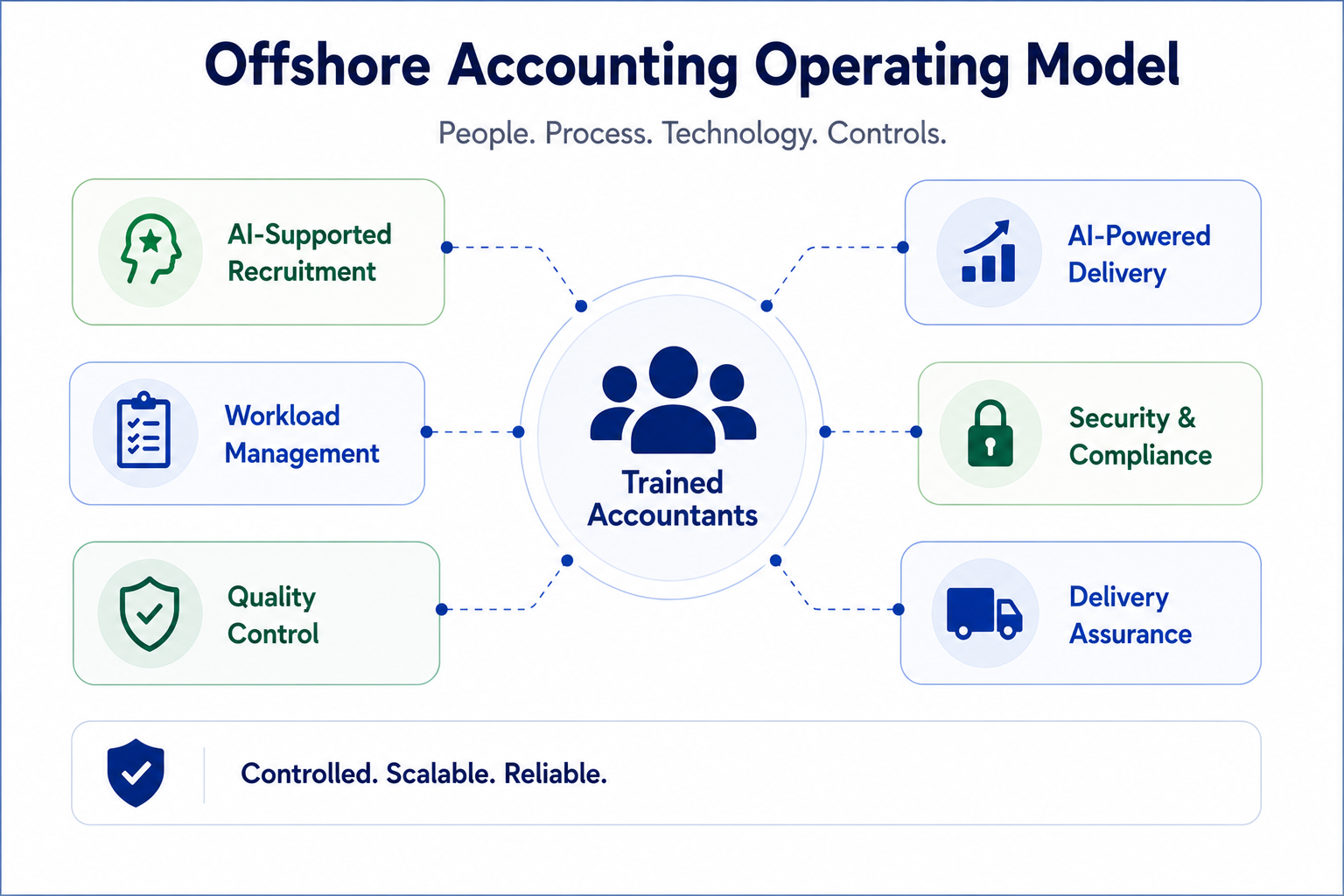
Recruitment Screening Agent
A Recruitment Screening Agent compares candidates with documented role requirements.
It may review accounting experience, software exposure, communication assessments, availability, and experience with U.S. bookkeeping or tax workflows.
The agent should create a consistent shortlist, not make the final hiring decision.
A qualified interviewer must still assess technical understanding, communication, professional judgment, and whether the candidate is comfortable raising questions when instructions are incomplete.
Workload and Productivity Agent
A Workload and Productivity Agent compares assigned work with completed output, turnaround time, review status, unresolved questions, and workload distribution.
However, it must also understand workflow dependencies.
A bookkeeping file may appear delayed because the offshore preparer is waiting for a bank statement, a client response, system access, or a technical decision from a U.S. manager.
Without that context, the agent may incorrectly classify blocked time as poor employee performance.
The workflow should therefore record:
- When active preparation began
- When the task became blocked
- What caused the block
- Who owns the dependency
- When the required response was received
- When active work resumed
The agent can then distinguish active processing time from dependency wait time.
This prevents offshore professionals from being penalized for delays outside their control and helps the firm identify where the real bottleneck exists.
Employee Development Agent
An Employee Development Agent combines quality trends, turnaround time, training records, review notes, and progress across different workflow types.
Its purpose should be development, not surveillance.
For example, it may identify that a bookkeeper performs well on standard reconciliations but needs additional support with accruals or multi-entity activity.
The manager can then assign targeted training, adjust the workload, or pair the employee with an experienced reviewer.
The final assessment should remain with someone who understands client complexity, dependencies, communication, and the employee’s overall progress.
Quality and Error-Pattern Agent
A Quality and Error-Pattern Agent connects recurring issues across clients, accounts, processes, preparers, and reviewers.
A repeated coding problem may come from weak training. It may also be caused by an inconsistent chart of accounts, unclear client instructions, poor source documents, or an outdated SOP.
The agent should help the firm distinguish a people problem from a process problem.
Expert Insight
“The most valuable quality insight is not simply who made an error. It is why the error continued. AI can connect repeated review notes, but an experienced accounting manager must decide whether the solution is training, stronger client context, or a workflow correction.”
Anshul Agrawal,
Accounts Director, CA, SafeBooks Global
Review SafeBooks Global’s guidance on psychological safety and offshore team performance to ensure error reporting supports improvement rather than blame.
Information Security and Compliance Agent
An Information Security and Compliance Agent can monitor active users, access reviews, policy renewals, consent status, unusual exports, overdue offboarding, and unresolved security actions.
The challenge is volume.
Accounting firms may generate large numbers of events across QuickBooks, Xero, tax software, document portals, remote desktops, email, and identity platforms.
NIST describes log management as the process of generating, transmitting, storing, accessing, and disposing of log data so organizations can investigate incidents, identify operational issues, and meet recordkeeping needs.
Sending every event to the Qualified Individual would create alert fatigue.
The agent should apply a behavior-based baseline that considers normal working hours, approved devices, expected client access, usual data volumes, and standard login locations.
It can then prioritize higher-risk patterns, such as:
- A multi-client export outside the user’s normal shift
- Access from an unmanaged device
- Entry into clients outside the assigned portfolio
- Repeated failed MFA attempts followed by a successful login
- Unusual download volume before an employee’s departure
- Permission changes made outside the approved process
Behavioral baselines should not operate without oversight. Risky behavior can become normalized over time, so the Qualified Individual or security owner should periodically review the baseline, thresholds, and suppressed alerts.
SafeBooks Global’s offshore accounting data security guide explains how firms can connect access controls with remote accounting delivery.
Management Intelligence Agent
A Management Intelligence Agent converts operational data into a unified view of usable capacity.
A useful Capacity Utilization Metric should consider more than assigned hours. It should include active preparation time, dependency wait time, first-level review, rework, unresolved exceptions, and final reviewer availability.
This allows partners to see where capacity is being lost.
For example, additional offshore preparers will not improve delivery when completed files remain stuck in the U.S. review queue.
The agent should identify whether operational drag is occurring during preparation, client follow-up, technical escalation, quality review, or final approval.
This provides better evidence for decisions about hiring, process changes, client pricing, and reviewer allocation.
Central Coordination Agent
A Central Coordination Agent connects the specialist agents and creates one operational view.
For example, the quality agent may identify recurring reconciliation errors. The coordinator can create a training task, notify the engagement manager, update the client risk status, and check whether the issue improves during the next close cycle.
Without coordination, the firm may have several dashboards but no clear accountability.
The coordinator should preserve an activity record showing what was identified, which evidence supported the alert, who received the task, what decision was made, and when the matter was resolved.
It should not approve its own recommendations.
Protect the Human Review Layer
AI agents can create false confidence when their outputs appear precise but rely on incomplete data.
CPA firms should pilot each agent, compare results with actual work, and retain ongoing human testing after deployment.
Review thresholds should reflect risk. Payroll, tax, trust accounts, payments, unusual journal entries, and client-facing deliverables require stronger human checkpoints than routine task reminders.
The firm should also monitor ignored alerts, false positives, and missed exceptions.
A useful control layer should direct attention to meaningful risk, not create another overloaded review queue.
Combine AI Governance With Managed Offshore Delivery
AI agents can monitor work, identify patterns, and improve management visibility.
They do not provide trained accountants, secure infrastructure, client knowledge, backup coverage, process ownership, or professional judgment.
SafeBooks Global helps U.S. CPA firms build offshore accounting teams supported by documented workflows, controlled access, first-level quality review, and delivery accountability.
This creates the human and operating foundation required for AI-supported controls to work effectively.
Review the questions to ask before hiring a remote accounting team or schedule a discovery call to discuss how offshore capacity can fit into an AI-enabled accounting model.