Every February, CPA firms hear the same concern from e-commerce clients:
“My 1099-K says $800,000, but my books show $600,000. Did we miss something?”
Usually, no.
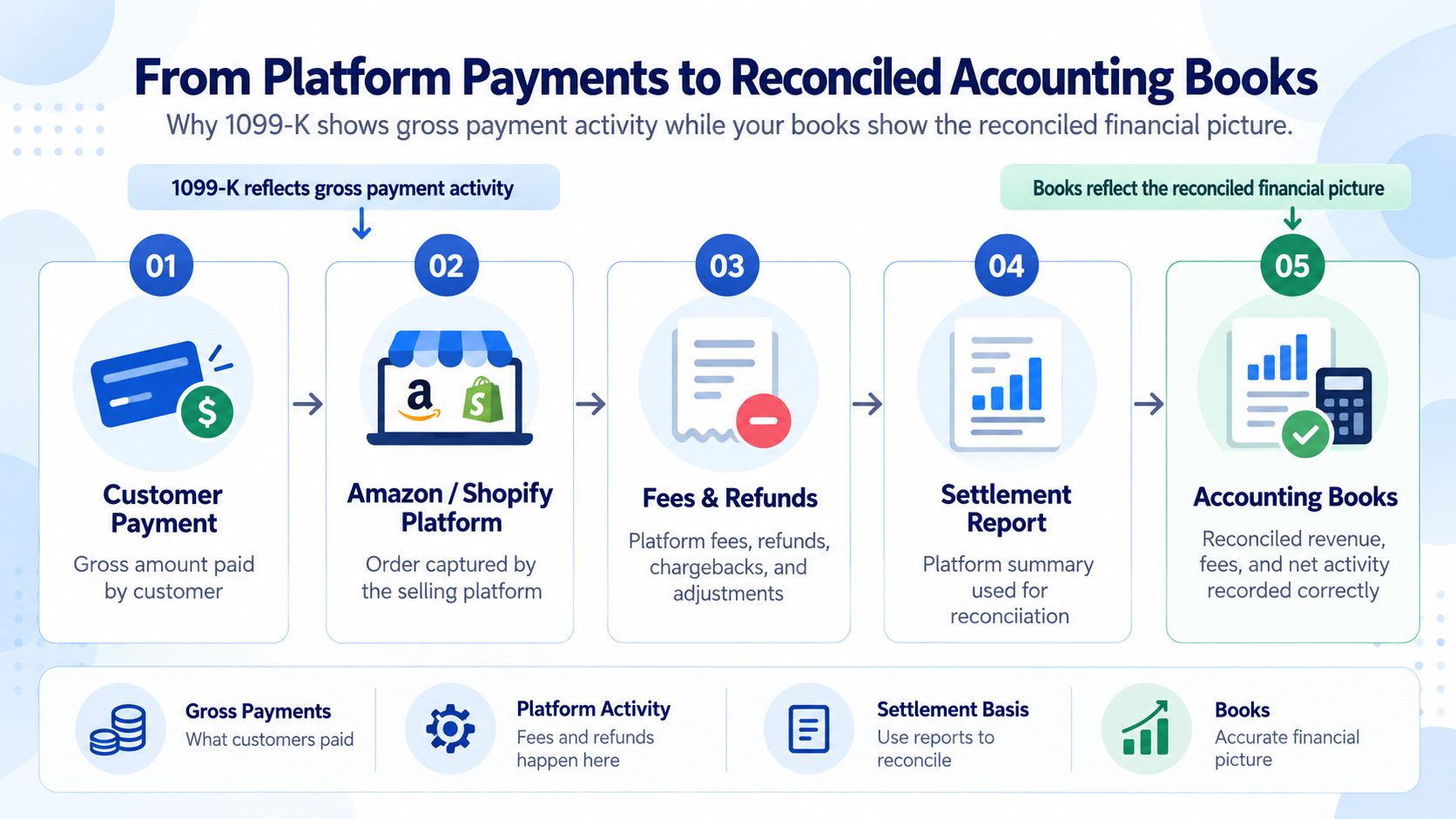
A 1099-K reports payment transactions processed through platforms such as Amazon and Shopify Payments. The books reflect recorded revenue after refunds, fees, adjustments, and other accounting entries.
The numbers can differ without either being wrong.
For CPA firms, the real challenge is reconciling those differences consistently across multiple platforms, settlement reports, and payment systems.
Key Takeaway
A 1099-K reports gross payment activity processed through a platform, while accounting books reflect recorded revenue after adjustments such as refunds, fees, and other business transactions. The difference is usually not missing income, but a reconciliation gap that needs proper documentation.
Why Does the 1099-K Show More Than My Client Actually Made?
The simple answer:
A 1099-K reports the total amount of payments processed through a platform before marketplace deductions.
The books show the financial activity recorded by the business after accounting for adjustments.
Think about it like a paycheck.
Your gross salary and your bank deposit are not the same number.
The difference comes from deductions and adjustments.
E-commerce works similarly.
A customer may pay $100 for a product, but the seller may receive less after:
- Marketplace fees
- Payment processing fees
- Refunds
- Returns
- Shipping adjustments
- Other selling costs
The 1099-K captures the payment activity.
The books capture the business reality.
Where Did the Missing $200K Go?
The difference between the 1099-K and the books is often made up of normal e-commerce adjustments.
Illustrative example:
Description | Amount |
Gross payments reported on 1099-K | $800,000 |
Customer refunds and returns | ($50,000) |
Marketplace and payment processing fees | ($80,000) |
Shipping and fulfillment adjustments | ($40,000) |
Other selling adjustments | ($30,000) |
Recorded sales activity in books | $600,000 |
Example shown for illustration purposes only. Actual adjustments vary depending on the business model and platforms used.
The $200,000 difference did not disappear.
It represents the costs and adjustments involved in operating an e-commerce business.
Does a Difference Between 1099-K and Books Create a Problem?
The difference itself is not unusual.
The important question is:
Can the business explain the difference?
For CPA firms, the goal is not to make the 1099-K and books show the same number.
The goal is to maintain records that clearly connect:
- Marketplace sales
- Customer payments
- Refunds
- Platform fees
- Settlement amounts
- Accounting records
A documented reconciliation process helps businesses explain why gross payment reporting and recorded revenue may differ.
The risk is not having a difference.
The risk is having an unexplained difference.
Why Are Amazon and Shopify Reconciliations So Time-Consuming for CPA Firms?
E-commerce businesses often look simple from the outside.
A customer places an order.
The business receives payment.
Revenue is recorded.
But behind every transaction, multiple systems are involved.
A typical e-commerce business may have:
- Amazon seller accounts
- Shopify stores
- Shopify Payments
- PayPal
- Stripe
- Shipping platforms
- Inventory systems
- Fulfillment providers
Each platform provides different reports.
CPA teams may need to review:
- Sales reports
- Settlement statements
- Fee reports
- Refund reports
- Payment processor statements
The challenge is connecting all of these sources into accurate financial records.
Why Marketplace Fees Create Confusion
One of the biggest misunderstandings is confusing gross sales with the amount deposited.
Example:
Transaction | Amount |
Customer Purchase | $100 |
Marketplace Fee | ($15) |
Payment Received | $85 |
The customer paid $100.
The platform retained $15 as a fee.
The business received $85.
Both numbers are correct.
For accurate reporting:
- Sales should reflect the transaction value
- Fees should be recorded separately
- Deposits should match settlement activity
Why Refunds and Returns Make E-commerce Books More Difficult
Unlike many traditional businesses, e-commerce sales often change after purchase.
A customer may:
- Return an item
- Request a refund
- Dispute a transaction
- Exchange a product
The original sale and the adjustment may happen at different times.
This creates additional reconciliation work for CPA firms, especially during:
- Month-end close
- Tax season
- Year-end reporting
Why E-commerce Clients Can Hurt CPA Firm Realization Rates
E-commerce clients can be valuable relationships for CPA firms.
However, they can also consume significant team time when bookkeeping processes are not structured properly.
Common challenges include:
- High transaction volume
- Multiple sales channels
- Frequent adjustments
- Marketplace reporting differences
- Catch-up work before tax deadlines
The issue is not the client relationship.
The issue is the amount of recurring manual work required behind the scenes.
Many firms want to provide strong advisory support to e-commerce clients but find their teams spending too much time rebuilding transaction histories.
What Should CPA Firms Keep In-House and What Can They Delegate?
The highest-value work for CPA firms is often:
- Client communication
- Financial review
- Tax planning
- Advisory conversations
Recurring bookkeeping tasks such as:
- Marketplace reconciliation
- Transaction cleanup
- Settlement matching
- Monthly bookkeeping support
can often be handled by a dedicated accounting support team.
This allows firms to maintain client relationships while reducing the operational burden of recurring accounting work.
How SafeBooks Global Supports E-commerce Accounting Workflows
SafeBooks Global helps US CPA firms manage the recurring accounting workload that comes with growing e-commerce clients.
Our support includes:
- Bookkeeping assistance
- Marketplace reconciliation support
- Accounting workflow management
- Month-end close support
The goal is simple:
Help CPA firms reduce repetitive accounting workload while maintaining accurate and organized financial records.
Learn more about our accounting firm support services.
For businesses looking for bookkeeping support, explore our business bookkeeping services.
Need Help Managing Growing E-commerce Clients?
A $200,000 difference between a 1099-K and the books is not automatically a problem.
An unexplained difference is.
The firms that build strong e-commerce practices are the ones that can explain these differences clearly while keeping their teams focused on higher-value client work.
SafeBooks Global supports CPA firms with dedicated accounting support for recurring bookkeeping and reconciliation needs.
Connect with SafeBooks Global through our contact page.