
What Bookkeeping Tasks Should Outsource First?
It is 11 p.m. during Q1, and a partner is reviewing transaction coding that a staff accountant rushed through between two client calls.
Half the entries are misclassified. The uncategorized queue contains more than 200 transactions. Month-end close is already three days late for six clients.
The firm clearly needs more capacity. The difficult question is what to delegate first without creating additional corrections, security risks, or management work.
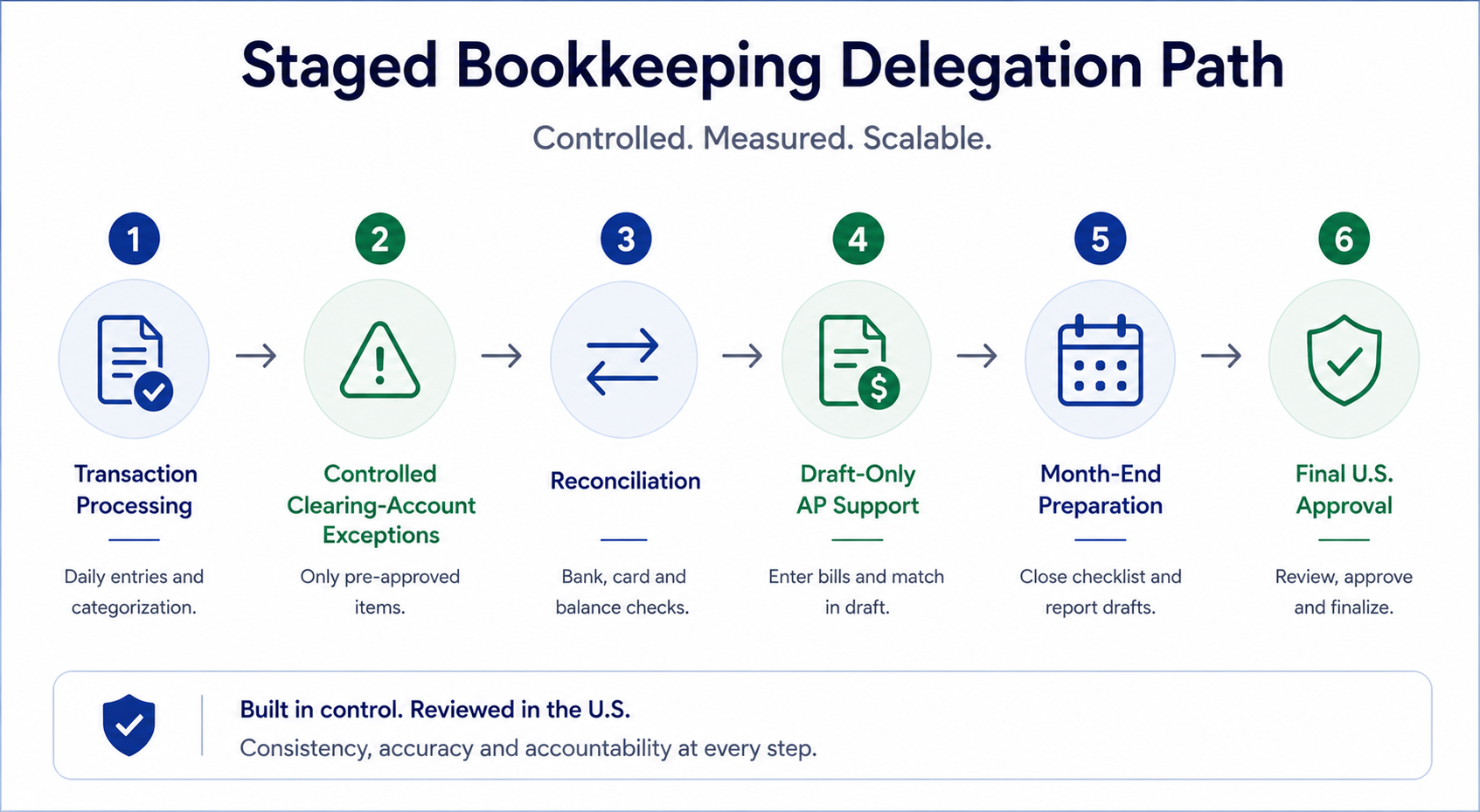
Successful bookkeeping outsourcing does not begin by transferring an entire client portfolio. It begins with a controlled sequence. Move rules-based work first, confirm that the workflow produces review-ready results, and expand only when quality is stable.
Key Takeaway
CPA firms should outsource high-volume, rules-based bookkeeping work first, including transaction categorization, receipt matching, sub-ledger cleanup, and standard reconciliations. Month-end preparation can move next once accuracy and exception handling are consistent. Client advice, unusual accounting decisions, payment release, final review, and approval authority should remain with the U.S. firm.
Begin With the Bookkeeping Data Layer
The best starting point is work that follows clear rules and creates the foundation for accurate reporting.
Transaction categorization, receipt matching, bank-feed cleanup, and vendor record maintenance consume significant staff time but generally require limited judgment when client-specific rules are documented.
Sub-ledger cleanup should also happen early. This may include consolidating duplicate vendor profiles, mapping unapplied credits, correcting customer records, and standardizing 1099 tracking fields.
These activities should move as a complete workflow rather than as disconnected tasks sent through email.
For example, a transaction-coding process should explain common vendor rules, required documents, related-party treatment, escalation thresholds, and how unresolved items should be recorded.
A documented remote accounting workflow gives both teams the same definition of complete, blocked, and ready for review.
Follow a Controlled Delegation Sequence
Bookkeeping activity | When to delegate | Responsibility retained in-house |
Transaction coding and uncategorized queues | First stage | Approval of unusual or client-sensitive items |
Receipt and invoice matching | First stage | Resolution of missing or disputed documents |
Sub-ledger cleanup and data standardization | First stage | Approval of structural account changes |
Bank and credit card reconciliations | After coding quality stabilizes | Review of material or unexplained differences |
AP and AR processing support | After access controls are tested | Payment release, banking authority, and client decisions |
Month-end close preparation | After reconciliations become review-ready | Final adjustments, variance analysis, and close approval |
Tax-ready schedules and workpaper support | After monthly workflows are stable | Tax treatment, technical judgment, and final review |
This sequence protects the general ledger before more complex activities move offshore.
SafeBooks Global’s guide to outsourcing complete bookkeeping workflows explains why delegating a controlled process is stronger than sending isolated tasks.
Plan for Broken Bank Feeds and Missing MFA Tokens
Bank reconciliations depend on complete and current transaction data.
Cloud accounting platforms sometimes lose live bank connections because credentials expire, banks require new multifactor authentication, or data feeds fail. An offshore bookkeeper may not be able to refresh the connection because the authentication token is controlled by the U.S. firm or client.
Without a backup process, one broken feed can stall an entire remote shift.
Create an Uncategorized Clearing Account Protocol for transactions that cannot be confirmed because the feed, statement, or supporting information is unavailable.
The remote team may place unresolved items in a designated suspense or clearing account only when the firm’s procedure permits it. Each item should include a description, supporting evidence, owner, and resolution deadline.
The onshore owner should refresh the bank connection, upload the required statement, or answer the open question during U.S. business hours.
The clearing account should be reviewed regularly and cleared before the close is approved. It should not become a permanent location for uncertain transactions.
This allows production to continue without forcing offshore staff to guess or allowing unresolved balances to disappear inside the ledger.
Move Reconciliations Only After Coding Is Reliable
Reconciliations rely on the quality of the underlying transaction data.
If vendor records are duplicated, transactions are misclassified, or documents are missing, moving reconciliations too early simply pushes poor data deeper into the close process.
Before expanding, review random samples and measure first-pass acceptance. If the same mistakes continue, update the client playbook or training before adding more work.
Once coding quality is stable, the offshore team can prepare standard bank and credit card reconciliations, identify open items, and document unexplained differences.
The U.S. reviewer should retain responsibility for material variances, unusual transfers, related-party activity, and client-specific accounting decisions.
Enforce Dual Control for AP and Payments
Accounts payable support can move offshore, but financial authority should not.
The remote bookkeeping team may enter bills, match invoices to supporting documents, prepare proposed payment batches, and flag due dates.
The software must enforce a zero-disbursement permission structure.
The offshore user should have draft-only access with no ability to approve or release ACH payments, print authorized checks, modify banking details without review, or initiate wires.
Payment approval should remain behind a separate U.S.-controlled login with strong multifactor authentication.
This separation should be enforced through the platform’s permissions, not only written in an SOP. A policy cannot prevent an unauthorized payment when the user’s account still has release rights.
SafeBooks Global’s guide to offshore accounting data security explains how role-based access and least-privilege controls support remote accounting workflows.
Add Month-End Preparation Without Losing Final Control
Month-end preparation can create significant capacity once routine bookkeeping is stable.
An offshore team may prepare supporting schedules, recurring journal entries, balance-sheet reconciliations, missing-document lists, and preliminary reports.
The U.S. firm should retain material journal entry approval, unusual accrual decisions, variance analysis, financial statement review, client communication, and final close approval.
This creates a continuous preparation process rather than a month-end rush.
A continuous close workflow can help firms resolve routine items throughout the month and reserve the final close period for material exceptions.
Give the Remote Team Client Context
A detailed procedure can still fail when it does not explain what is normal for the client.
A restaurant, property manager, e-commerce company, and professional services firm may use the same accounting platform but have very different transaction patterns.
Create a short client context sheet covering recurring vendors, expected transaction ranges, related parties, unusual accounts, normal seasonal changes, and specific escalation rules.
This reduces false exceptions and prevents the remote team from applying generic rules to client-specific activity.
Expert Insight
“A bookkeeping SOP explains how to complete a task, but a client context sheet explains when the standard process should stop. That distinction helps remote teams identify unusual activity instead of processing it without question.“
Shivangi Agrawal
Managing Director, CA, CPA (USA), SafeBooks Global
Measure Quality Before Expanding Scope
Do not evaluate outsourcing only by the number of transactions completed.
Track first-pass acceptance, recurring review notes, turnaround time, unresolved exceptions, clearing-account aging, and onshore review hours.
The remote team should also complete a first-level quality check before work reaches the U.S. reviewer. This may include testing a sample, confirming supporting documents, reviewing uncategorized items, and verifying that all exceptions are documented.
If the onshore team continues to recheck every transaction, the firm has created duplicate work rather than additional capacity.
A structured practice management support workflow can help track assignments, review stages, open items, and quality trends.
Build a Managed Bookkeeping Workflow
Hiring an individual remote bookkeeper may work when the firm already has mature procedures, secure systems, and managers available to supervise the role.
A managed provider is generally stronger when the firm also needs onboarding support, workflow documentation, first-level quality control, backup coverage, and consistent delivery.
SafeBooks Global provides remote bookkeeping support for CPA firms through documented processes, controlled access, review-ready work, and defined accountability.
Review how offshore bookkeeping compares with in-house accounting staff or schedule a discovery call to identify the first bookkeeping workflow your firm can delegate safely.