
Why CPA Firms Are Building Offshore Teams in India
Last January, a managing partner at a mid-sized CPA firm in Ohio told me something that stayed with me:
“We posted a senior accountant role for six months. We received twelve applications. Three were qualified. One accepted and then disappeared on the first day.”
That experience is no longer unusual.
Reuters reported that the U.S. accounting workforce in 2024 was approximately 10% smaller than it had been in 2019. By 2025, major and mid-sized accounting firms were actively expanding their India operations to address the shortage, with some hiring directly from Indian universities and supporting CPA training. (Reuters)
There were some encouraging pipeline signals in late 2025. Accounting enrollment increased, but the number of accounting graduates still fell 6.6% during the 2023–2024 academic year. The improvement was also uneven, with smaller firms continuing to face greater recruiting pressure than larger firms and major universities. (Business Insider)
That is the accounting talent shortage facing firms in 2026. The pipeline may be showing early signs of recovery, but domestic hiring alone still cannot provide every firm with the capacity it needs.
Key Takeaway
U.S. CPA firms are building offshore accounting teams in India because the domestic talent shortage has become a structural capacity problem rather than a temporary busy-season issue. The strongest firms are keeping client relationships, technical judgment, and final approval onshore while assigning repeatable bookkeeping, tax preparation support, audit support, and back-office production to secure, process-led teams in India.
Why the Talent Pressure Is Not Going Away
Demand for accountants remains strong.
The Bureau of Labor Statistics projects 5% employment growth for accountants and auditors between 2024 and 2034, with approximately 124,200 openings each year. Many of those openings will result from retirement, career changes, and people leaving the workforce. (Bureau of Labor Statistics)
Automation may reduce some manual activities, but it is not expected to eliminate the need for accountants. Instead, the BLS expects technology to make analytical and advisory responsibilities more important. (Bureau of Labor Statistics)
This leaves CPA firms with two connected challenges:
- They need enough production capacity to complete recurring work.
- They need to protect experienced professionals for review, advisory, and client communication.
Hiring more U.S. accountants remains part of the answer. It is no longer the entire answer.
The problem is also linked to how firms structure careers, compensation, workloads, and professional development, as discussed in SafeBooks Global’s analysis of the accounting talent crisis.
Why CPA Firms Are Looking to India
India has a large accounting and professional services workforce, established global delivery infrastructure, and professionals with experience supporting international finance operations.
Reuters reported that U.S. firms including RSM US, Moss Adams, Sikich, and CohnReznick were expanding in India during 2025. RSM US said it aimed to more than double its India workforce to 5,000 by 2027. (Reuters)
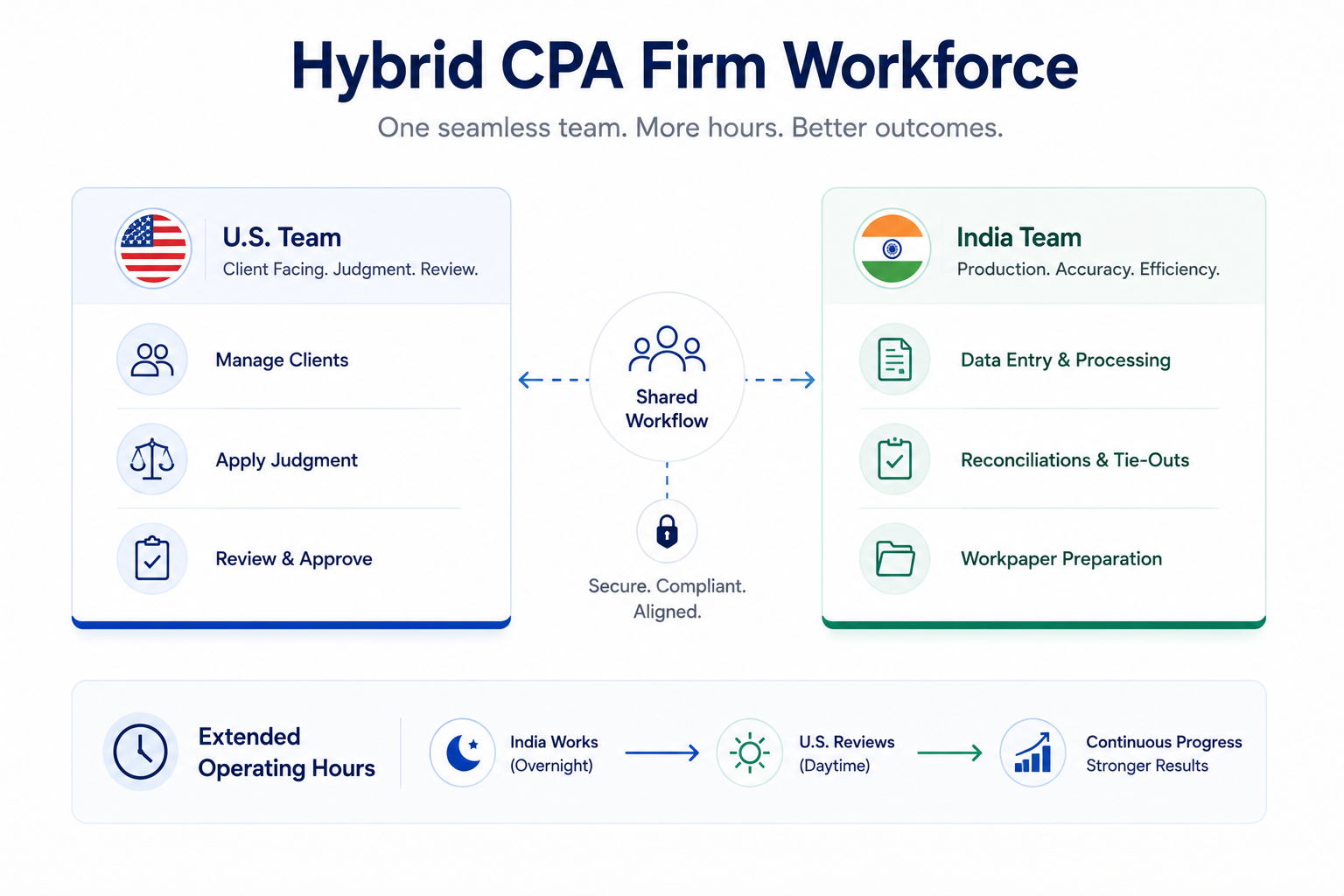
India also offers time-zone coverage that can extend the firm’s production cycle. Work assigned by a U.S. team at the end of its day can move forward during India’s business hours and return for review the next morning.
That advantage does not happen automatically. The assigned team still needs training in the firm’s software, documentation standards, U.S. GAAP workflows, client expectations, and escalation rules.
Move the Right Work Offshore
The objective is not to move entire client relationships offshore. It is to create a clearer division between production work and professional judgment.
Suitable offshore workflows may include bookkeeping, reconciliations, AP and AR support, tax document organization, first-level tax preparation, audit workpaper preparation, and practice management support.
Complex tax positions, audit conclusions, final review, advisory discussions, and client relationship ownership should remain with qualified onshore professionals.
Before moving any workflow, define:
- What the offshore team will prepare
- What documents it needs
- What “review-ready” means
- Which issues require escalation
- Who retains final approval
A documented remote accounting workflow should be in place before the team handles full production volume.
Choose a Delivery Model That Protects Operating Margins
Firms can build an India-based team through direct hiring, an employer of record, a staffing agency, or a managed offshore accounting partner.
Direct staffing can work when the firm has documented processes, experienced remote managers, secure infrastructure, and time to train every employee.
Managed offshore support is generally stronger when the firm also needs workflow oversight, first-level quality review, replacement coverage, security controls, and ongoing training.
The decision should not be based only on salary or hourly rates.
A more useful metric is:
Fully Loaded Production Cost per File = Offshore Delivery Cost + Technology Cost + Management Time + Review Time + Rework Cost
A low hourly rate provides little value when U.S. seniors spend several hours correcting every file. The provider should lower the firm’s production cost without increasing internal management overhead.
Reviewing the main offshore accounting staffing models can help firms decide how much recruitment, training, and workflow ownership they want to retain.
Build an Integration Loop That Encourages Questions
Offshore teams often fail because they receive login credentials without enough operating context.
Each offshore professional should have a named onshore contact who explains client-specific decisions, review expectations, and exceptions. This person needs protected time to support the relationship.
The firm should also use an asynchronous query log. Every blocker should record the client, issue, supporting evidence, required decision, owner, and response deadline.
However, a log works only when employees feel safe using it.
Remote professionals may hesitate to raise questions if they believe doing so will make them appear unprepared. Firms should actively reward early exception reporting and treat a flagged blocker as evidence of quality control, not poor performance.
A weekly review can recognize questions that prevented rework, missed deadlines, or incorrect assumptions. This turns escalation into an expected professional behavior.
SafeBooks Global’s guide to offshore team psychological safety explains how culture and workflow design affect remote team performance.
Scale Only After Quality Becomes Predictable
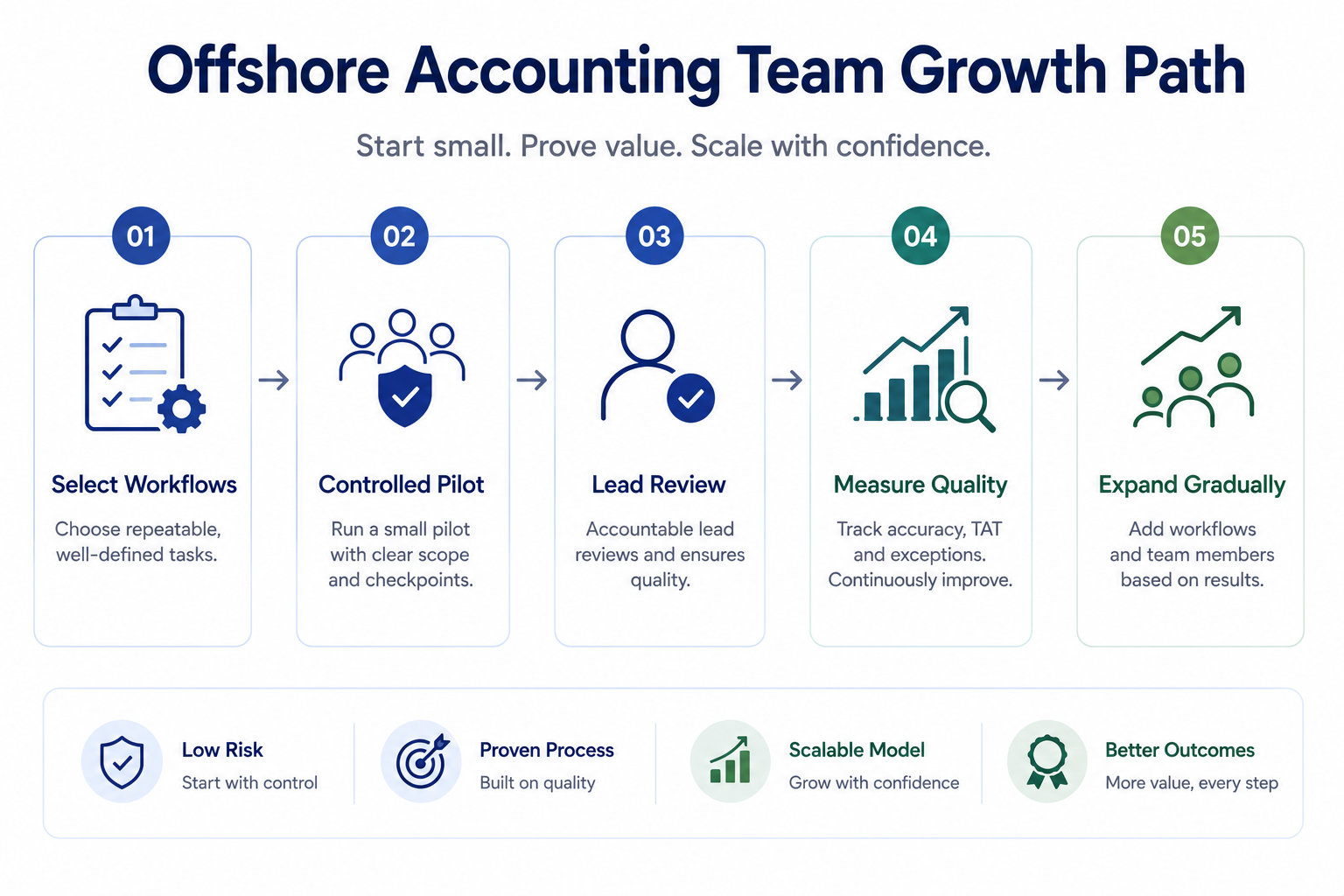
Do not begin with a large offshore team.
Start with one workflow and a limited client group. Measure turnaround time, first-pass acceptance, repeated errors, exception response time, and onshore review hours.
The provider should also have an experienced lead reviewer who checks basic completion, formatting, tie-outs, and supporting documentation before work reaches the U.S. firm.
If senior review time remains high, the model has not yet created usable capacity.
Expert Insight
“The purpose of an offshore team is not to increase headcount. It is to increase review-ready capacity. Firms should scale only when each additional offshore professional reduces the production and correction work handled by U.S. seniors.“
Shivangi Agrawal
Managing Director, CA, CPA (USA), SafeBooks Global
Treat Security and Retention as Part of Delivery
The offshore team should work through controlled access with multifactor authentication, role-based permissions, restricted local storage, and individual activity logs.
The provider should also demonstrate how access is removed, open work is reassigned, and client information remains protected when an employee leaves.
SafeBooks Global’s offshore accounting data security guide explains the controls firms should verify before granting access.
Retention is equally important. Offshore professionals who receive technical training, constructive feedback, career progression, and inclusion in the firm’s operating rhythm are more likely to build long-term process knowledge.
Treating India-based professionals only as low-cost labor weakens engagement and continuity. Treating them as part of a structured delivery team creates a more dependable operating model.
Build Capacity Without Repeating the Hiring Problem
The accounting talent shortage cannot be solved through one hiring channel.
The stronger response is a hybrid workforce. U.S. professionals retain technical judgment, client relationships, and final approval. India-based teams provide production capacity through secure, documented, and measurable workflows.
SafeBooks Global helps U.S. CPA and accounting firms build this model across bookkeeping, tax, audit, and back-office operations.
The focus goes beyond recruiting remote employees. SafeBooks provides workflow structure, secure access, quality follow-up, team continuity, and review-ready delivery.
Explore SafeBooks Global’s offshore accounting services for U.S. firms or schedule a discovery call to identify which workflows can move offshore and how the team should be structured.