
Tax Brackets, Standard Deduction and Inflation Adjustments
A client receives a year-end bonus and worries about moving into a higher tax bracket. Another asks whether to make charitable contributions before December 31. Meanwhile, a business owner wants to estimate next year’s tax liability.
For CPA firms, these conversations involve two different tax years.
Decisions made before December 31, 2026, affect 2026 taxes. The projected 2027 brackets help plan for income earned next year.
The IRS is expected to release its official 2027 inflation adjustments in late October or early November 2026.
Important: As of October 29, 2026, the figures below are projections based on Wolters Kluwer’s September 18, 2026 analysis, not final IRS amounts.
Projected 2027 Federal Income Tax Brackets
The seven federal marginal income tax rates remain 10%, 12%, 22%, 24%, 32%, 35%, and 37%.
Wolters Kluwer projects approximately 3.2% inflation-related increases in the 2027 income thresholds.
Tax rate | Single | Married filing jointly | Head of household | Married filing separately |
10% | Up to $12,800 | Up to $25,600 | Up to $18,250 | Up to $12,800 |
12% | 12,801–52,025 | 25,601–104,050 | 18,251–69,650 | 12,801–52,025 |
22% | 52,026–109,125 | 104,051–218,250 | 69,651–109,100 | 52,026–109,125 |
24% | 109,126–208,325 | 218,251–416,650 | 109,101–208,300 | 109,126–208,325 |
32% | 208,326–264,550 | 416,651–529,100 | 208,301–264,550 | 208,326–264,550 |
35% | 264,551–661,375 | 529,101–793,650 | 264,551–661,350 | 264,551–396,825 |
37% | Over $661,375 | Over $793,650 | Over $661,350 | Over $396,825 |
Source: Wolters Kluwer, September 18, 2026. Projected taxable income thresholds.
What a Higher Tax Bracket Actually Means
A recurring misunderstanding in tax planning is that crossing into a higher bracket causes all income to be taxed at the new rate.
Consider a single taxpayer with $110,000 in projected 2027 taxable income.
Under the projected brackets, the 24% rate begins above $109,125. Therefore, only $875 falls into the 24% bracket. The remaining taxable income is taxed at the applicable lower marginal rates.
For CPA firms, explaining this distinction helps clients make more informed decisions about raises, bonuses, and additional income.
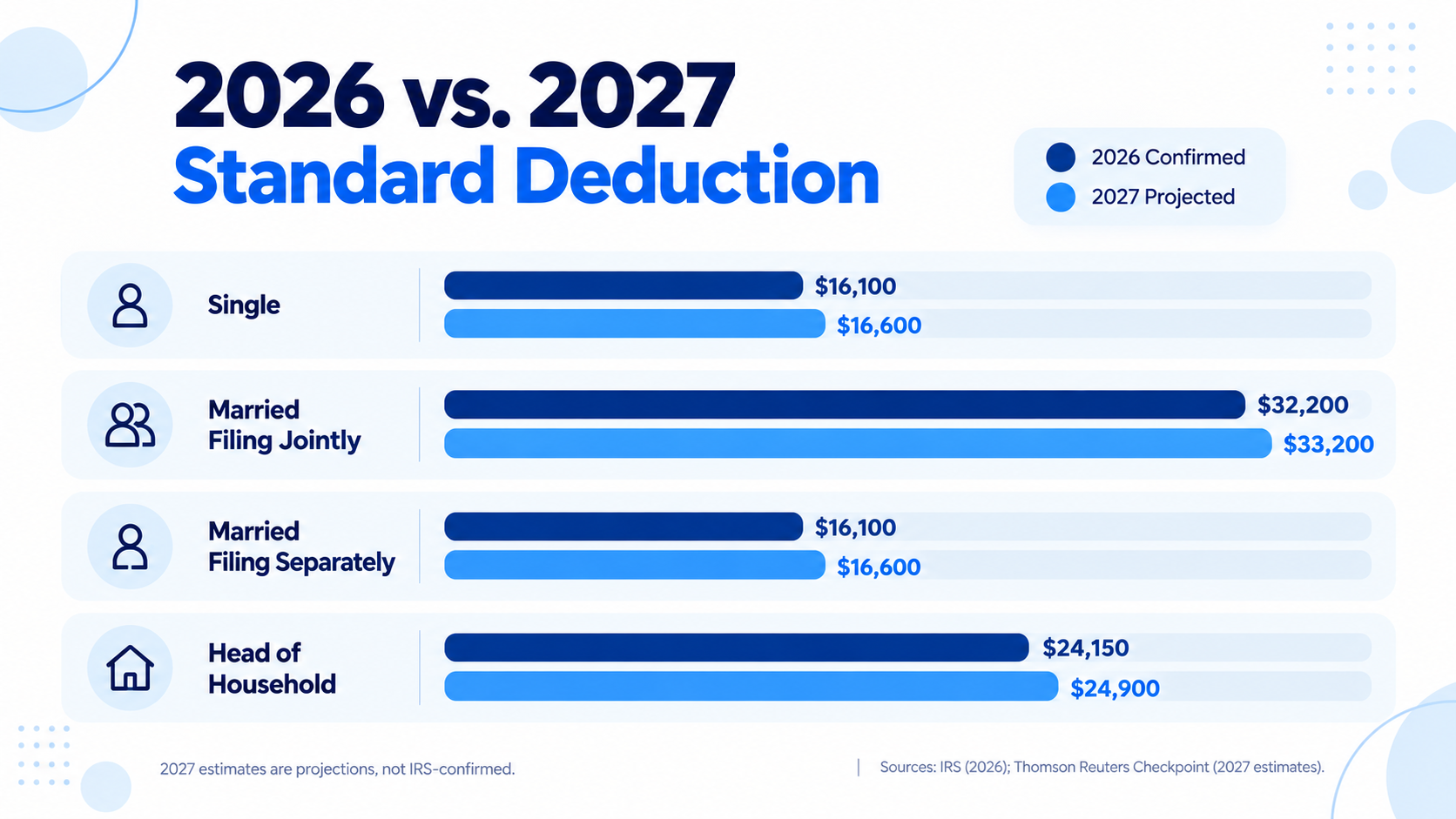
2027 Standard Deduction: Projected vs. 2026
The standard deduction is also expected to increase.
Filing status | 2026 confirmed | 2027 projected |
Single | $16,100 | $16,600 |
Married filing jointly | $32,200 | $33,200 |
Head of household | $24,150 | $24,950 |
Married filing separately | $16,100 | $16,600 |
When Should Clients Itemize Instead?
A higher standard deduction makes itemizing less beneficial for some taxpayers, but the comparison depends on eligible expenses.
For example, a married couple anticipating $35,000 in allowable itemized deductions during 2027 could benefit from itemizing rather than claiming the projected $33,200 standard deduction.
CPAs should compare eligible mortgage interest, charitable contributions, state and local taxes, and other allowable deductions after applying relevant limitations.
The timing of deductible payments can also affect the final comparison.
Other 2027 Inflation Adjustments Worth Reviewing
Beyond tax brackets, several inflation-adjusted provisions influence client planning.
Wolters Kluwer projects a Section 199A qualified business income threshold of $416,650 for joint filers and approximately $208,300 for most other filing statuses.
This is relevant when reviewing pass-through business income, particularly where deduction limitations may apply.
Capital gains thresholds and Alternative Minimum Tax exemptions are also expected to increase.
For clients with investment portfolios, realizing long-term gains within a lower capital gains bracket may create planning opportunities. However, other income, capital losses, and applicable taxes must be considered before recommending transactions.
2027 Tax Brackets vs. the 2027 Filing Season
The distinction between the tax year and filing year is essential.
Returns filed in early 2027 generally report income earned in 2026 and use 2026 tax brackets.
The projected 2027 brackets apply to income earned between January 1 and December 31, 2027, with returns generally filed in 2028.
A CPA firm preparing 2026 returns while developing 2027 projections should maintain separate calculation templates.
Mixing tax-year assumptions can affect estimated payments, withholding recommendations, and client planning discussions.
What CPA Firms Should Review Before December 31, 2026
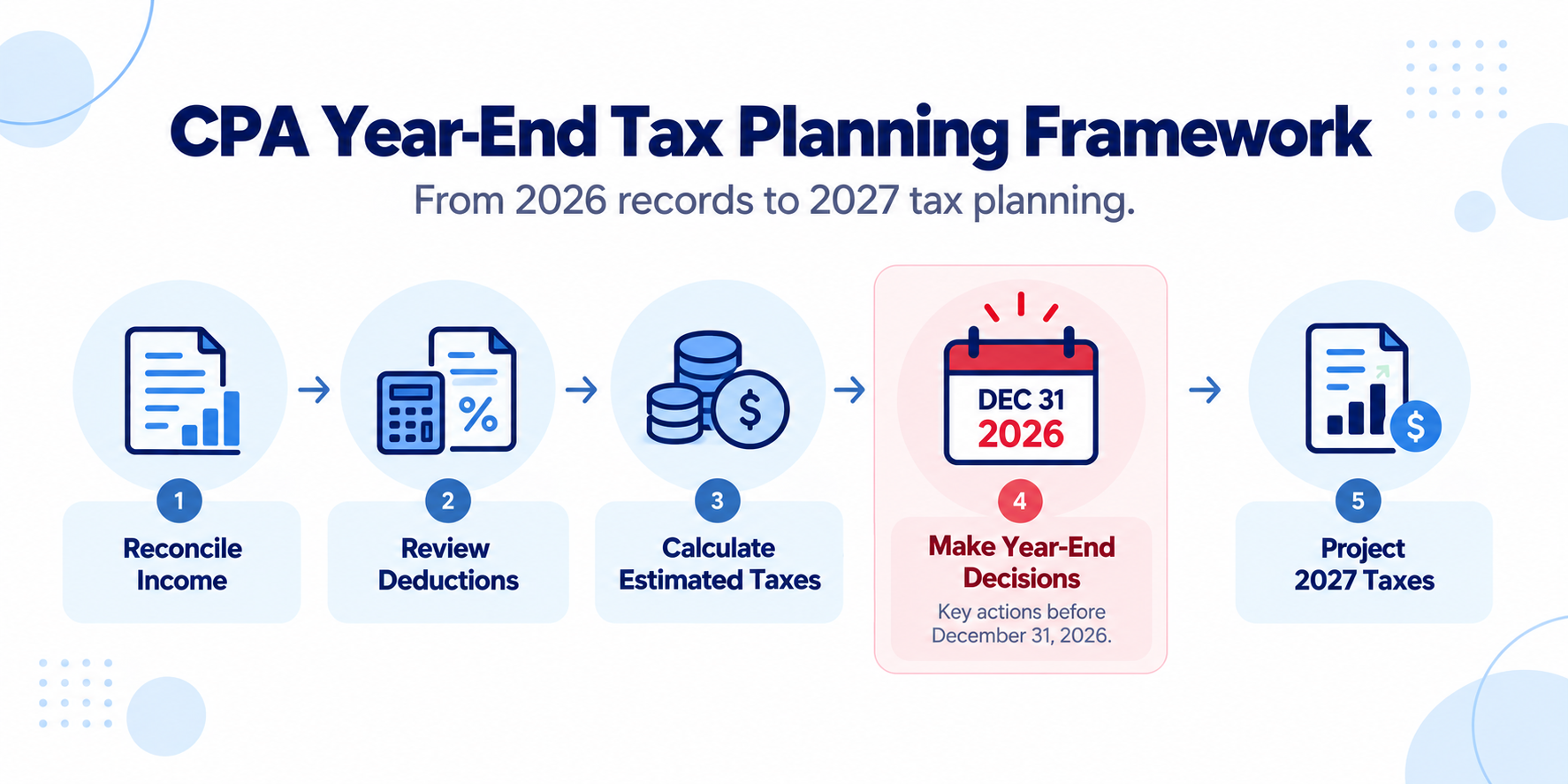
The immediate planning opportunity is the remaining part of 2026.
Accounting teams should prioritize five activities:
- Review projected 2026 taxable income: Reconcile year-to-date earnings, business profits, and anticipated bonuses against confirmed 2026 brackets.
- Evaluate deduction timing: Compare allowable 2026 itemized deductions against the standard deduction before deciding whether year-end payments are advantageous.
- Review business expenses: Identify unreconciled transactions, potentially deductible expenses, and missing documentation before closing December accounts.
- Check estimated payments: Compare projected tax liabilities with withholding and estimated tax payments to identify possible shortfalls.
- Prepare separate 2027 projections: Update planning models once official IRS inflation adjustments are released.
These tasks depend on reliable accounting records rather than tax software calculations alone.
How SafeBooks Supports CPA Firms With Year-End Accounting
Tax planning becomes more difficult when financial records are incomplete or reconciliations remain outstanding.
For example, during November and December, an offshore accounting team can assist with transaction classification, account reconciliations, expense documentation, and preparation of financial schedules.
In January, the same structured workflow can support bookkeeping cleanup, workpaper preparation, and resolution of outstanding accounting exceptions.
SafeBooks Global provides offshore bookkeeping and accounting services and tax preparation support for U.S. CPA firms.
This allows internal professionals to focus on tax planning, technical review, and client advisory responsibilities while routine accounting preparation follows established procedures.
Final Takeaway
The projected 2027 tax brackets offer an early reference for future tax planning, but the more immediate opportunity is preparing clients for the December 31, 2026 year-end.
CPA firms should use confirmed 2026 figures for current-year decisions and incorporate official 2027 adjustments once published.
Accurate financial records and timely reconciliations provide the foundation for both.
Contact SafeBooks Global to discuss offshore accounting and tax preparation support for your CPA practice.