How CPA Firms Cut 1040 Prep Time Without Sacrificing Accuracy
The 2027 filing season is approaching, and CPA firms have a limited window to improve their Form 1040 workflows before January.
Adding more preparers may seem like the obvious solution. But if completed returns sit in review queues or staff spend hours organizing documents, additional preparation capacity will not solve the problem.
SafeBooks Global’s published case studies demonstrate two different approaches: one firm improved preparation speed through AI-assisted document handling, while another expanded review capacity to clear a high-volume backlog.
The lesson is straightforward: faster 1040 preparation requires removing delays without removing quality controls.
Where CPA Firms Lose Time During 1040 Preparation
The biggest delays often happen outside tax calculations.
Workflow stage | Common bottleneck | Improvement |
Client intake | Missing W-2s, 1099s, or K-1s | Document completeness checks |
Preparation | Manual sorting and data entry | Automated document extraction |
Review | Completed returns awaiting approval | Complexity-based assignments |
Corrections | Repeated clarification requests | Standardized exception tracking |
Firms should measure where returns wait before adding more preparation capacity.
1. Standardize Intake Before Preparation Begins
Incomplete client documents create repeated interruptions.
A return involving only W-2 income should not require the same intake checklist as one involving rental properties, investments, and partnership income.
A structured process should identify missing documents, compare current-year records with prior-year information, and establish a clear ready-for-preparation status.
Due diligence checks should also begin at intake.
For returns involving EITC, CTC, ACTC, ODC, AOTC, or head-of-household claims, preparers should collect relevant information and flag inconsistencies early to support Form 8867 compliance.
This reduces the chance of reviewers discovering unresolved eligibility questions near the filing deadline.
2. Use AI to Reduce Document Handling
SafeBooks’ first case study involved a Texas enrolled agent practice migrating from Canopy to TaxDome and Juno AI.
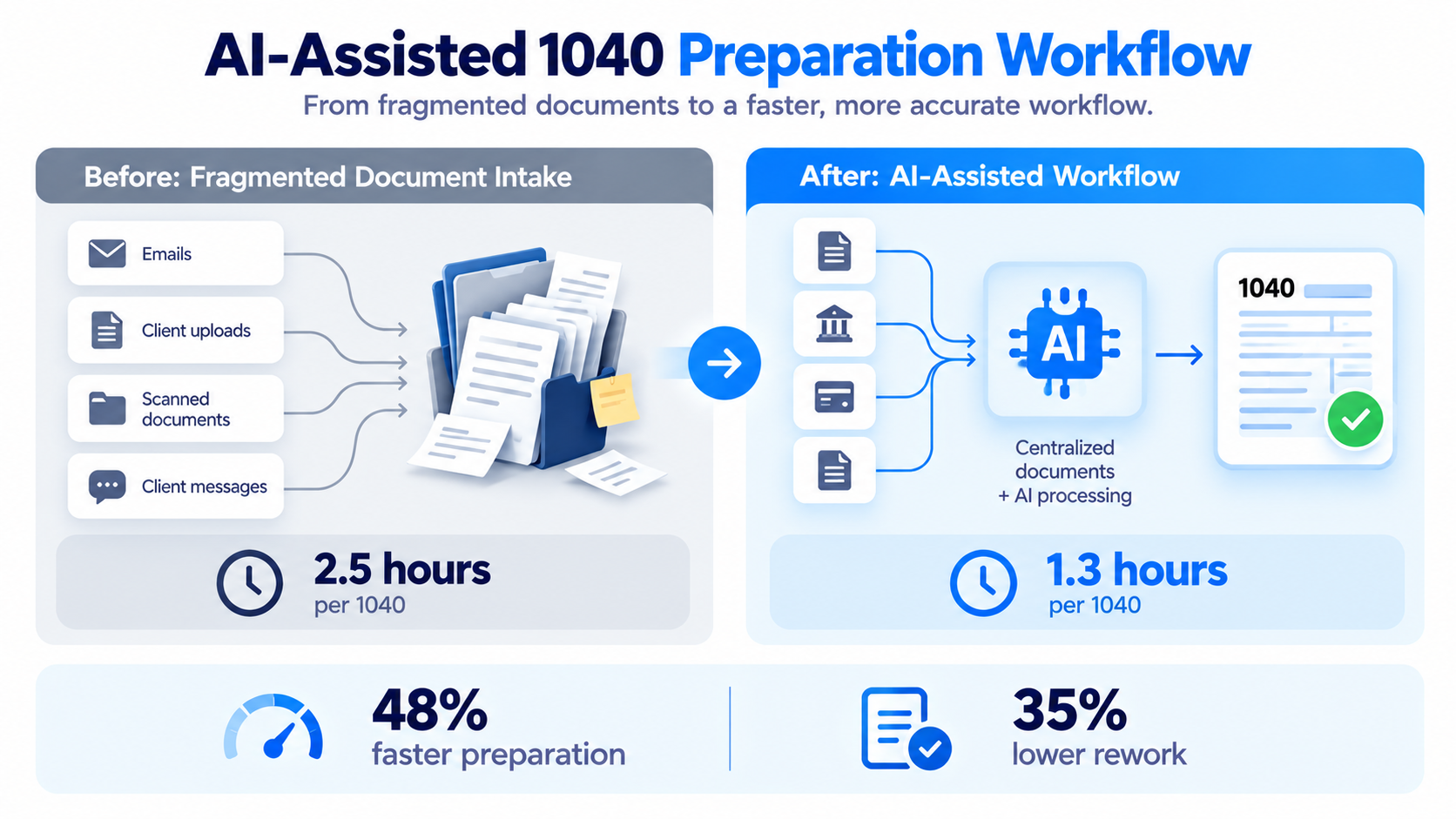
Before migration, staff spent approximately 30–60 minutes organizing documents before beginning preparation.
SafeBooks mapped existing workflows, centralized document intake, configured automated reminders, and introduced AI-assisted document organization and extraction.
The firm also tested 20 returns across both systems, including ten using Juno AI.
Results From the TaxDome and Juno AI Engagement
Metric | Before | After |
Average 1040 preparation time | 2.5 hours | 1.3 hours |
Error-driven rework | Baseline | 35% reduction |
EA’s peak-season weekly hours | Approximately 80 | 60–65 |
Preparation time decreased by 48%, saving approximately 1.2 hours per return.
The published case study attributes the improvement largely to AI-assisted document organization and data extraction, supported by centralized workpapers and redesigned workflows.
The results reflect this particular engagement, not a guaranteed outcome across other firms.
Read the SafeBooks TaxDome and Juno AI case study.
3. Match Review Capacity to Return Complexity
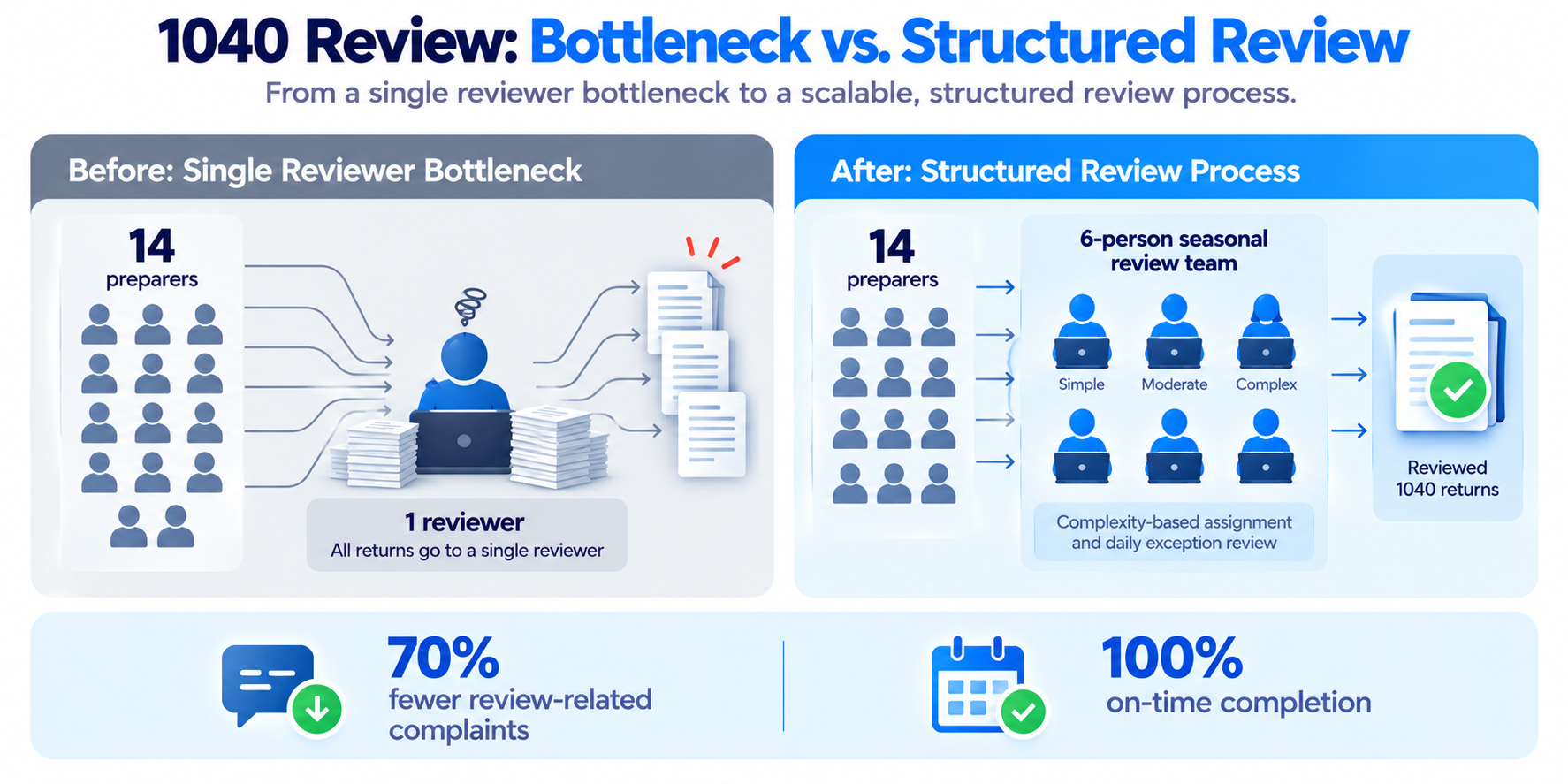
SafeBooks’ second case study involved a different high-volume 1040 firm processing approximately 1,800 returns during a compressed 10-week period.
The firm had 14 preparers but only one junior reviewer.
Preparation continued, while completed returns accumulated in the review queue.
SafeBooks introduced complexity-based assignments, real-time queue visibility, and a six-person seasonal review team operating for 12 weeks.
Daily review meetings helped resolve exceptions and escalate complex returns.
Results From the High-Volume Review Engagement
- Approximately 70% reduction in client complaints related to review delays.
- 100% of returns completed on time, the firm’s first fully on-time season in five years.
- Two SafeBooks reviewers requested for year-round retention after the engagement.
The case study does not publish the percentage of returns in each complexity category or a numerical reduction in review turnaround time.
Its measurable outcome was improved review completion and fewer client complaints.
Read the SafeBooks high-volume 1040 review case study.
4. Measure Preparation and Review Separately
CPA firms should track preparation hours, review turnaround, rework rates, and returns awaiting client information.
The two SafeBooks cases demonstrate why these measures should remain separate.
The AI migration engagement reduced preparation time by 1.2 hours per return. Applying that rate to 1,800 returns would represent 2,160 potential hours, but that is only an illustrative calculation, not a combined outcome from the two case studies.
For internal performance targets, firms should establish a baseline and track whether improvements reduce errors and review delays.
5. Protect Taxpayer Information in Offshore Workflows
Offshore preparation introduces additional confidentiality requirements.
Under IRC Section 7216 and its regulations, disclosing taxpayer return information to a preparer outside the United States generally requires appropriate taxpayer consent before disclosure.
Even remote viewing of taxpayer information can constitute disclosure.
CPA firms should confirm compliant consent procedures, secure software access, role-based permissions, and restrictions on transmitting taxpayer identification information.
Security measures do not replace the need for applicable consent.
How SafeBooks Supports Faster 1040 Workflows
SafeBooks Global supports US CPA firms through offshore tax preparation services and structured review support.
Its published engagements illustrate two practical operating models.
One involved reorganizing intake and preparation through TaxDome and Juno AI. The other introduced seasonal review capacity, complexity-based assignments, and daily coordination.
In both cases, work was organized around the firm’s existing tax preparation responsibilities, with US professionals retaining appropriate technical oversight and final filing authority.
Final Takeaway
CPA firms preparing for 2027 should identify whether their main constraint is document intake, preparation, or review.
The right improvement depends on where returns lose time.
Before January, measure preparation and review performance separately, pilot one workflow improvement, and verify that accuracy remains consistent.
Contact SafeBooks Global to discuss offshore 1040 preparation and review support.