Accounting firms are not short of outsourcing options.
The harder decision is choosing the model that fits the way the firm actually works.
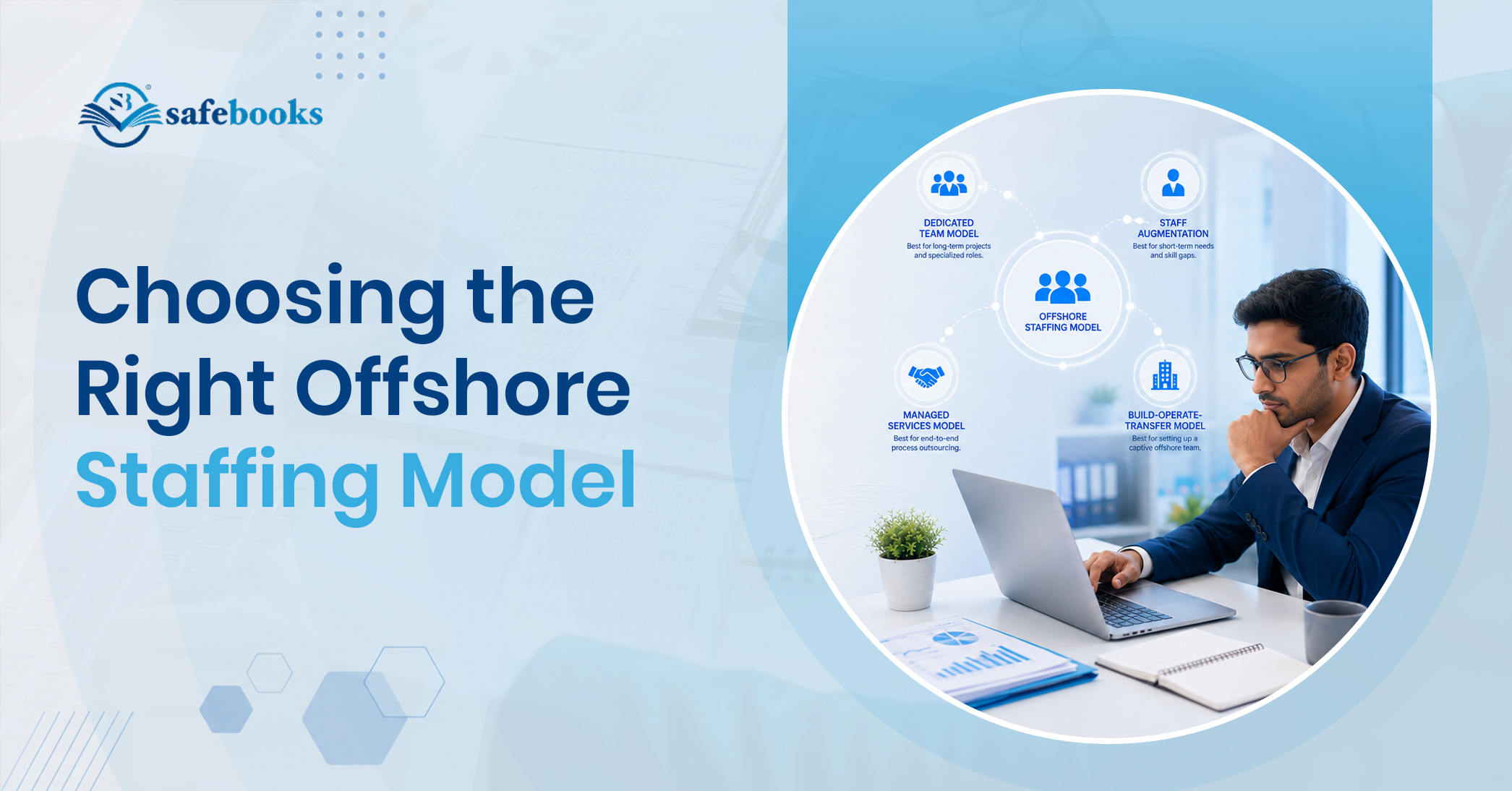
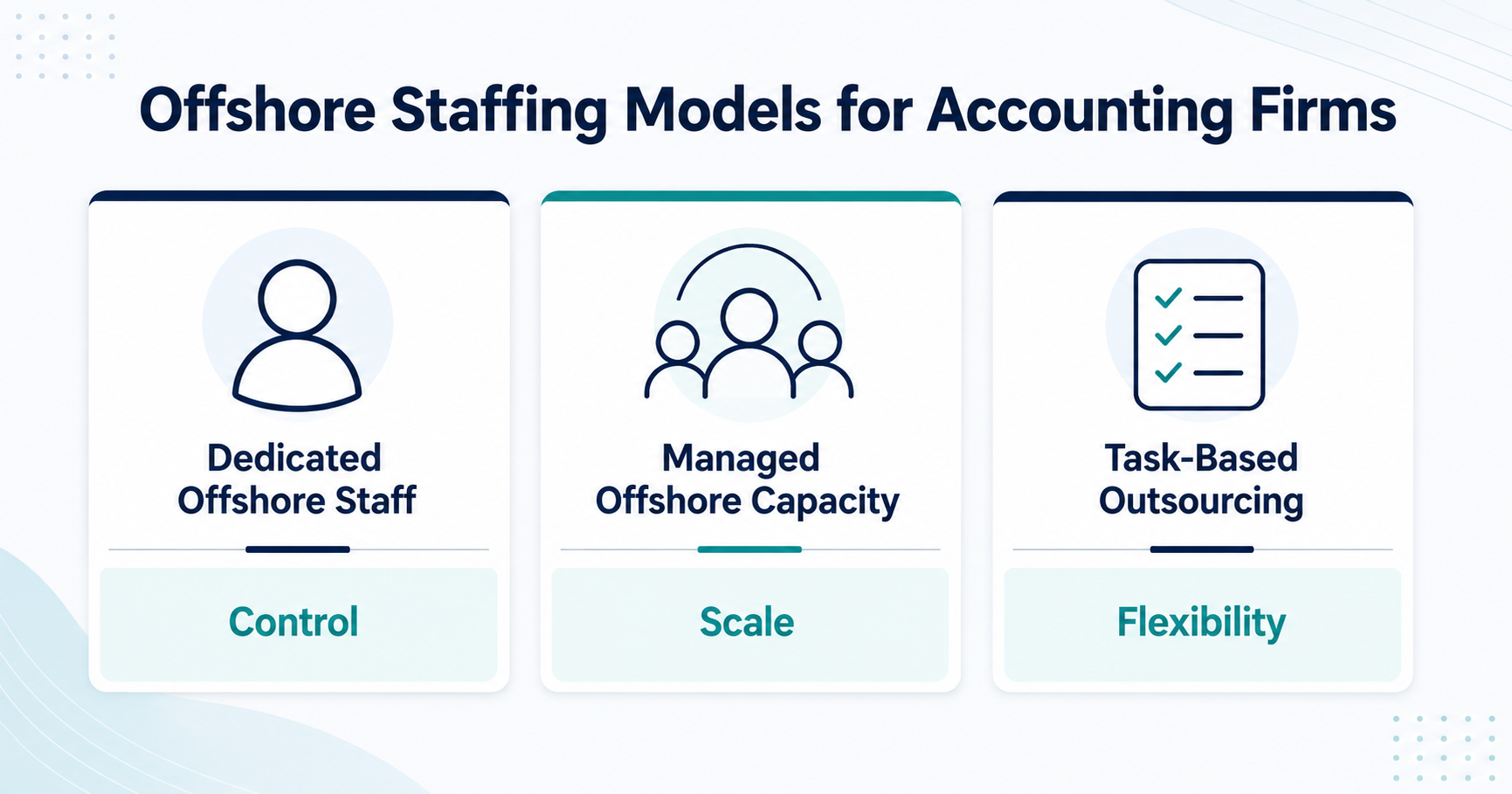
Some firms need dedicated offshore accountants who become part of their daily workflow. Others need managed offshore capacity with team leads, review coordination, and scalable support. Some firms only need task-based outsourcing for tax season overflow, bookkeeping cleanup, or defined backlogs.
This decision has become more important as firms face steady demand and a tight talent pipeline. The AICPA reported that accounting bachelor’s and master’s degree completions fell to 55,152 in the 2023-24 academic year, down 6.6% from the prior year. The Bureau of Labor Statistics also projects 5% growth for accountants and auditors from 2024 to 2034, with about 124,200 openings each year on average. (AICPA & CIMA)
For accounting firms, offshore staffing should be treated as an operating model decision. The right choice depends on workload pattern, review control, internal SOPs, security requirements, and how much management time the firm can commit.
Key Takeaway: Which Offshore Staffing Model Should Accounting Firms Choose?
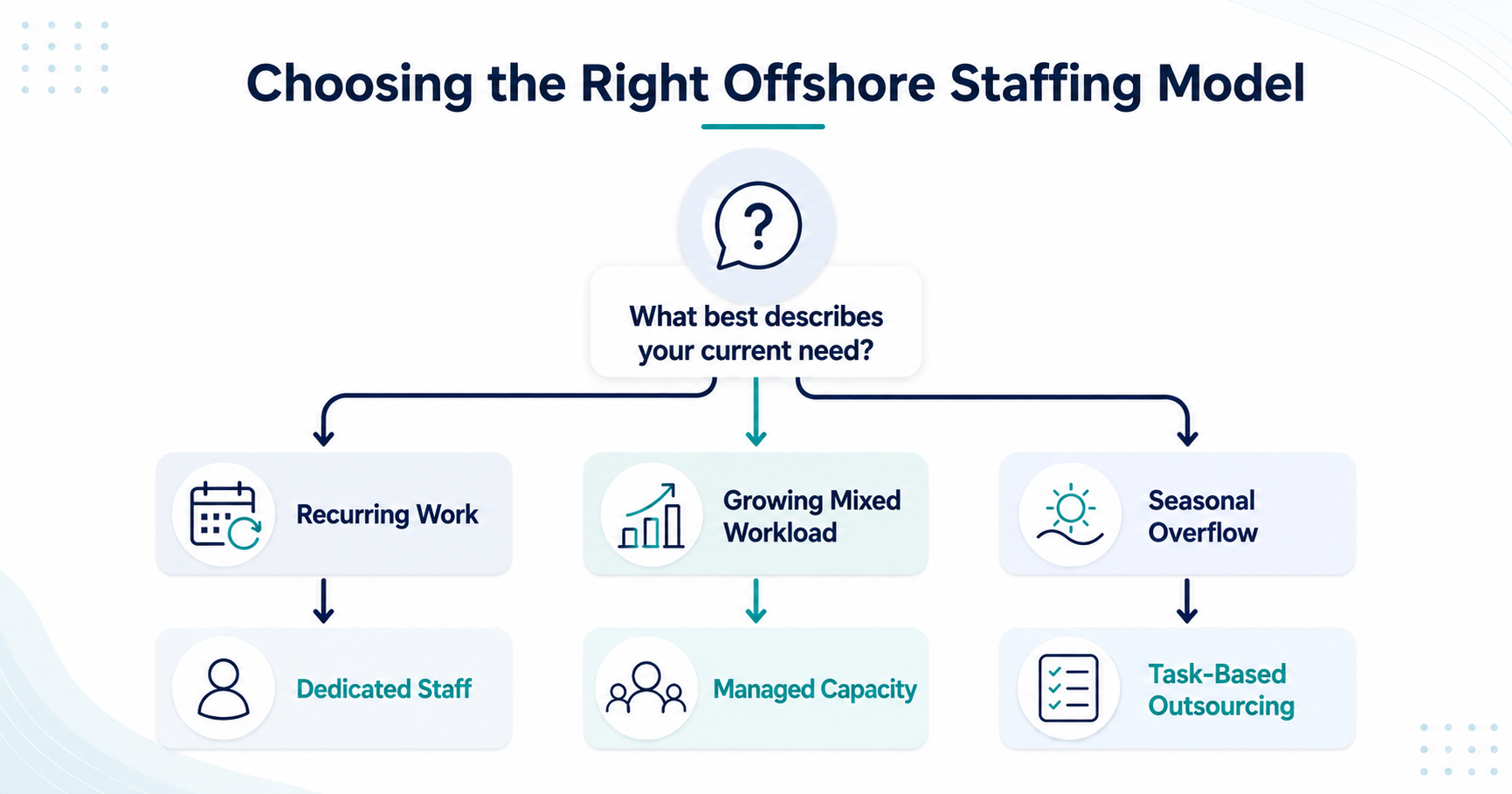
Dedicated offshore staff works best for recurring work and direct control. Managed offshore capacity works best when firms need a structured offshore team with supervision, workflow coordination, and flexible scale. Task-based outsourcing works best for seasonal overflow, simple backlogs, or clearly defined deliverables.
The best model is the one that gives the firm usable offshore capacity without increasing review pressure.
Model 1: Dedicated Offshore Staff
In the dedicated staff model, an offshore accountant works regularly with your firm, usually full-time or part-time. They learn your clients, tools, SOPs, naming conventions, review style, and communication expectations.
This model works well for recurring bookkeeping, monthly close support, AP/AR support, payroll support, tax preparation support, audit documentation, and back-office accounting tasks.
The biggest advantage is continuity. A dedicated offshore accountant becomes familiar with recurring client issues and how your firm wants work prepared. Over time, this can reduce repeated explanations and improve review readiness.
The trade-off is management effort. Your firm still needs to assign work, provide feedback, review output, and maintain clear SOPs. If the internal workflow is unclear, a dedicated offshore accountant may stay busy without becoming effective.
This model fits firms that want offshore team members to operate as an extension of the internal team.
Model 2: Managed Offshore Capacity
Managed offshore capacity is different from hiring one offshore accountant.
Here, the provider supplies a structured team or pod with supervision, workflow coordination, quality checks, and backup support. The firm is not only buying staff hours. It is buying managed delivery capacity.
This model works well for firms with growing client volume, mixed workloads, tax season pressure, recurring bookkeeping work, or multi-client CAS support. It is useful when partners and managers need capacity but do not want every detail of team management sitting internally.
A strong managed offshore accounting team may include team leads, defined SLAs, status reporting, review checkpoints, and escalation rules. Some firms use a transition approach where the provider first shadows existing workflows, then performs work under supervision, and then takes over defined workstreams once the process is stable.
The risk is unclear scope. If the firm does not define deliverables, review standards, timelines, and approval boundaries, managed capacity can still become messy.
For firms building distributed workflows, SafeBooks’ guide on remote accounting workflow setup is a useful supporting resource.
Model 3: Task-Based Outsourcing
Task-based outsourcing is the most flexible model.
The firm sends specific work to a provider on a per-file, per-return, per-reconciliation, per-project, or hourly basis. This works well for seasonal overflow, simple reconciliations, one-time cleanup projects, backlog support, or defined tax preparation volume.
The benefit is low commitment. A firm can test offshore support without building a long-term team structure.
The downside is continuity. Since the same person may not always work on the same client, the provider may not build client context. This can create repeated questions, inconsistent workpapers, or more manager review time.
Task-based accounting outsourcing works best when the work is standardized, low judgment, and easy to review.
Offshore Staffing Model Comparison
Factor | Dedicated Offshore Staff | Managed Offshore Capacity | Task-Based Outsourcing |
Best for | Recurring work and direct control | Scaling with structure and supervision | Seasonal overflow or defined tasks |
Pricing predictability | Fixed monthly staff cost | Monthly or capacity-based | Variable, per-task or hourly |
Typical rate range | Often lower per hour, depending on seniority | Usually priced as a managed pod or capacity block | Often higher per hour for flexibility |
Continuity | High | Medium to high | Lower |
Firm management effort | Higher | Shared with provider | Lower at first, higher if rework appears |
Review control | Strong if SOPs are clear | Strong with SLA and QC layer | Variable |
Main risk | Poor internal management | Vague scope boundaries | Quality variance and context loss |
Cost Is Not Just the Rate
Cost matters, but the cheapest model is not always the most efficient.
The research reference shows common offshore rate ranges can vary widely by model, seniority, and geography, with dedicated staff often priced differently from managed pods or task-based support. Task-based outsourcing can appear cheaper because the firm pays only for assigned work, but the real cost rises if managers spend extra time correcting files or explaining client context again.
Dedicated staff may create a predictable monthly cost. Managed capacity may carry a more structured fee, but it can reduce internal management burden. Task-based outsourcing may help during peak periods, but it can create review friction if the output is inconsistent.
Firms should compare hourly rate, internal review time, onboarding effort, software access, security setup, rework, and continuity before choosing a model.
Geography Also Affects the Model
India is often preferred for technical depth, accounting scale, tax support, bookkeeping, audit support, and back-office workflows. The time-zone gap can work well for overnight production, but it requires clear handoffs.
The Philippines is often chosen for English fluency, cultural alignment, and communication-heavy support roles.
Latin America can be useful when firms need nearshore time-zone overlap and same-day collaboration, although the available accounting talent pool may be smaller for U.S. tax and GAAP-specific work.
The right geography depends on whether the firm needs production capacity, communication overlap, or both.
Security and Compliance by Staffing Model
Security expectations should not change based on the model.
Accounting firms should use MFA, role-based access, secure portals, audit logs, restricted file permissions, and separate preparation and approval rights. Shared logins and email attachments should be avoided. The FTC Safeguards Rule requires financial institutions under FTC jurisdiction to protect customer information and implement multi-factor authentication unless an approved equivalent control is used. (Federal Trade Commission)
For tax-related offshore work, IRS Section 7216 becomes important when tax return information is disclosed or used by tax return preparers. Firms should review consent requirements before sending individual tax return information offshore. The IRS maintains a Section 7216 information center covering disclosure and use of tax return information by tax return preparers. (IRS)
A stronger offshore setup should also fit into the firm’s written information security plan. That means controlled access, secure VPN or remote desktop environments, no local file saving, disabled USB or print options where applicable, staff NDAs, activity logs, and incident response procedures.
SafeBooks explains its secure remote workflow approach in its blog on how SafeBooks protects client financial data.
Where Each Model Can Go Wrong
Dedicated staff can fail when the firm expects the offshore accountant to figure out the workflow alone. Without SOPs, task ownership, and manager feedback, direct control does not automatically create quality.
Managed capacity can fail when the scope is vague. The provider may supply a capable team, but unclear deliverables and weak review expectations can still create bottlenecks.
Task-based outsourcing can fail when the work needs client context. If every task is treated as a separate transaction, the firm loses continuity and managers may spend more time reviewing.
This is why offshore capacity for CPA firms should be designed around workflow maturity, not just workload volume.
Where SafeBooks Fits Into Offshore Staffing
SafeBooks Global helps accounting firms choose offshore support models around how their work actually moves.
For recurring work, SafeBooks can support dedicated offshore accounting capacity across bookkeeping, tax support, audit support, and back-office workflows. For firms that need structured scale, SafeBooks supports managed workflows with clear roles, review-ready output, and secure delivery. For firms with defined overflow needs, SafeBooks can support specific workstreams without forcing a one-size-fits-all structure.
Accounting firms can explore SafeBooks’ support for accounting firms, bookkeeping and accounting, tax support, audit support, and back-office support.
Expert Insight
“The right offshore model depends on how the firm wants to control work. Dedicated staff gives continuity, managed capacity gives structure and scale, and task-based outsourcing gives flexibility. The mistake is choosing based only on cost instead of matching the model to the firm’s workflow and review process.“
Shivangi Agrawal
Managing Director, CA, CPA (USA), SafeBooks Global
Choose the Model That Protects Review Control
Dedicated staff gives control and continuity. Managed capacity gives structure and scale. Task-based outsourcing gives flexibility for defined work.
The best model is the one that helps your firm complete more work without weakening review quality, client trust, or data security.
If your firm is comparing offshore staffing models, contact SafeBooks Global to discuss which structure fits your current workload and growth plans.