The Profession Keeps Talking About Advisory, But Who Is Doing the Compliance Work?
Every accounting firm wants to move toward advisory.
That makes sense. Advisory services are more strategic, more valuable, and more closely connected to client decision-making. Firms want to help clients with cash flow, growth planning, tax strategy, financial visibility, and operational decisions.
But there is one question many firms avoid:
Who is doing the compliance work underneath?
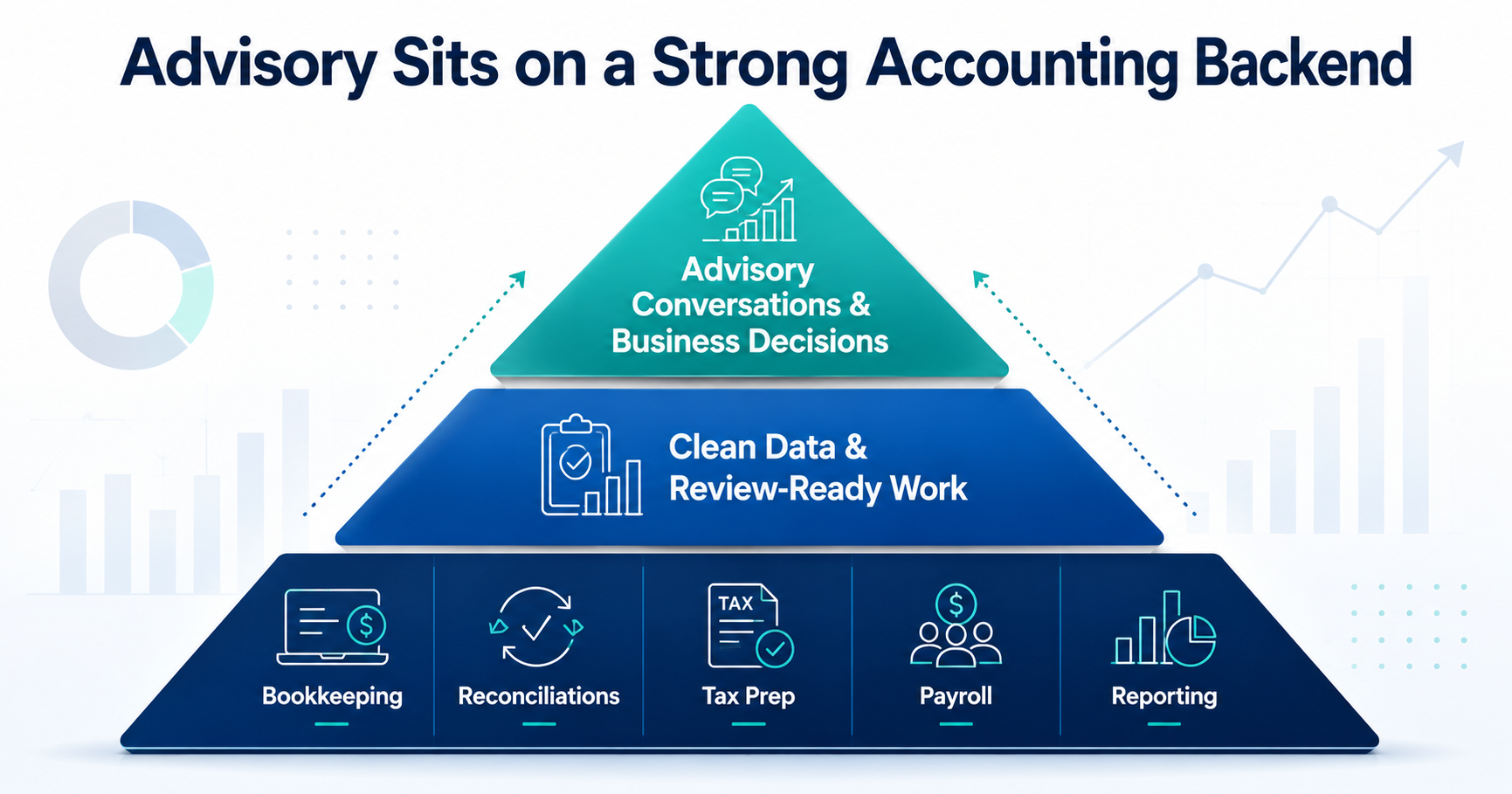
Advisory does not run on strategy decks. It runs on clean books, accurate tax prep, timely reconciliations, complete workpapers, reliable reporting, and organized client data.
Industry data shows why this matters. The 2024 CPA.com and AICPA PCPS CAS Benchmark Survey reported that CAS practices had a 17% median growth rate and projected 99% median growth over the next three years. Advisory is clearly a growth opportunity, but that growth still depends on a stable backend. (CPA.com)
Advisory is not a replacement for compliance.
Advisory sits on top of compliance.
Advisory Breaks When the Backend Is Not Ready
The phrase “moving beyond compliance” is useful, but it can also be misleading.
A firm cannot advise on cash flow if monthly books are delayed. It cannot guide tax planning if tax prep is rushed. It cannot advise on margins if reconciliations are inconsistent. It cannot support growth decisions if reporting is not trusted.
The advisory conversation is only as strong as the financial information behind it.
When bookkeeping, tax preparation, payroll, sales tax, reconciliations, and reporting are unstable, partners do not have the confidence or time needed to guide clients properly.
This is why advisory services often do not fail because the strategy is weak. They fail because the backend is still chaotic.
The Invisible Work That Blocks Advisory Capacity
Most firms do not struggle with the idea of advisory. They struggle with the capacity to deliver it.
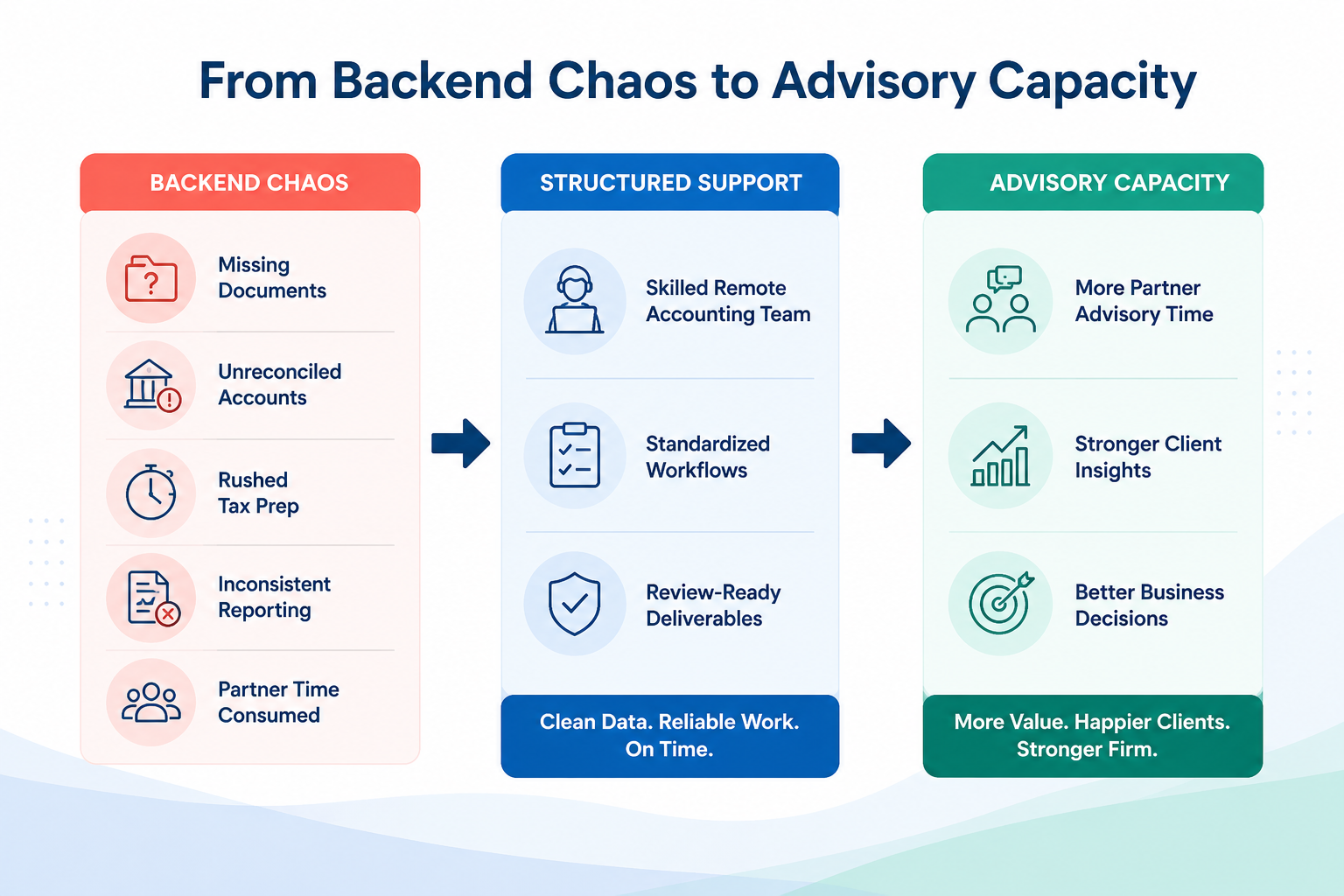
Partners want to spend time on client conversations, planning, and insight. But they are often still pulled into review bottlenecks, cleanup work, missing documents, unresolved reconciliations, and rushed reporting.
The problem usually starts in the backend.
Client documents arrive late or incomplete. Bank accounts are not reconciled on time. Workpapers are not review-ready. Tax prep support comes too close to deadlines. Monthly reports require too many corrections.
By the time the advisory meeting arrives, the partner is not preparing strategic insights. They are still trying to confirm whether the numbers are reliable.
This is the invisible work problem. It does not always show up as a separate line item, but it quietly consumes advisory capacity.
The Compliance Work Still Has to Get Done
Accounting firms cannot skip the work that makes advisory possible.
The backend includes recurring, necessary work such as bookkeeping, reconciliations, AP and AR support, payroll records, sales tax filing, tax prep support, audit support, reporting packs, document follow-up, and workpaper preparation.
None of this work sounds as attractive as advisory.
But without it, advisory becomes vague.
A client does not need a cash flow conversation based on outdated numbers. They need reliable books first. They do not need a tax planning discussion built on incomplete records. They need clean tax prep support first. They do not need a KPI dashboard if the source data is wrong. They need reconciled accounts first.
This is why compliance work should not disappear from the conversation. It needs to be organized, delegated, reviewed, and delivered with consistency.
SafeBooks supports this layer through back-office support for accounting firms, bookkeeping and accounting support, and tax support for accounting firms.
Senior Talent Should Stay Focused on Judgment
CPA firms are under pressure to grow advisory revenue, but senior professionals are often still reviewing basic work, cleaning up reconciliations, chasing documents, and fixing reporting gaps.
That creates a hidden capacity problem.
Every hour a partner or senior manager spends repairing backend issues is an hour not spent on planning, client conversations, or advisory decisions.
That does not mean backend work is low-value. It means it should be handled at the right level, with the right process, before it reaches senior review.
A practical way to think about this is simple:
Work Type | Best Fit |
Repetitive, rules-based work | Automate where possible |
Recurring accounting and compliance support | Delegate to trained support teams |
Review, interpretation, and client strategy | Keep with senior professionals |
This protects advisory capacity without weakening quality.
Automation Helps, But It Does Not Replace the Backend
Automation can support advisory growth, but only when the process is already structured.
Tools can help with document collection, transaction matching, reporting, workflow tracking, and dashboard creation. But automation cannot fix unclear ownership, poor client follow-up, inconsistent reconciliations, or weak review standards.
The firms that scale successfully do not rely on technology or people in isolation. They build a hybrid backend.
Routine, rules-based work is automated where possible. Recurring compliance and accounting support is handled through trained teams. Senior professionals stay focused on review, interpretation, tax planning, client strategy, and advisory decisions.
This connects directly with the broader AI conversation in accounting. Firms do not get better advisory simply by adding more software. They get better advisory when software supports a clean operating model.
Where Structured Remote Teams Fit In
Remote accounting teams can help firms protect advisory capacity, but only when they are used in the right way.
They should not be treated as basic task execution support. A strong remote team should understand workflows, documentation standards, review expectations, client follow-up, and the systems used by the firm.
When structured properly, remote teams can support bookkeeping, reconciliations, tax prep support, reporting, workpaper preparation, client follow-ups, and other recurring backend work. This helps partners and senior staff focus on review, client conversations, planning, and advisory.
The key is structure.
Without clear workflows, remote support can create the same problems firms already have. With clear workflows, checklist-driven processes, and review-ready deliverables, remote teams become a practical layer of advisory capacity.
SafeBooks has also discussed the importance of building reliable remote accounting workflows before scaling distributed teams.
Expert Insight
“Advisory becomes difficult when the backend is unstable. Partners need clean books, timely reconciliations, accurate workpapers, and reliable reporting before they can have meaningful advisory conversations. The firms that scale advisory well are usually the firms that first create operational discipline behind the scenes.”
Shivangi Agrawal, Managing Director (CA, CPA USA), SafeBooks
Advisory Success Starts Behind the Scenes
The profession is right to talk about advisory. Clients need more than historical reporting. They need guidance, planning, and better financial visibility.
But advisory cannot be built on a weak backend.
The firms that scale advisory successfully are not only better at strategy. They are better at operations. They know how to separate recurring work from senior judgment. They know how to create review-ready outputs. They know how to use automation without losing control. They know how to build teams that protect partner capacity.
Advisory growth is not only a front-office opportunity.
It is a backend discipline.
For CPA firms ready to create stronger backend capacity, SafeBooks helps build structured remote accounting teams that support bookkeeping, reconciliations, tax prep support, reporting, and review-ready workflows. To discuss how this could support your firm, contact SafeBooks.