
When Fast Growth Outruns Financial Clarity
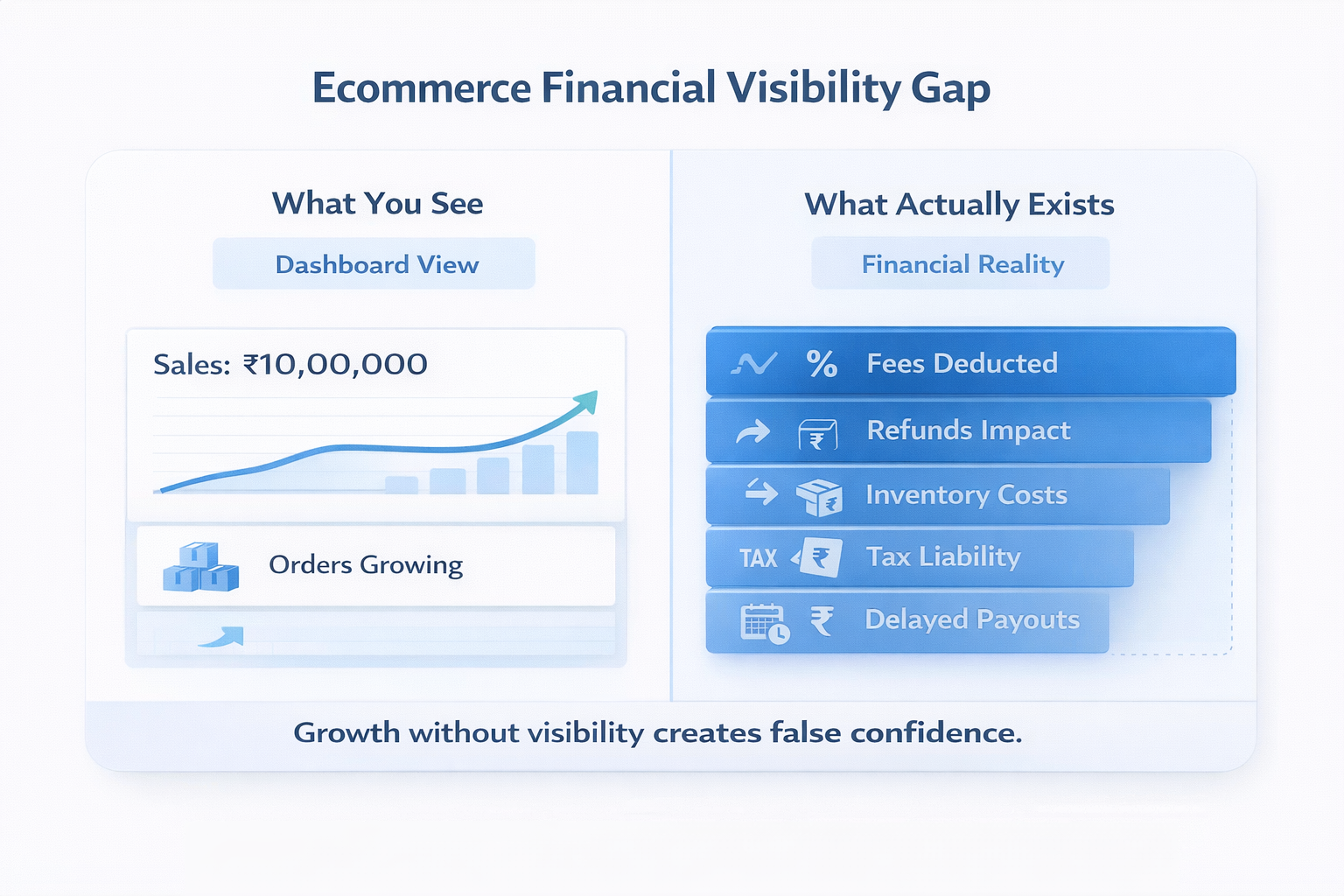
Many ecommerce brands grow fast, but their books do not keep up.
Sales increase. Orders flow in. Dashboards show momentum. But behind that growth, financial clarity starts slipping. What looks like a profitable business often hides margin gaps, tax exposure, and cash flow pressure underneath.
This is where most ecommerce accounting mistakes begin.
When Platform Deposits Replace Real Revenue Tracking
A common pattern in ecommerce bookkeeping errors is relying on platform payouts as the source of truth.
When a deposit hits your bank, it feels like revenue. But that number is already reduced by fees, refunds, and adjustments. What reaches your bank is only the final outcome, not the full transaction.
Example:
If Shopify pays you ₹50,000 after deducting ₹10,000 in fees and ₹5,000 in refunds, your actual sales were ₹65,000, not ₹50,000.
Recording deposits as revenue hides the structure of your business. It removes visibility into:
- how much you actually sold
- what you paid in fees
- how refunds are impacting margins
This same mismatch shows up across systems and is explained in this POS reconciliation guide.
A better approach is to separate gross revenue, deductions, and payouts clearly. This is typically built through structured workflows within ecommerce bookkeeping systems.
Why Incomplete Product Costing Breaks Margin Accuracy
Profitability in ecommerce is driven more by cost accuracy than revenue.
Most businesses track supplier cost but ignore everything else required to get the product ready to sell. Freight, duties, and packaging quietly increase the actual cost per unit.
Example:
A product purchased for ₹500 may end up costing ₹700 after shipping and duties. If you price based on ₹500, your margin assumptions are immediately wrong.
This creates a ripple effect. Pricing decisions, ad spend, and discounting strategies all get built on incorrect numbers.
To avoid this, businesses need to track landed cost, not just purchase price. This level of clarity is a key outcome of properly implemented accounting systems for online businesses.
The Cash Accounting Trap in High-Volume Ecommerce
Cash accounting works in the early stages because it is simple. But simplicity becomes a limitation as transaction volume increases.
In ecommerce, revenue and cash do not move together. Sales happen instantly, but payouts are delayed. Inventory is purchased upfront, but revenue is realized later.
Example:
You invest ₹10 lakh in inventory this month and record a loss. Next month, you sell those products and show a profit, even though both events are part of the same business cycle.
This creates distorted performance tracking.
Accrual accounting solves this by aligning:
- revenue with the cost of generating it
- financial reporting with actual business activity
This shift is essential for businesses that want reliable financial insights, not just bank-based tracking.
When Reconciliation Is Skipped, Numbers Stop Matching
Ecommerce operations run across multiple systems. Orders, payments, and deposits are all recorded separately.
Without reconciliation, these systems drift apart.
What starts as a small mismatch becomes a larger issue over time. Missing entries, duplicate transactions, and unrecorded fees begin to impact reporting accuracy.
High-growth businesses usually build a reconciliation rhythm:
- weekly checks for transaction-heavy stores
- monthly closing for structured reporting
Many also rely on tools like A2X or Webgility to map platform data into accounting systems. Combined with automated accounting workflows, this reduces manual dependency and improves accuracy.
Why These Mistakes Compound Faster Than You Expect
At a small scale, these issues look manageable.
But ecommerce operates on volume. Even a small gap per transaction multiplies quickly.
A ₹100 mismatch across 1,000 orders becomes a ₹1,00,000 discrepancy. More importantly, decisions start getting made on incorrect data.
This is where growth becomes unstable.
Inventory Disconnect and Its Financial Consequences
Inventory is often managed operationally but not financially.
When it is not linked to accounting, businesses lose visibility into stock value and cost allocation. This affects both profitability and cash planning.
The impact is not immediate, but it is significant. Overstocking ties up capital, while stockouts reduce revenue.
A connected system ensures inventory movement updates financial reports in real time. This is often achieved through integrated setups within bookkeeping and accounting services.
Expense Classification That Hides Real Profitability
Not all expenses behave the same way, but many ecommerce businesses treat them as if they do.
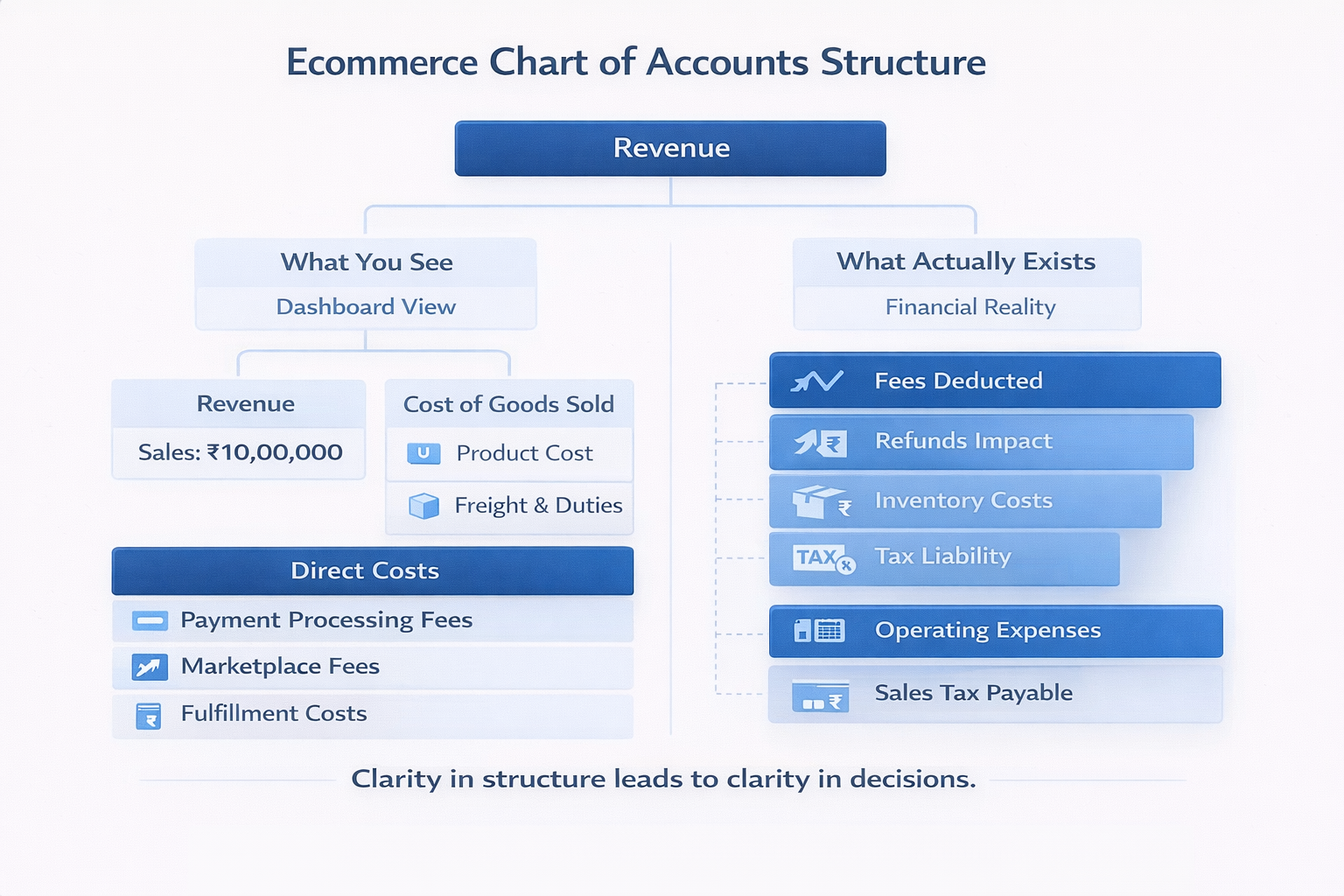
When costs are grouped broadly, it becomes difficult to understand what is driving profitability.
A clearer structure separates:
- product-related costs (COGS)
- fulfillment and platform fees
- marketing spend
- operating expenses
This level of clarity helps identify where margins are being lost and where optimization is possible.
Tax Tracking Gaps That Turn Into Liabilities
Tax handling in ecommerce is often reactive instead of structured.
As businesses expand across regions, tax obligations increase. Many jurisdictions introduce thresholds that trigger compliance requirements once sales cross a certain level.
When taxes are not tracked separately, they get mixed into revenue, creating a false sense of income.
Proper bookkeeping treats taxes as a liability. This ensures:
- accurate reporting
- better compliance
- fewer surprises during filing
When Revenue, Profit, and Cash Flow Get Confused
Revenue, profit, and cash are three different realities, but they are often treated as one.
A business can generate strong revenue and still face cash shortages. Inventory purchases, marketing spend, and payout delays all affect liquidity.
Without separating these views, decision-making becomes risky.
Tracking:
- profit through the P&L
- financial position through the balance sheet
- liquidity through cash flow
gives a complete picture of business health.
Expert Insight
“In ecommerce, most businesses don’t have a revenue problem, they have a visibility problem. When bookkeeping is not structured properly, founders end up making decisions based on incomplete numbers. That’s where margins quietly erode. Clean, accrual-based accounting isn’t just about compliance, it’s about giving the business a clear financial direction.”
Shivangi Agrawal, Managing Director (CA, CPA USA), SafeBooks
The Risk of Operating Without a Defined Bookkeeping System
Many ecommerce businesses operate without a defined system.
Transactions are recorded inconsistently. Processes change over time. There is no standard method for handling sales, fees, or inventory.
This creates long-term instability.
A structured system defines how transactions are recorded and ensures consistency as the business grows. This is where integrated solutions like ecommerce accounting and reporting systems play a critical role.
How Better Bookkeeping Directly Impacts Business Value
Clean financial data is not just operational. It is strategic.
Investors and buyers rely on accurate financials to assess risk and profitability. Businesses with structured, accrual-based records often command stronger valuation multiples compared to those with unclear data.
In many cases, the difference is not performance. It is clarity.
If your growth is ahead of your financial clarity, your numbers are already working against you. Contact us