
Why Rental Property Income Tracking Fails Without Property-Level Visibility
When rental income and expenses are not tracked by property, it becomes difficult to know which assets are performing and which ones are draining cash.
Most owners rely on total numbers such as rent collected and expenses paid. On the surface, everything looks stable.
But this approach hides performance differences between properties.
A portfolio may appear profitable while one or two properties quietly reduce returns. This is not a data issue. It is a visibility issue.
How Property-Level Income and Expense Tracking Improves Investment Decisions
Each property operates differently due to tenant quality, maintenance needs, and vacancy cycles.
When all transactions are grouped together, these differences disappear.
Tracking income and expenses per property allows you to identify which assets are consistent, which require attention, and where pricing adjustments may be needed.
This is where accounting becomes a decision-making tool instead of just a reporting function.
How to Track Rental Property Income Accurately
Tracking income goes beyond recording monthly rent.
A complete system includes rent, late fees, parking income, and utility reimbursements. These additional income streams often determine whether a property generates strong returns.
Security deposits must be handled separately as liabilities unless retained.
If your records do not clearly show these categories, it is worth reviewing how financial data should be organized for better visibility.
How to Track Rental Property Expenses Without Distorting Profitability
Expense tracking is where most inaccuracies occur.
Costs must be clearly assigned to each property. Repairs, insurance, and taxes should be directly linked, while shared expenses should be allocated logically.
A key distinction must also be maintained between repairs and capital improvements.
Repairs are routine expenses, while improvements add long-term value. Under the commonly referenced 30 percent rule, replacing a significant portion of a major system such as plumbing or HVAC is typically treated as a capital improvement rather than a repair.
Incorrect classification directly impacts reported profitability and tax outcomes.
Property-Level Profitability Tracking Using NOI Formula
Each property should have its own financial view.
The most important metric here is Net Operating Income.
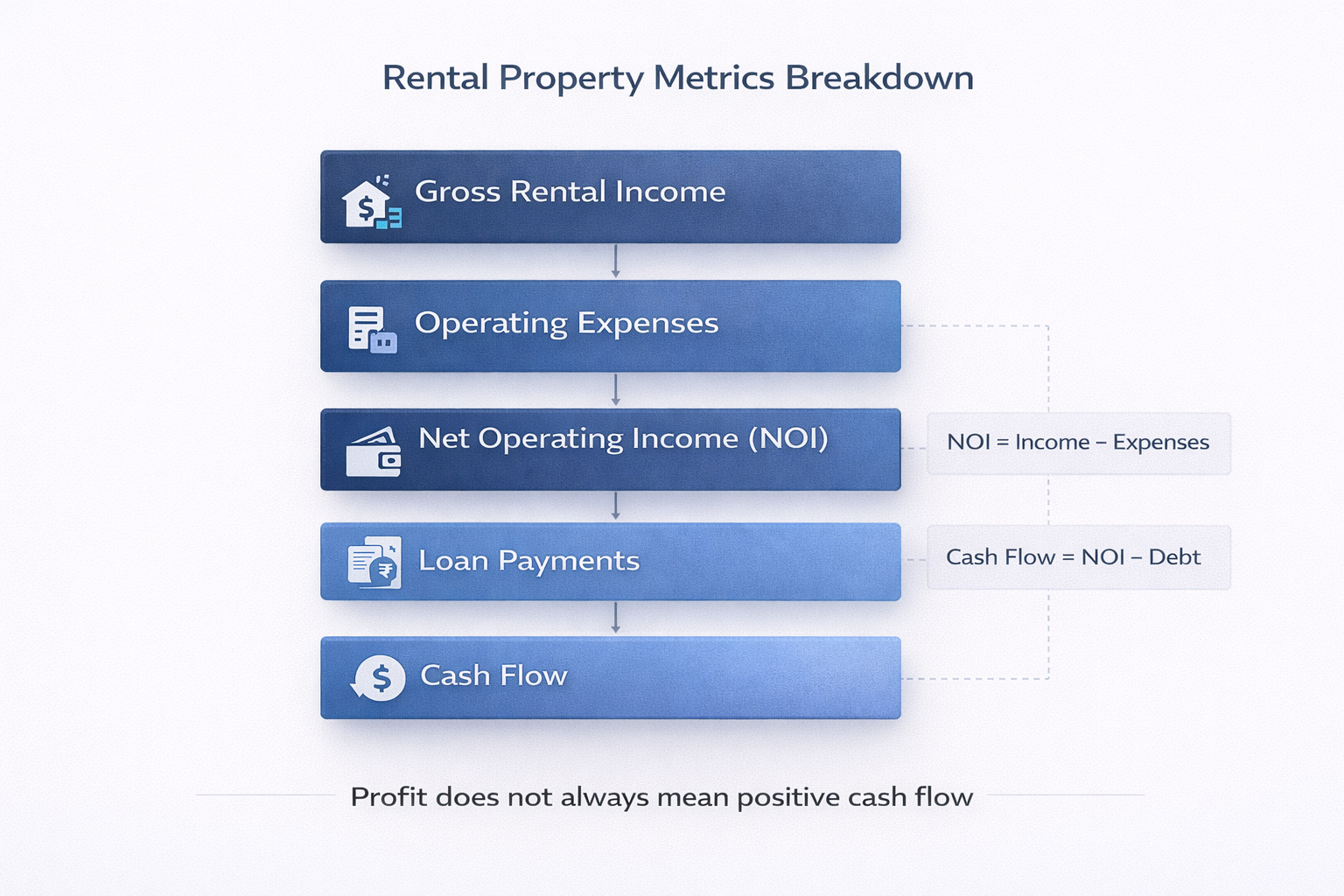
NOI = Gross Rental Income − Operating Expenses
Example
If a property generates ₹6,00,000 in rent and incurs ₹2,20,000 in operating expenses:
NOI = ₹3,80,000
This allows direct comparison between properties and highlights which assets are actually performing.
Vacancy Impact on Rental Property Income and Yield
Most rental calculations assume full occupancy, which is rarely realistic.
Table: Vacancy Impact on Annual Income
Scenario | Monthly Rent | Vacancy | Actual Annual Income |
Ideal (assumed) | ₹50,000 | 0 months | ₹6,00,000 |
Realistic | ₹50,000 | 2 months | ₹5,00,000 |
Vacancy reduces actual income and must be factored into every financial decision.
Rental Property Cash Flow vs Profit Explained
Profit and cash flow are often confused.
A property may show profit but still create financial pressure due to loan repayments and irregular expenses.
Tracking must clearly separate accounting profit from actual cash movement.
This distinction is essential for evaluating sustainability.
Monthly Reconciliation Process for Rental Property Accounting Accuracy
Tracking without verification leads to unreliable numbers.
A strong system includes regular reconciliation to ensure all transactions are recorded correctly.
For multi-property owners, a more advanced safeguard is the three-way reconciliation method:
- bank balance
- book records
- tenant-level balances
All three should match. Any mismatch indicates an issue that needs correction.
Structuring Rental Property Chart of Accounts for Better Financial Clarity
A structured chart of accounts improves how financial data is interpreted.
Instead of broad categories, transactions should be grouped into revenue, direct costs, operating expenses, and liabilities.
This creates clarity and enables better reporting across properties.
For scalable systems, understanding how structured bookkeeping systems improve financial clarity becomes important.
Key Rental Property Performance Metrics and Formulas
Tracking numbers alone is not enough. They must be interpreted.
Key metrics include:
Net Operating Income
NOI = Gross Rental Income − Operating Expenses
Expense Ratio
Expense Ratio = Operating Expenses ÷ Gross Income
Occupancy Rate
Occupancy Rate = Rented Months ÷ Total Months × 100
Cash Flow
Cash Flow = Income − All Expenses − Loan Payments
These metrics help determine whether a property is worth holding or needs intervention.
Operational Metrics That Affect Rental Property Performance
Financial results reflect outcomes, but operational metrics explain the reasons behind them.
High vacancy, frequent tenant turnover, or rising maintenance costs often indicate deeper issues.
Identifying these early helps prevent long-term losses.
Rental Property Tracking Systems and Tools for Better Accuracy
The tracking method used directly impacts reliability.
Smaller portfolios can manage with structured spreadsheets. As portfolios grow, accounting software or property management systems provide better control and automation.
Automation reduces errors and improves consistency across multiple properties.
Expert Insight
“Rental portfolios often look stable at a summary level, but the real story sits at the property level. Without structured tracking, underperforming assets go unnoticed and decisions get delayed. Clear, property-wise financial visibility is what turns real estate from passive ownership into an actively managed investment”
Anshul Agrawal, Accounts Director (CA), SafeBooks
Why Rental Property Financial Tracking Matters for Long-Term Portfolio Growth
Rental income may seem stable, but without proper tracking, it becomes unpredictable.
Clear visibility allows owners to identify weak assets, control costs, and plan investments with confidence.
This is what separates passive ownership from structured portfolio management.
If your rental portfolio is growing but your numbers still feel unclear, it is time to improve how your finances are structured.
We help property owners build systems that provide clear visibility into income, expenses, and overall performance.
Contact us to set up a tracking system that supports better financial decisions.