
Why Your Revenue Is Not What You Think It Is
In ecommerce, revenue is rarely as simple as the amount shown on the order screen.
A customer pays $50. Your dashboard shows $50. But your bank rarely receives $50.
Between that moment and the actual deposit, multiple financial layers intervene. Payment processors deduct fees. Refunds reverse transactions. Settlement timing delays cash. When all of this is combined, the number you “see” and the number you “keep” begin to drif t apart.
This gap is not an accounting error. It is how ecommerce systems are designed. While platforms like Shopify explain why payouts differ from sales, the real challenge is how to account for those differences correctly.
Ecommerce Revenue vs Cash Received Understanding the Gap
Most ecommerce platforms report gross sales. Your bank reflects net cash. The difference between the two is not noise, it is structure.
When a transaction is processed, it moves through issuing banks, card networks, and payment gateways before it reaches your account. Each layer takes a portion of the transaction value. By the time the payout is created, what remains is already reduced.
This is why ecommerce accounting is not just about recording transactions. It is about understanding movement across systems.
A similar disconnect exists in POS systems, where transaction-level sales rarely match deposits in real time, as explained in the POS reconciliation guide. The same logic applies here, just with more layers.
How Fees Actually Reduce Ecommerce Margins
Most businesses assume payment fees are straightforward. In reality, they are layered.
A typical transaction fee includes interchange paid to banks, network fees paid to card providers, and processor markup. On platforms like Shopify, additional charges may apply if external gateways are used. This creates a stacking effect that quietly eats into margins.
Consider a simplified monthly scenario:
Description | Amount |
Gross Sales | $100,000 |
Processing Fees (~2.9%) | -$2,900 |
Platform / Additional Fees | -$4,500 |
Refund Impact | -$7,000 |
Net Before Costs | ~$85,600 |
This gap is where most profitability assumptions fail.
Without structured tracking, businesses believe they are operating at higher margins than they actually are. Over time, this leads to pricing errors, incorrect forecasts, and poor financial decisions.
This is where systems built through bookkeeping and accounting services bring clarity by separating revenue, fees, and adjustments properly.
Refunds and Chargebacks Accounting Treatment Explained
Refunds are often misunderstood. They are not expenses. They are reversals of revenue.
From an accounting standpoint, refunds should be recorded as contra revenue. This ensures that revenue is not overstated on financial statements.
However, refunds create a second problem. Most payment processors do not return the original transaction fee. That fee becomes a permanent loss.
A simple example makes this clear:
Sale Transaction
- Customer pays: $100
- Fee deducted: $3
- Net received: $97
Refund Issued
- Customer refunded: $100
- Fee not returned: $3
Final Outcome
- Total loss: $3
At scale, this becomes a significant margin drain.
Chargebacks go further. They not only reverse revenue but also add penalty fees and increase risk exposure with payment processors. High chargeback rates can lead to increased fees or even account restrictions.
Payment Timing Creates Reporting Mismatch
Ecommerce operates on accrual logic. Cash operates on settlement cycles.
A sale recorded today may be deposited two to five days later. In marketplace models, this delay can extend to two weeks or more.
This creates a reporting mismatch, especially during month-end closing. Revenue may belong to one period while cash arrives in another. If not handled correctly, financial reports begin to distort actual performance.
This is one of the most common reasons ecommerce founders feel that “numbers don’t match.”
Multiple Payment Gateways Fragment Financial Visibility
As businesses grow, they rarely rely on a single payment processor.
Sales may originate from one system, but payouts arrive from multiple sources such as Shopify Payments, PayPal, and Stripe. Each follows its own settlement logic, fee structure, and payout schedule.
This fragmentation creates multiple deposits for the same pool of sales. Without consolidation, there is no unified financial view.
At this stage, basic bookkeeping stops working. Structured reconciliation becomes necessary.
Ecommerce Sales vs Payout vs Bank Deposit Comparison
Component | Sales (Order Level) | Processor / Payout Level | Bank Level |
What it shows | Total order value | Net after fees and refunds | Final cash received |
Fees | Not visible | Deducted before payout | Already reduced |
Refunds | Recorded separately | Adjusted in payout | Reflected in lower deposits |
Timing | Immediate | Delayed | Settlement-based |
Gateways | Combined | Split by processor | Multiple entries |
Accuracy | Top-line only | Operational clarity | Cash reality |
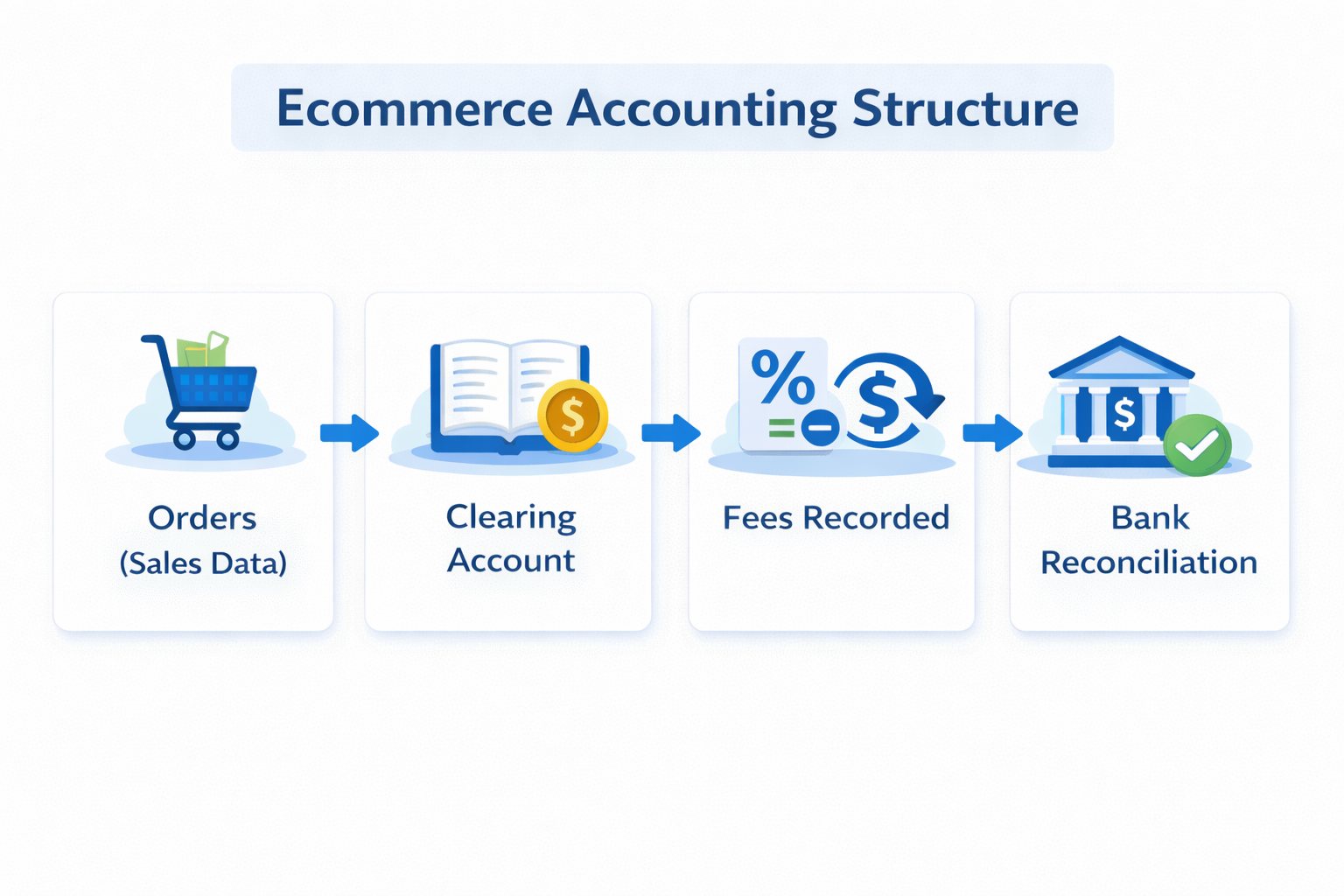
The Clearing Account Method for Ecommerce Reconciliation
One of the most effective ways to solve this complexity is through a clearing account.
A clearing account acts as a bridge between sales and bank deposits. Instead of directly recording deposits as revenue, transactions are first mapped through this temporary account.
Here is how it works in practice:
Step 1: Record Sale
Debit: Clearing Account $100
Credit: Revenue $100
Step 2: Record Fees
Debit: Processing Fees Expense $3
Credit: Clearing Account $3
Step 3: Record Bank Deposit
Debit: Bank $97
Credit: Clearing Account $97
At any point, the clearing account shows what is pending, received, or missing.
This structure eliminates guesswork. It creates traceability between systems and ensures that every deduction is accounted for.
For businesses managing multiple gateways, integrating this process with AR/AP software integration significantly reduces manual reconciliation effort.
Why Most Ecommerce Accounting Setups Fail
The issue is rarely a lack of tools. It is a lack of structure.
Many businesses:
- treat deposits as revenue
- ignore fee leakage
- fail to track refund timing
- do not reconcile payouts properly
These gaps remain small initially but compound as volume increases.
At scale, they lead to overstated profits, tax inconsistencies, and poor strategic decisions.
Expert Insight
“Most ecommerce businesses think they have a revenue problem or a margin problem. In reality, they have a visibility problem. Once payouts are broken down properly, the business starts making sense.”
The shift is simple but powerful. Stop relying on deposits. Start tracking movement.
Shivangi Agrawal, Managing Director (CA, CPA USA), SafeBooks
What Structured Ecommerce Accounting Actually Solves
When ecommerce accounting is set up correctly, three things change immediately.
Margins become real instead of assumed. Financial reports start aligning with operations. Decision-making improves because numbers can be trusted.
This is not about adding complexity. It is about removing confusion.
If your current reporting still depends on bank deposits as the primary reference point, it is time to move toward structured systems with professional bookkeeping and accounting services.