
The Complete Guide for Store Owners
Your Shopify dashboard may show strong sales, but the amount landing in your bank account often tells a different story.
No error. No alert. Just a gap.
For ecommerce businesses, this gap creates confusion around revenue, cash flow, and profitability. But the truth is simple.
This mismatch is not a mistake. It is how ecommerce payments are designed.
Shopify Sales vs Bank Deposits Explained
Most store owners expect their Shopify sales to match their bank deposits.
They do not.
Shopify sales represent what customers paid at checkout. Bank deposits represent what remains after processing, adjustments, and payout cycles. This is the same principle seen in payment systems covered in the POS reconciliation guide, where transaction data and actual cash movement rarely align in real time.
Once you understand this difference, reconciliation becomes a structured process instead of guesswork. This is exactly where structured workflows and teams like SafeBooks Global step in to bring clarity to what otherwise feels like inconsistent numbers.
How Shopify Payout Process Impacts Bank Deposits
Before money reaches your bank, it passes through multiple stages.
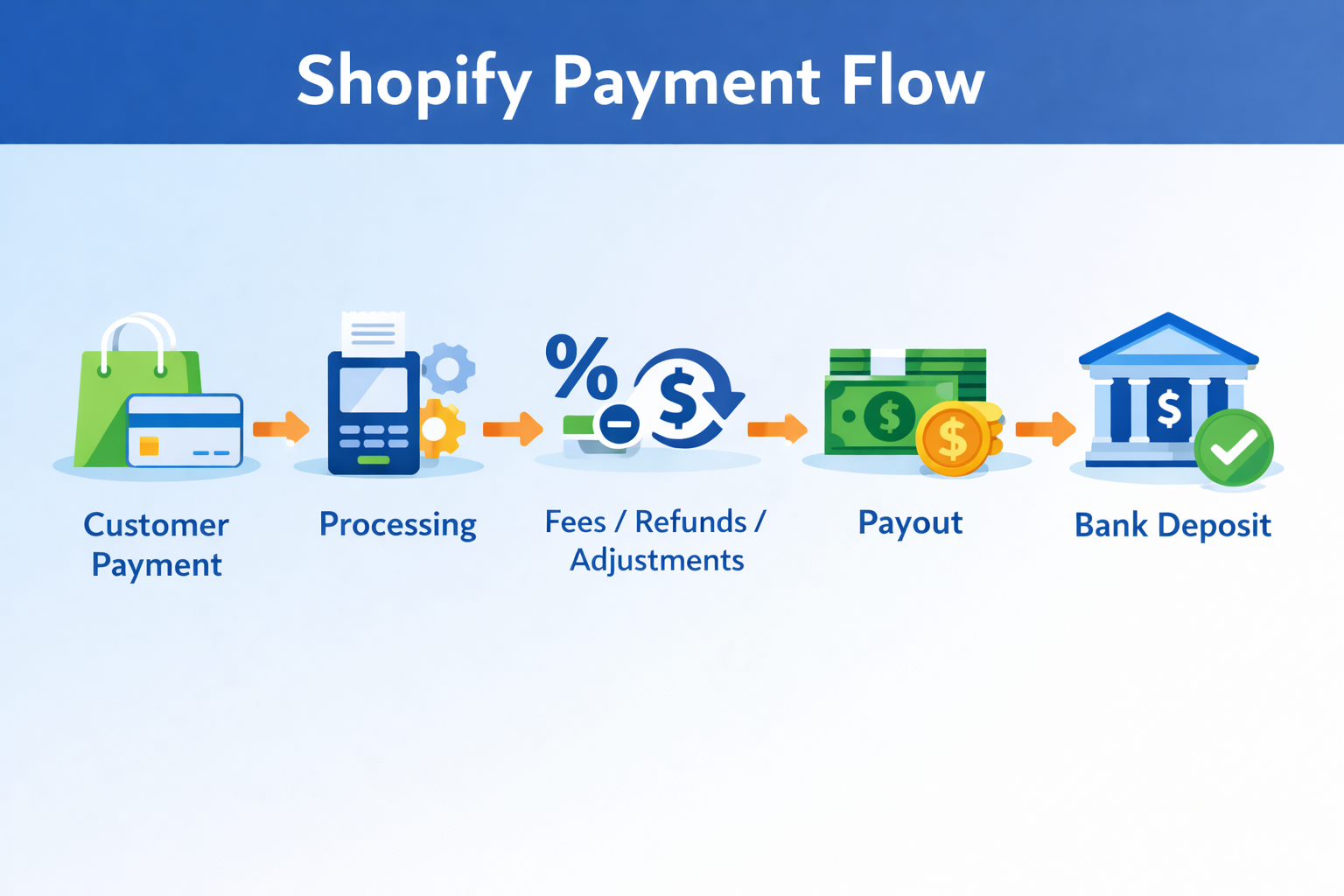
Each stage introduces changes. These changes create the gap between Shopify sales and bank deposits.
Shopify Payment Processing Fees Reduce Bank Deposits
Shopify follows a net settlement model.
This means you do not receive your full sales amount. Payment processing fees, transaction charges, and other deductions are removed before payout.
To make this practical, consider a simple example.
If your store generates $10,000 in sales:
- Payment processing fees may reduce this by $250–$300
- Refunds may remove another $200
- Adjustments or app-related charges may reduce it further
The final deposit may land closer to $9,400–$9,500.
Nothing is missing. It has already been deducted.
Refunds add another layer. When a transaction is refunded, the original processing fee is usually not returned. Over time, this directly reduces the total cash received compared to sales reported.
This is where many businesses underestimate their actual costs. A structured setup through bookkeeping and accounting services ensures these leakages are tracked properly instead of being absorbed silently.
Shopify Payout Timing vs Sale Date Differences
Sales are recorded instantly.
Payouts are not.
There is always a delay between the time a customer pays and when the funds reach your bank. This delay includes settlement, batching, and bank processing.
A single bank deposit may include multiple days of sales. At the same time, recent sales may not yet appear in your account. This timing difference is one of the biggest reasons Shopify sales do not match deposits.
From an accounting standpoint, this is not just a timing issue. It directly impacts how revenue is reported across weeks and months, especially during closing cycles.
Refunds and Chargebacks Impact Shopify Payout Amounts
Refunds do not always show up where you expect them.
Instead of appearing as a separate bank transaction, they reduce your upcoming payouts. This creates a situation where sales appear stable, but deposits suddenly drop.
Chargebacks go further.
They immediately deduct funds and include additional fees, often linked to past transactions. These are one of the most disruptive elements in ecommerce accounting because they disconnect the timing between revenue and cash impact.
Without a proper system, businesses struggle to identify where the deduction actually came from.
Multiple Payment Gateways Cause Deposit Mismatch
If your store accepts payments through multiple providers such as PayPal or Stripe, your cash flow becomes fragmented. Shopify shows total sales in one place, but deposits arrive from different sources.
This creates multiple deposit streams, making it difficult to match sales with bank activity without a structured reconciliation system.
This is where many businesses hit scale-related issues. As volume increases, manual tracking becomes unreliable, and gaps start compounding over time.
Taxes, Shipping, and Currency Conversion Differences
Shopify sales reports include taxes and shipping charges.
These are not your actual earnings.
Taxes are liabilities, and shipping is often a pass-through cost. Including them in sales inflates the number compared to what you actually receive. For international stores, currency conversion adds another layer. Exchange rate changes and conversion fees ensure that sales and deposits will never perfectly match.
Shopify Adjustments, App Fees, and Subscription Deductions
Additional deductions may also impact payouts.
These include Shopify subscription fees, app charges, and operational adjustments. They are visible in payout reports but often missed when businesses compare only summary figures. Over time, these “small” adjustments become a consistent source of discrepancy if not tracked properly.
Expert Insight
“Most ecommerce businesses don’t have a revenue problem. They have a visibility problem. Once payouts are broken down properly, the numbers stop being confusing and start guiding decisions.“
Shivangi Agrawal, Managing Director (CA, CPA USA), SafeBooks
Why Shopify Sales vs Deposits Mismatch Creates Accounting Risks
The mismatch itself is not the issue.
The real risk is misinterpretation.
Businesses that rely only on bank deposits often underestimate their costs and overstate their performance. Over time, this leads to poor decision-making and inaccurate reporting.
This is why structured systems and expert support become critical.
Working with a team that understands ecommerce flows, like SafeBooks Global’s ecommerce bookkeeping services, ensures that your books reflect reality instead of just cash movement.
How to Reconcile Shopify Sales and Bank Deposits Correctly
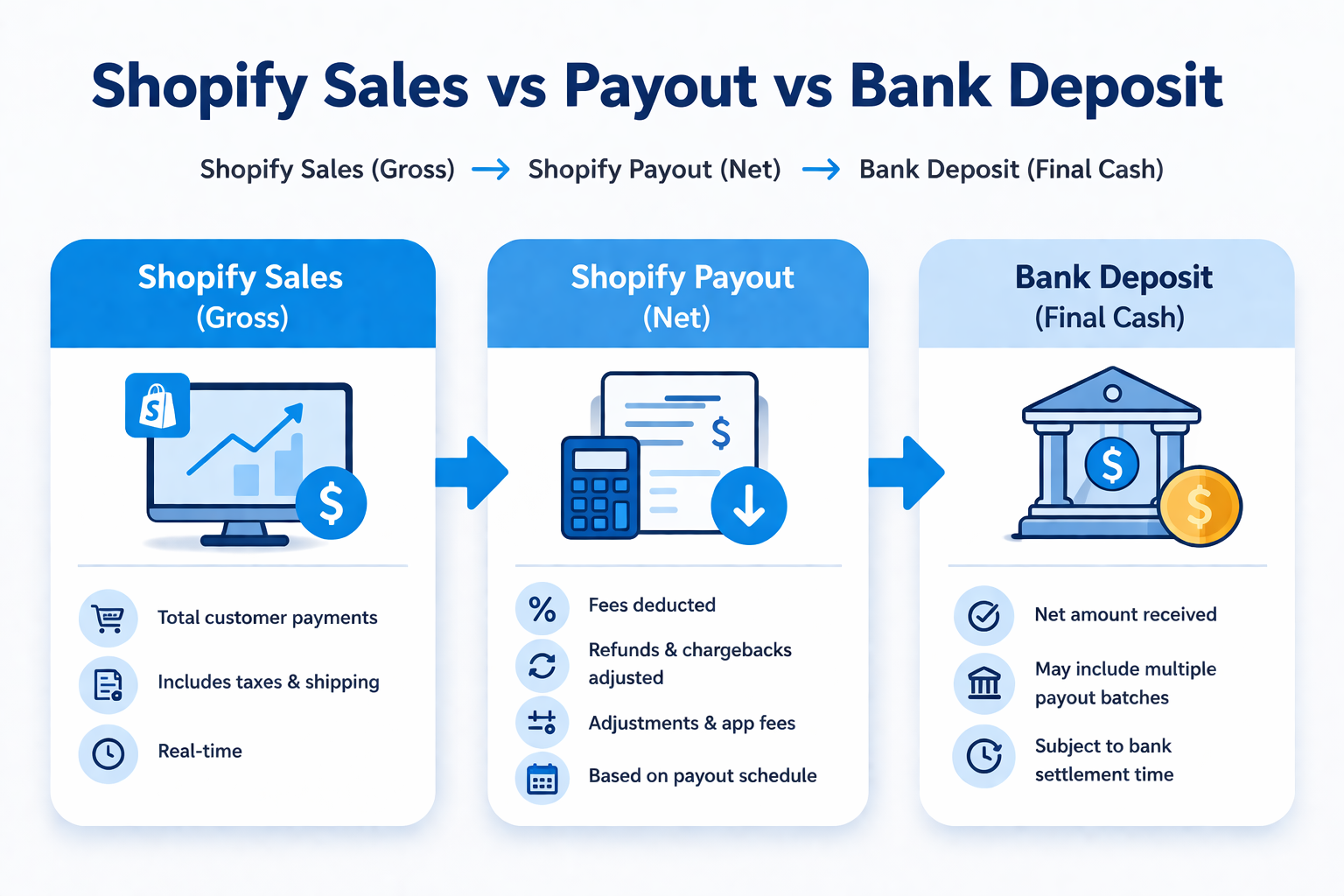
The right approach starts with a shift in method.
Instead of matching sales to deposits, match payouts to deposits.
Each payout represents a complete financial snapshot. It includes sales, fees, refunds, and adjustments. Once payouts are matched to bank deposits, the remaining breakdown becomes clear. For businesses managing multiple systems, aligning workflows through AR/AP software integration helps eliminate manual gaps and improves consistency.
Shopify Sales vs Payout vs Bank Deposit Detailed Comparison
Component | Shopify Sales Report | Shopify Payout Report | Bank Statement |
What it shows | Total customer payments (gross) | Net amount after fees, refunds, adjustments | Final cash received |
Includes fees | No | Yes (deducted) | Already deducted |
Includes refunds | Yes (as separate entries) | Deducted from payout | Reflected as lower deposit |
Timing | Real-time | Based on payout schedule | Based on bank settlement |
Multiple gateways | Combined view | Split by provider | Separate deposits |
Taxes & shipping | Included | Included but adjusted | Not actual earnings |
Use case | Sales tracking | Reconciliation reference | Cash flow tracking |
Understanding Shopify Sales vs Deposits for Better Financial Decisions
Instead of asking why the numbers do not match, focus on what happens between the sale and the payout.
That is where costs exist, where delays happen, and where profitability is defined. Once this layer is understood, financial clarity improves significantly.
How to Handle Shopify Sales vs Bank Deposit Differences as You Scale
Your Shopify dashboard shows performance. Your bank account shows outcome.
The difference between the two is where accurate accounting happens. Businesses that understand this gap build stronger financial systems, improve reporting accuracy, and make better decisions as they scale.
If your reconciliation process still feels inconsistent, structured support through professional bookkeeping and accounting services can help you maintain accurate, audit-ready records without internal complexity.