The accounting profession in 2026 has shifted from rapid digital adoption to disciplined ecosystem design.
For years, CPA firms followed a best-of-breed philosophy. Every niche need led to another software subscription. Lease accounting tool. SALT compliance tracker. Separate document portal. Standalone 1099 module. Independent AI add-ons.
The result is tool sprawl.
In 2026, firms are no longer judged by the number of tools they own. They are judged by how seamlessly data flows across systems and how intelligently AI operates within that ecosystem.
Consolidation is no longer optional. It is strategic.
App Fatigue and the Productivity Paradox
App fatigue has become a measurable operational liability.
Hybrid teams toggling between:
- Practice management
- Document portal
- General ledger
- Payroll system
- Compliance tools
- AI plugins
experience constant context switching.
This reduces focus, increases rework, and slows cycle time.
Many firms believe their stack is good enough. But good enough does not scale in an AI-driven environment.
The bigger issue is that automation potential is being wasted. Studies indicate that nearly 77% of general accounting operations can now be fully automated using modern AI-native systems. Yet many firms remain stuck in manual exports, spreadsheet reconciliations, and disconnected workflows.
When automation is not embedded into a unified architecture, firms cannot move from prepare-and-review to review-and-advise.
The Real Cost of Software Bloat
The cost of a bloated stack extends far beyond subscription fees.
It shows up in:
- Duplicate data entry
- Reconciliation errors
- Training inefficiencies
- Longer month-end closes
- Lower realization rates
Operational Comparison
Metric | Disconnected Stack | Consolidated 2026 Stack |
Month-End Close | 14 to 21 days | 2 to 5 days |
Realization Rate | Below 80% | 90% or higher |
Manual Error Rate | 10% to 15% | Under 1% with AI validation |
Weekly Admin Hours | 5+ hours | Under 5 hours |
AI Integration | Fragmented add-ons | Embedded across workflows |
True productivity in 2026 is defined by reduced bottlenecks, not longer hours.
Why Consolidation Is Accelerating
The primary driver of consolidation is AI readiness.
AI requires a single source of truth.
When CRM, GL, compliance logs, payroll, and document management operate in isolation, AI cannot reason across the full business lifecycle.
As discussed in our analysis of AI in Tax Preparation Tools, the CPA’s role is shifting toward governance and oversight. That shift requires structured systems.
Unified ecosystems allow:
- Continuous auditing
- Real-time anomaly detection
- Automated coding and reconciliation
- Predictive forecasting
Fragmented systems block this progress.
What to Remove First in 2026
Strategic decommissioning must be deliberate.
Start with shelfware. Software that is paid for but underused.
Then evaluate integration capability.
The 2026 Decommissioning Framework
Decommission Phase | Critical Action | Strategic Justification |
Inventory Audit | Map all subscriptions and access credentials | You cannot secure or optimize what you cannot see |
Usage Verification | Analyze login frequency and workflow reliance | Identify stalled tools and spreadsheet workarounds |
API Capability | Evaluate native integrations and automation support | Remove tools requiring manual exports |
Redundancy Review | Identify overlapping functionality | Eliminate duplicate portals or compliance trackers |
Security Compliance | Confirm MFA, encryption, and audit logging | Remove tools failing 2026 governance standards |
Primary removal targets include:
- Standalone compliance point solutions
- Rule-based RPA bots that break after UI updates
- Disconnected document portals
- Legacy on-prem systems without cloud integration
- AI tools operating outside core workflows
Modern structured environments, as described in Cloud vs On Prem Accounting for CPA Firms, reduce complexity and improve defensibility.
The Modern 2026 Core Stack
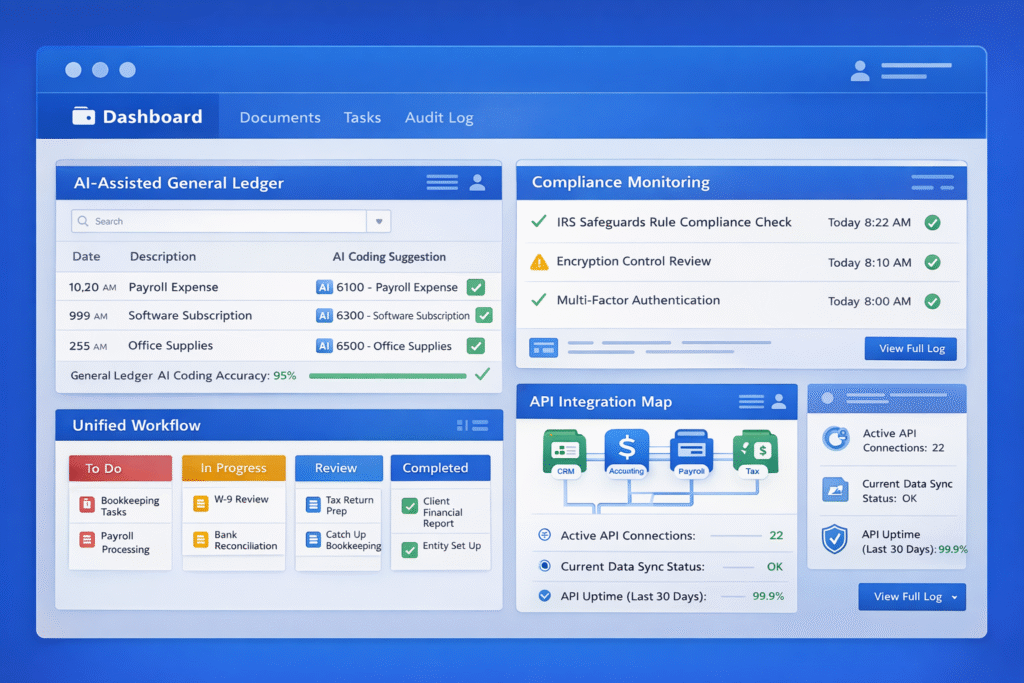
The consolidated CPA tech stack typically includes:
- AI-native general ledger
- Unified document and client portal
- Embedded compliance tracking
- Continuous audit monitoring
- Integrated practice management
Instead of prepare-and-review, firms now operate under review-and-advise models.
This transformation is demonstrated in this CPA Firm Cloud Migration Case Study, where consolidation reduced cycle time and increased visibility across workflows.
Governance and Zero Trust in 2026
Consolidation is also a security decision.
IRS Publication 4557 and the FTC Safeguards Rule require:
- Written Information Security Plan
- Multi-factor authentication
- Encryption controls
- Vendor oversight
- Continuous monitoring
Zero Trust architecture is becoming standard. Every user and device must be verified.
Fragmented stacks increase risk exposure. Unified systems simplify governance.
For firms building scalable infrastructure, this approach aligns with the systems described here Accounting Firms.
Expert Insight
“The strongest firms in 2026 are not those buying more AI tools. They are the ones designing cleaner data architecture. Consolidation is not about reducing apps. It is about increasing control.”
Shivangi Agrawal, Managing Director at SafeBooks Global
Designing With Intention
The modern CPA firm does not accumulate software.
It curates infrastructure.
Before adding any new tool, leadership should ask:
- Does it integrate natively into our core platform?
- Does it shorten cycle time?
- Does it reduce rework?
- Does it improve realization?
- Does it strengthen governance?
If the answer is unclear, the tool should not be added.
Consolidation is intentional design.
If your firm is evaluating strategic tech rationalization or ecosystem redesign, visit our Contact Us page to discuss your roadmap.