
How Accounting Firms Can Handle Bookkeeping Overflow Without Hiring Full-Time Staff
A CPA firm serves 25 bookkeeping clients. Five have overdue reconciliations, two need historical cleanup, and the internal team is already committed to month-end close.
The immediate problem is unfinished work. But does it justify another full-time employee?
Not necessarily.
Bookkeeping overflow should be measured as a capacity problem before it becomes a hiring decision.
For firms preparing for the 2027 filing season, the first step is to determine which tasks are temporary, which are recurring, and how much review capacity remains available.
Identify the Type of Overflow
Late reconciliations are often the first visible sign of a capacity problem. They indicate that preparation work, client documentation, or review is taking longer than the existing team can accommodate.
Different workloads require different responses.
Workload | Example | Practical response |
One-time backlog | Six months of unreconciled accounts | Defined cleanup project |
Seasonal overflow | Year-end transaction processing | Temporary support |
Recurring partial workload | Monthly work for 10 clients | Part-time bookkeeper |
Sustained growth | Consistent additional client volume | Evaluate dedicated capacity |
A temporary backlog should not automatically trigger permanent recruitment.
Calculate Preparation and Review Capacity
Return to the 25-client firm.
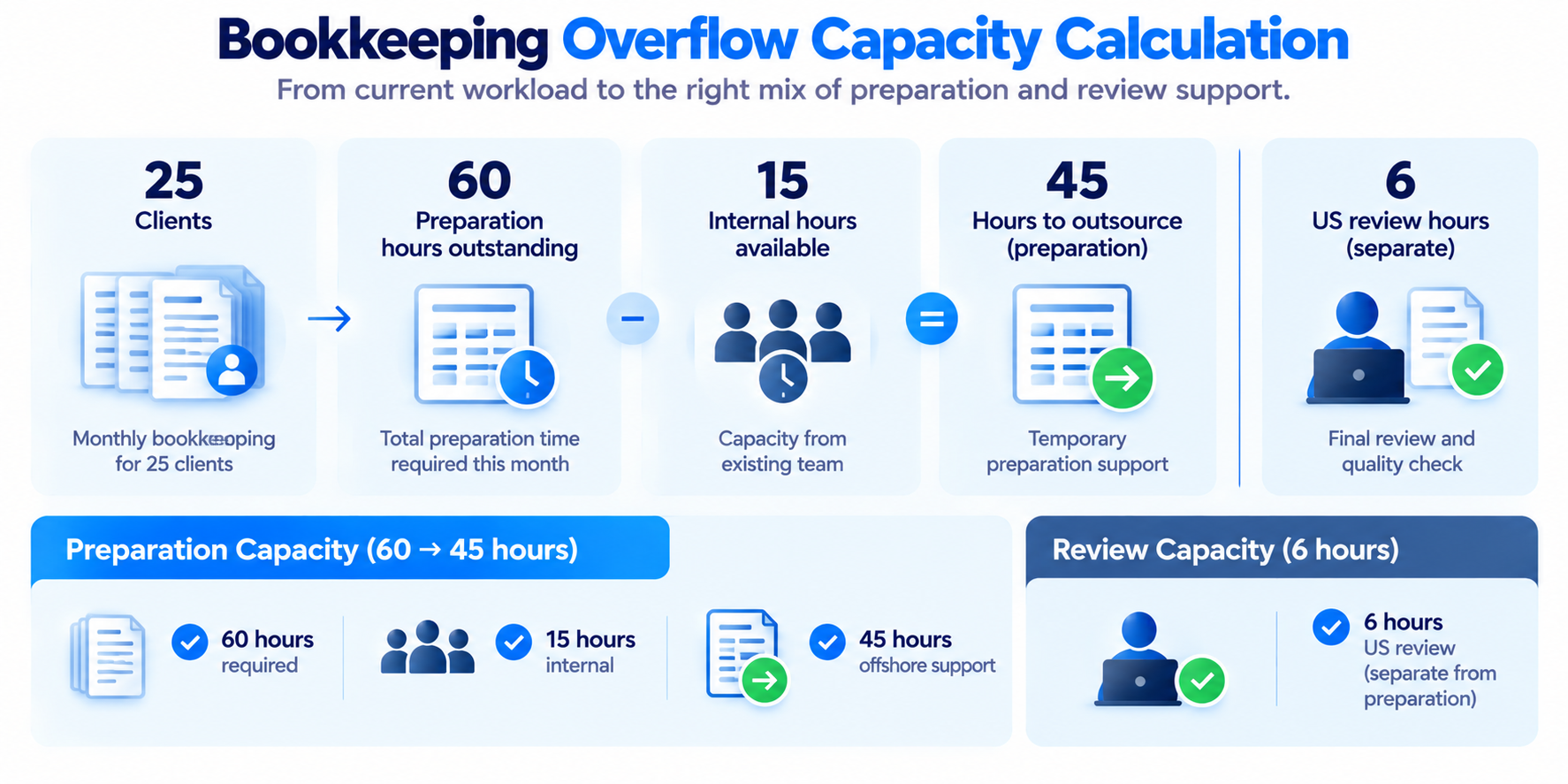
Its outstanding workload is estimated as follows:
Capacity calculation | Hours |
Overdue reconciliations | 30 |
Historical cleanup | 24 |
Exception documentation | 6 |
Total preparation backlog | 60 |
Available internal preparation hours | (15) |
External preparation required | 45 |
Estimated US review time | 6 |
The firm needs 45 hours of temporary preparation support and six hours of reviewer availability.
The six review hours are an illustrative planning assumption, not an industry benchmark. Actual review effort depends on complexity and workpaper quality.
This distinction matters. Outsourcing 45 hours of preparation does not eliminate the work required to approve the results.
Compare Overflow Cost With Hiring
Suppose a provider charges a hypothetical $20 per preparation hour.
At that rate:
- Offshore preparation: 45 × $20 = $900
- US review: 6 × $65 = $390
- Total incremental workload cost: $1,290
This is not a SafeBooks quotation.
A full-time employee would provide substantially more capacity, but salary, benefits, recruitment, onboarding, and ongoing utilization would need consideration.
For a one-time 45-hour backlog, permanent hiring is difficult to justify on capacity alone.
For detailed pricing comparisons, see Hourly vs Monthly Bookkeeping Support.
When Should Overflow Become a Permanent Hire?
A useful management checkpoint is three consecutive months of recurring overflow.
If additional work continues for three months, investigate whether it represents sustained client growth rather than a temporary backlog.
Before hiring, confirm that demand is predictable, sufficient to utilize the proposed employee, and supported by adequate review capacity.
Three months is a suggested decision trigger, not an established accounting-industry standard.
A firm might instead choose recurring part-time support if the additional workload remains well below full-time capacity.
How Quickly Can Overflow Support Begin?
Temporary support still requires onboarding.
Before work starts, the firm must confirm scope, available resources, accounting-system access, workpaper standards, and review responsibilities.
SafeBooks’ published onboarding process includes needs assessment, resource planning, secure setup, integration, and training.
It does not specify a guaranteed number of days to start.
Firms facing immediate deadlines should therefore confirm resource availability and the first achievable delivery date before assigning urgent work.
Keep Preparation, Review, and Access Under Control
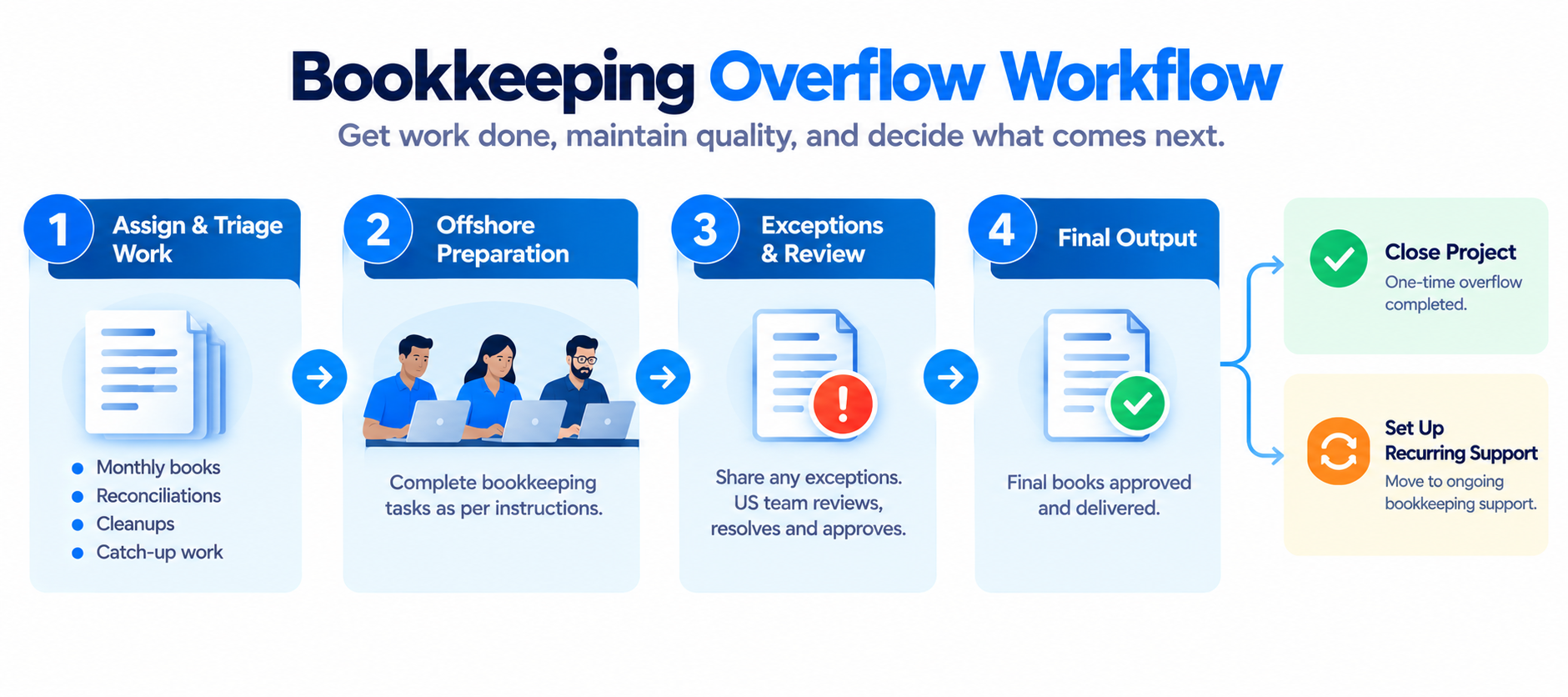
For the 45-hour backlog, the offshore team could prepare reconciliations, investigate unmatched transactions, and document unresolved differences.
The US reviewer would approve completed reconciliations and resolve accounting judgments requiring firm authorization.
A daily handoff should identify completed accounts, exceptions, missing client documents, and review-ready files.
For data security, restrict access to assigned clients and revoke unnecessary permissions when the project ends.
Where offshore access involves taxpayer return information, assess applicable IRC Section 7216 disclosure and consent rules.
How SafeBooks Supports Temporary Bookkeeping Overflow
SafeBooks Global offers project-based, part-time, and full-time remote bookkeeping services for US accounting firms.
For the 25-client example, the most relevant starting point is a defined cleanup project covering the five overdue reconciliation clients and two historical cleanup assignments.
SafeBooks could scope the preparation work around specified accounting periods, reconciliations, supporting schedules, and exception reports, subject to confirmed resource availability and agreed terms.
The US firm would retain client communication, technical review, and final approval.
If backlog work becomes recurring, a part-time arrangement can be evaluated separately.
For execution details, see Hourly Bookkeeping Services for CPA Firms.
Final Takeaway
Bookkeeping overflow does not automatically mean a CPA firm needs another full-time employee.
The more useful question is whether unfinished work represents a temporary backlog, recurring partial demand, or sustained growth.
For the five overdue clients in this example, start this week by estimating their outstanding hours, reserving reviewer time, and separating work that can be assigned externally.
Contact SafeBooks Global to discuss a defined bookkeeping cleanup project or flexible recurring support.