
The $2,000 Threshold and the Switch From FIRE to IRIS
A CPA firm preparing January 1099 filings could easily apply last year’s $600 threshold out of habit. Meanwhile, its filing software may still depend on the IRS FIRE system, which is shutting down in November 2026.
Both issues can disrupt year-end reporting if firms do not prepare early.
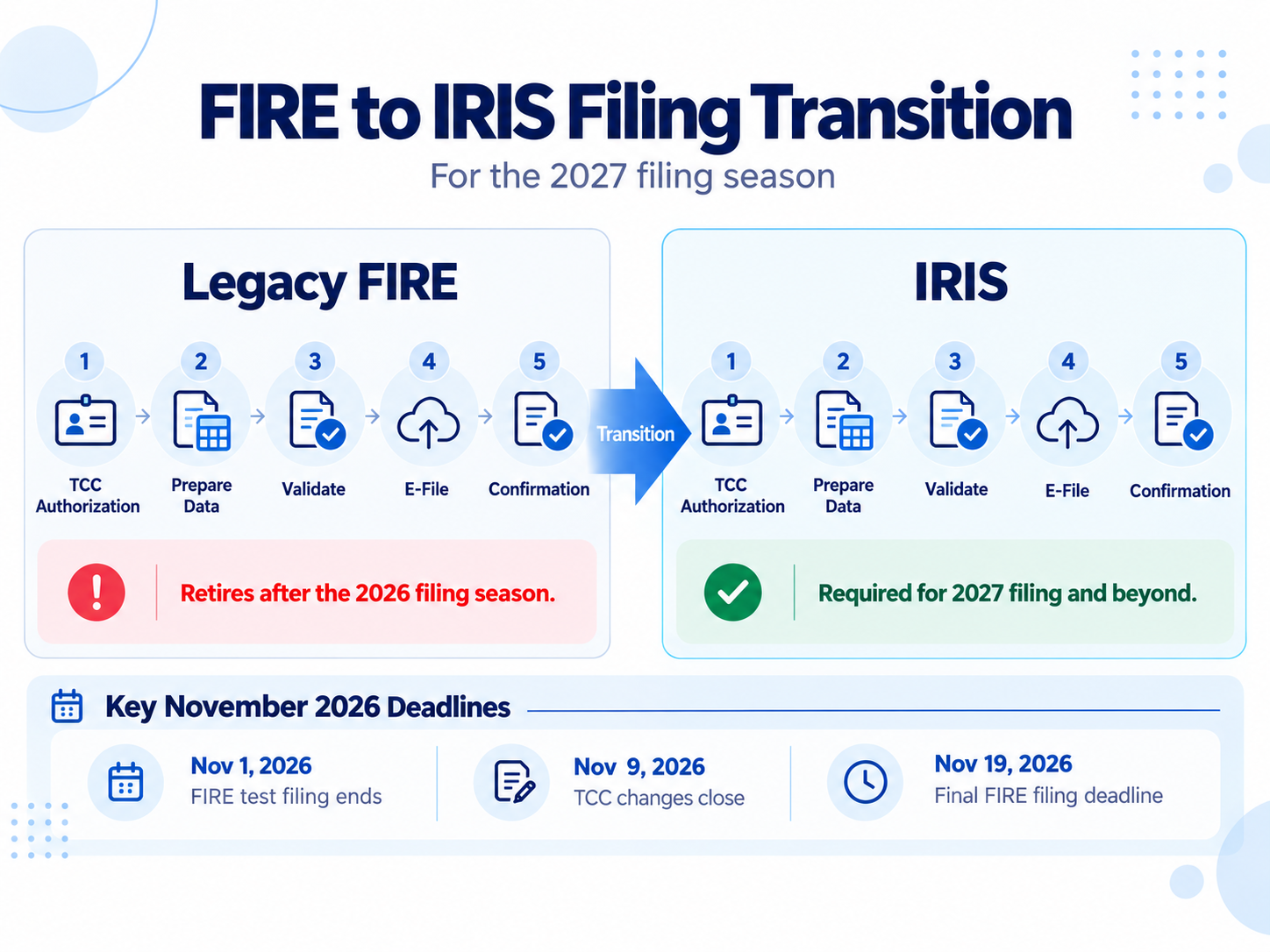
November 1, 2026, is the final date for FIRE test submissions, while November 19 marks the system’s final submission deadline. The IRS is moving electronic information return filing to IRIS for the 2027 filing season.
Alongside this transition, the federal reporting threshold for many Forms 1099-NEC and 1099-MISC payments increases to $2,000. However, Form 1099-K and certain miscellaneous payments follow different rules.
Here is what CPA firms need to review before year-end.
1099-NEC vs 1099-MISC vs 1099-K: What Changes in 2026?
The first distinction is the payment year.
Qualifying payments made in 2025 generally remain subject to the previous $600 threshold. The new $2,000 threshold applies to qualifying payments made during calendar year 2026.
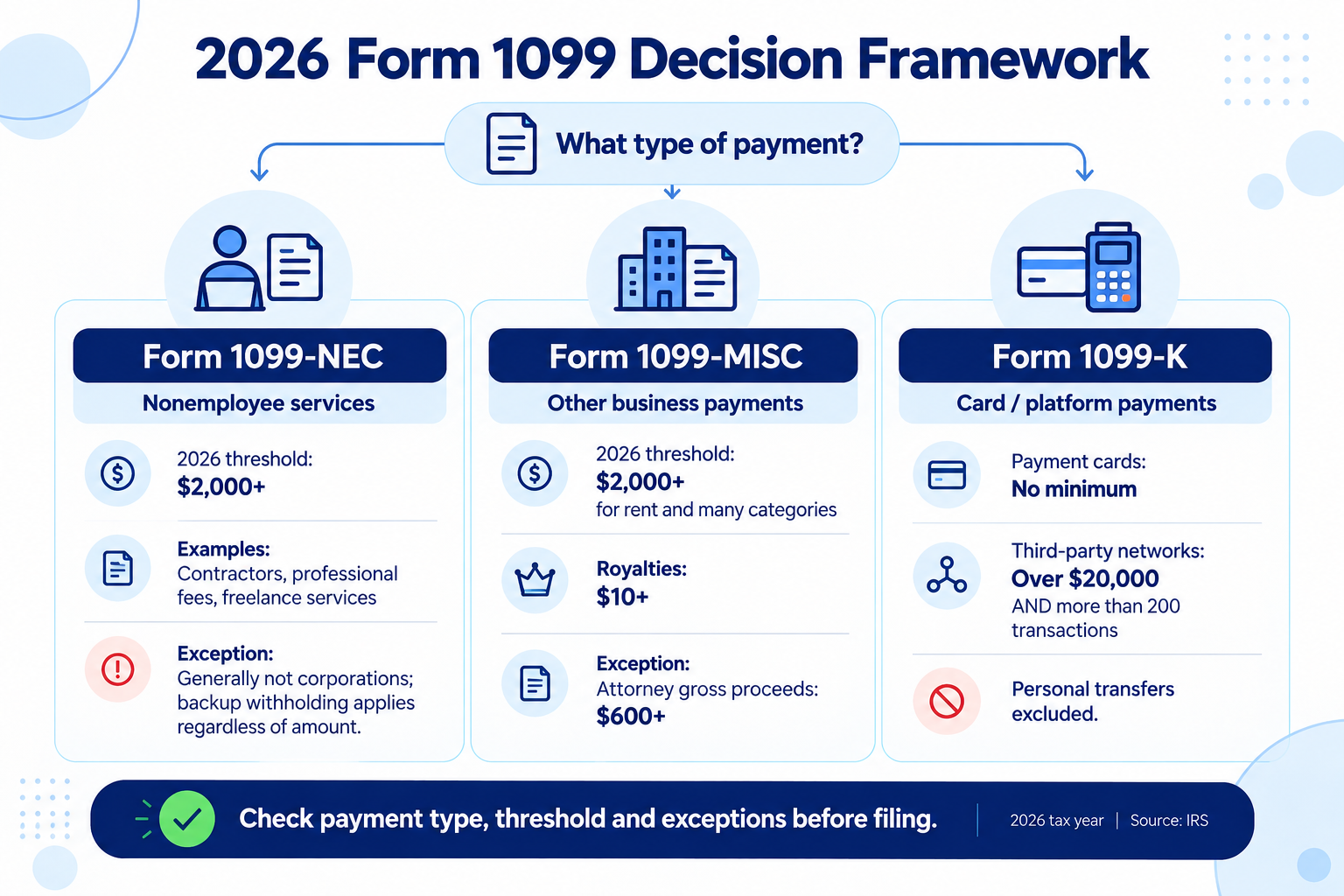
Form | Payment category | 2026 federal threshold |
1099-NEC | Contractor and nonemployee compensation | $2,000 |
1099-MISC | Rent, prizes, royalties, and miscellaneous income | $2,000 for many categories; exceptions apply |
1099-K | Payment card and third-party network transactions | No minimum for payment cards; over $20,000 and over 200 transactions for qualifying third-party networks |
For accounting teams, the challenge is identifying which payments qualify for each form before applying the reporting threshold.
Form 1099-NEC: The New $2,000 Contractor Threshold
For 2026, businesses generally must issue Form 1099-NEC when qualifying nonemployee compensation reaches $2,000 or more.
Consider a business paying an independent consultant $1,500 through direct bank transfers. Assuming no exception applies, that payment generally would not require Form 1099-NEC under the revised federal threshold.
However, payments subject to backup withholding may require reporting regardless of amount. Certain attorney payments and recipient classifications also need separate consideration.
Should CPA Firms Still Collect W-9s Below $2,000?
Yes, collecting W-9s during vendor onboarding remains a useful practice.
It helps establish taxpayer identification numbers, entity classifications, and reporting eligibility before payment totals increase.
A vendor receiving $900 in June may cross $2,000 by December. Maintaining complete records throughout the year avoids unnecessary January follow-ups.
Form 1099-MISC: Important Threshold Exceptions
Form 1099-MISC covers payments such as rent, royalties, prizes, and certain healthcare payments.
Although the $2,000 threshold applies to many categories, exceptions remain:
- Royalties: Generally reportable at $10 or more.
- Gross proceeds paid to attorneys: Generally reportable at $600 or more.
- Backup withholding: Reporting may be required regardless of payment amount.
Applying the $2,000 threshold to every Form 1099-MISC category could therefore result in missed filings.
Form 1099-K: Avoid Duplicate Payment Reporting
Form 1099-K follows separate rules.
For 2026, qualifying third-party network payments generally require reporting when they exceed $20,000 and involve more than 200 transactions. Payment card transactions have no minimum federal reporting threshold.
For example, if a business pays a contractor $3,000 through a payment card, the transaction is generally reported by the payment settlement entity on Form 1099-K.
The business generally should not report that same payment again on Form 1099-NEC.
CPA firms should distinguish direct payments from card and third-party network transactions during reconciliation.
For additional guidance, read Form 1099-K vs. Accounting Records: A Reconciliation Guide.
FIRE to IRIS: November 2026 Deadlines
The IRS is retiring FIRE and transitioning electronic information return filing to IRIS.
Three dates require immediate attention:
- November 1, 2026: Last day for FIRE test submissions.
- November 9, 2026: Last day to modify existing FIRE TCC applications.
- November 19, 2026, at 3 p.m. ET: Final deadline for FIRE submissions.
Starting with the 2027 filing season, IRIS will replace FIRE for electronic information return submissions.
IRIS supports two filing methods: the Taxpayer Portal for manual entry and CSV uploads, and Application to Application (A2A) for software-based submissions.
Existing FIRE Transmitter Control Codes (TCCs) do not replace the need for IRIS authorization.
For CPA firms managing multiple clients, this transition requires updating filing access, software configurations, and review procedures before January.
State 1099 Requirements Need Separate Review
Federal thresholds do not automatically determine state reporting obligations.
Some states maintain different thresholds, electronic filing requirements, or withholding-related reporting rules.
CPA firms supporting multistate businesses should review each applicable state’s requirements rather than relying exclusively on federal thresholds.
This becomes particularly important when businesses operate across several jurisdictions or make payments to vendors in different states.
How CPA Firms Should Prepare for the 2027 Filing Season
A structured workflow can distribute reporting preparation across three months.
November: Confirm IRIS authorization, update reporting thresholds, review vendor classifications, and collect missing W-9s.
December: Reconcile payments, identify reportable vendors, separate payment processor transactions, and investigate exceptions.
January: Prepare information returns, verify recipient details, complete reviews, and submit filings.
For most filers, Form 1099-NEC for 2026 is due February 1, 2027. Forms 1099-MISC and 1099-K generally have IRS filing deadlines of March 1 for paper submissions and March 31 for electronic submissions. Recipient statement deadlines and exceptions must be reviewed separately.
An offshore accounting team can assist with payment reconciliation, vendor record cleanup, supporting documentation, and exception tracking before the U.S. firm’s final review.
SafeBooks Global supports CPA firms through offshore bookkeeping and accounting services and tax preparation support, helping organize year-end accounting workflows while the U.S. firm retains final reporting responsibility.
Final Takeaway
The 2026 Form 1099 changes require more than updating a reporting threshold.
CPA firms must distinguish payment categories, review state requirements, and prepare for the FIRE-to-IRIS transition before the 2027 filing season.
Accurate records, early reconciliation, and clearly assigned responsibilities can prevent avoidable year-end reporting issues.
Contact SafeBooks Global to discuss offshore accounting support for your firm’s year-end workload.