

The email came in on a Tuesday.
A nonprofit organization needed to submit a report to a funder by Friday.
The request was simple:
“Show us how the $150,000 program grant was spent.”
The executive director knew the money had been used correctly.
The problem was proving it.
The organization had received funding from multiple sources:
- Foundation grants
- Individual donations
- Program funding
- Event revenue
Everything flowed through the same accounting system, but the grant activity was not clearly separated.
Expenses were recorded under general categories:
- Payroll
- Supplies
- Program costs
- Administrative expenses
The information existed.
It was just not organized in a way that answered the funder’s questions quickly.
This is a common challenge for nonprofit organizations.
The issue is rarely that the money disappeared.
The issue is that the organization cannot clearly show where each restricted dollar went.
For CPA firms serving nonprofits, maintaining clean grant-level bookkeeping is one of the most valuable ways to support clients while reducing year-end cleanup.
Key Takeaway
Restricted funds can only be used for the purpose approved by the donor or funder, and nonprofits must be able to show how those funds were used. Separate bank accounts are not always required, but clear bookkeeping and grant-level tracking are essential for accurate reporting.
What Makes Restricted Grant Money Different?
The main difference between restricted and unrestricted funds is how the money can be used.
When a nonprofit receives unrestricted funding, the organization generally has more flexibility in deciding how those funds support operations.
Restricted funding comes with specific requirements.
For example:
A nonprofit receives a $100,000 grant to support a youth literacy program.
That funding may be intended for:
- Program materials
- Teachers
- Community outreach
- Related program expenses
It may not automatically be available for unrelated expenses such as general office costs or another program.
The nonprofit is responsible for tracking the funding and demonstrating that it was used according to the grant agreement.
Restricted vs Unrestricted Funds
Category | Restricted Funds | Unrestricted Funds |
Who decides how money is used? | Donor or funder requirements | Organization leadership |
Example | Grant for a specific community program | General operating donation |
Tracking requirement | Must show approved usage | General financial reporting |
Reporting need | Grant and funder reports | Internal and financial reporting |
The goal is not simply knowing how much money the nonprofit has.
The goal is understanding what each dollar represents.
What Goes Wrong When Everything Sits in One Ledger?
A combined ledger may show accurate totals.
But it may not provide the visibility nonprofit leaders and funders need.
For example:
A nonprofit has:
- $300,000 in total cash
- $100,000 unrestricted donations
- $150,000 restricted program grant
- $50,000 event funding
The bank account shows $300,000.
But the organization cannot treat all $300,000 as flexible funding.
Without proper tracking, questions become difficult to answer:
- How much of this grant remains unused?
- Which expenses belong to which program?
- Did we spend funding according to donor requirements?
- How much unrestricted funding is actually available?
This is where strong nonprofit bookkeeping becomes important.
Does Every Restricted Grant Need Its Own Bank Account?
Usually, no.
A nonprofit does not always need a separate bank account for every restricted grant.
Some funders may require separate accounts, but the main requirement is clear tracking.
The important question is:
Can the nonprofit clearly identify:
- Where the money came from?
- What restrictions apply?
- How it was spent?
- What balance remains?
Many nonprofits use accounting systems to track funding by:
- Grant
- Program
- Class
- Project
The purpose is visibility, not necessarily separate banking.
Why Does This Create Pressure for CPA Firms?
For CPA firms, nonprofit clients often create challenges when bookkeeping is not organized throughout the year.
The problem usually appears during:
- Audit preparation
- Year-end close
- Form 990 preparation
- Grant reporting deadlines
A firm may need to spend hours reconstructing information that should already exist.
The team may have to review:
- Bank statements
- Expense details
- Grant agreements
- Vendor payments
- Payroll allocations
This creates unnecessary pressure during already busy periods.
Good nonprofit bookkeeping is not only about recording transactions.
It is about creating records that answer important questions before someone asks them.
What Do Nonprofit Clients Actually Need From Their Books?
Nonprofit organizations need financial information they can use.
Useful reporting helps leadership understand:
- How each program is performing
- How grants are being utilized
- Where expenses are increasing
- Whether funding goals are being met
Boards and funders want confidence that resources are being managed responsibly.
Clean books help nonprofits demonstrate good stewardship.
For CPA firms, this creates an opportunity to provide more than compliance support.
It creates an opportunity to become a trusted advisor.
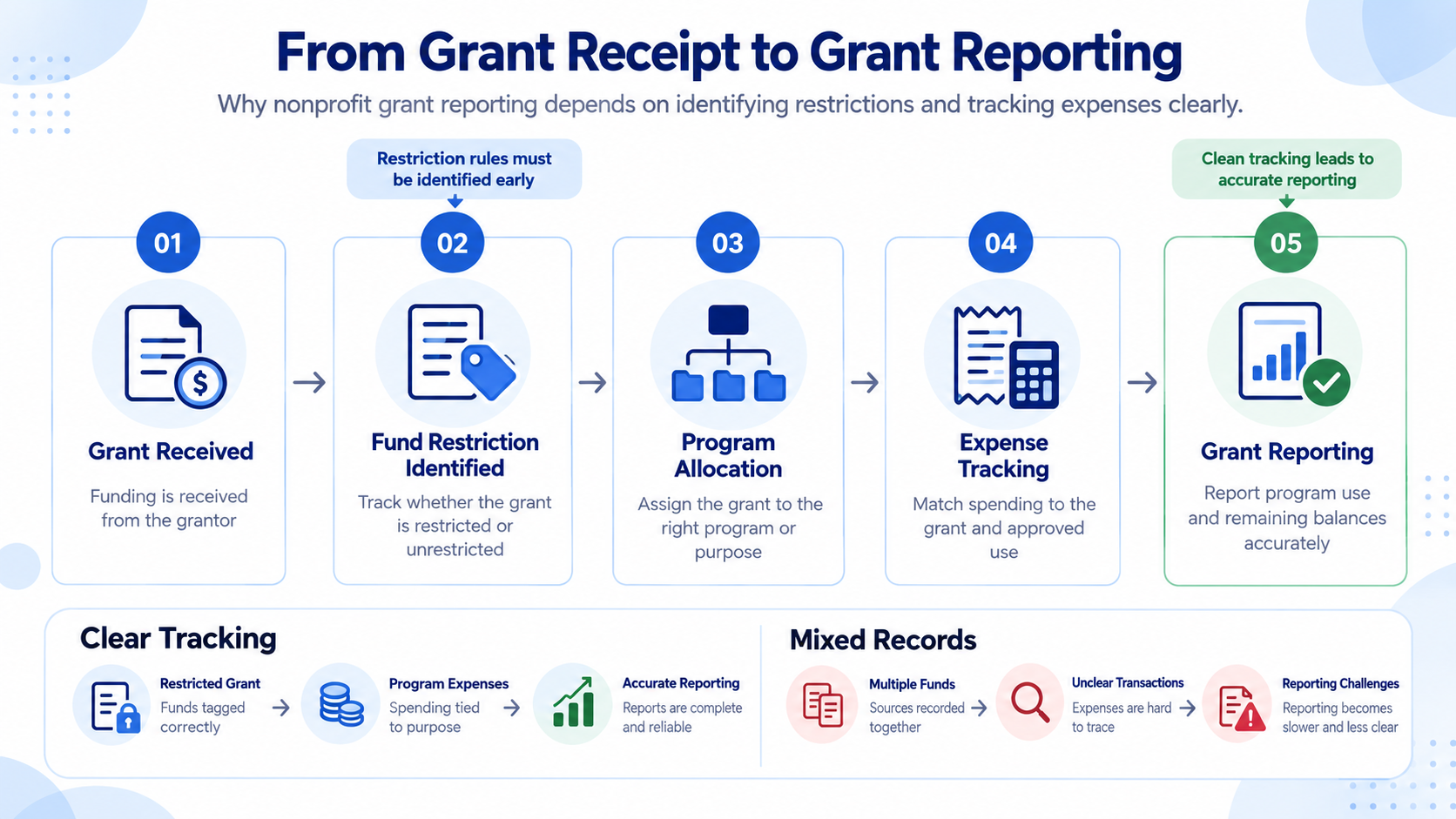
Why Clean Grant Tracking Matters Before an Audit
Many nonprofit accounting problems become visible when external review begins.
An auditor or funder may ask:
“Can you show how this grant was spent?”
If the answer requires weeks of research, the organization has a process problem.
Consistent monthly tracking makes future reporting easier.
It helps CPA firms support clients with:
- Cleaner audit preparation
- Faster financial reviews
- Better grant reporting
- Fewer last-minute questions
How Can CPA Firms Support Nonprofits Without Overloading Their Team?
Nonprofit clients need consistent bookkeeping throughout the year.
However, CPA firms also need to protect internal capacity.
The highest-value work for CPA firms includes:
- Client advisory
- Audit support
- Financial review
- Board-level conversations
Recurring bookkeeping tasks can be supported through a dedicated accounting team.
This includes:
- Transaction categorization
- Bank reconciliation
- Grant-level tracking support
- Monthly bookkeeping
- Financial reporting preparation
The goal is not replacing the CPA relationship.
The goal is helping firms deliver stronger nonprofit support without adding unnecessary internal workload.
How SafeBooks Global Supports Nonprofit Accounting Workflows
SafeBooks Global helps US CPA firms manage recurring bookkeeping requirements for nonprofit clients.
Our support helps firms with:
- Nonprofit bookkeeping workflows
- Grant tracking support
- Account reconciliation
- Monthly financial preparation
By handling recurring accounting tasks, SafeBooks Global helps CPA firms maintain consistent books while focusing internal resources on advisory, review, and client relationships.
Learn more about our accounting firm support services.
For organizations needing bookkeeping assistance, explore our business bookkeeping services.
Need Better Visibility Into Nonprofit Client Books?
For nonprofits, clean books are not just about compliance.
They are how organizations prove responsible use of funding and build trust with donors and funders.
CPA firms that help clients maintain clear grant tracking become more valuable partners.
SafeBooks Global supports CPA firms with dedicated accounting support designed to improve bookkeeping consistency and reporting visibility.
Connect with SafeBooks Global through our contact page.