The partner had three proposals open on his desk, and the honest problem was that he could not tell them apart.
Each provider promised significant savings. Each mentioned security. Each account manager promised support throughout the engagement.
I asked him four questions.
Which provider had sent its current security documentation? Which had disclosed its staff retention rate? Which had explained its review process? Which had put the complete price in writing?
He checked. The answer was none of them.
That is the trap when comparing offshore accounting companies. Providers can appear similar until you examine who performs the work, whether the same people remain assigned, how quality is controlled, and what the quoted rate includes.
The solution is a weighted scorecard covering the criteria that predict whether the relationship will work.
How Should a CPA Firm Compare Offshore Accounting Companies?
Compare offshore accounting companies with a weighted scorecard, not a price sheet.
Score each provider against the same criteria. Give the greatest weight to security, CPA-firm specialization, staff continuity, and review structure. Price should remain one part of the decision, not the basis for the entire decision.
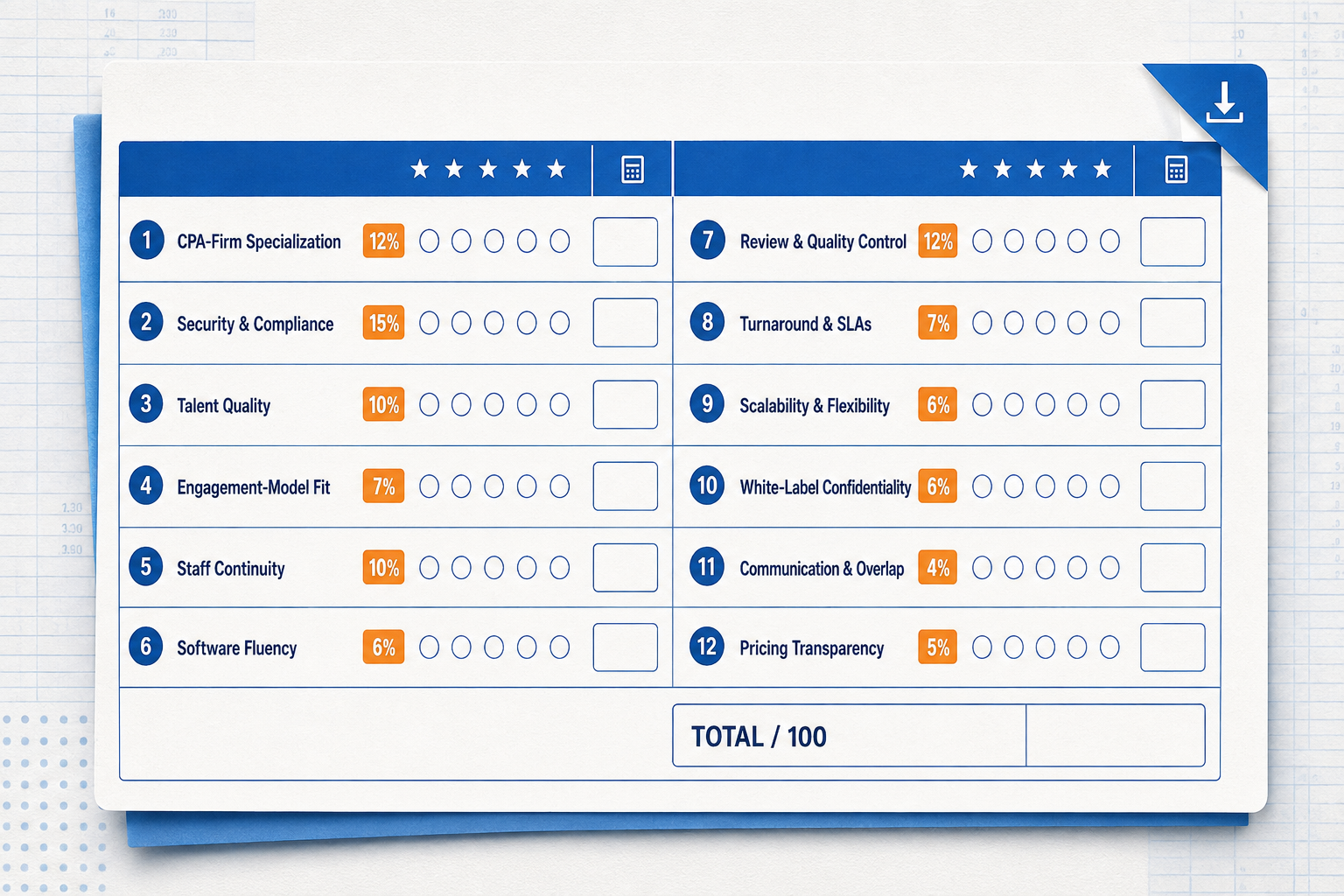
A buyer scorecard for offshore accounting is a weighted checklist a CPA firm uses to compare providers across dimensions such as security, specialization, staff continuity, and review structure, so the decision is based on fit and risk rather than price alone.
This gives partners a consistent way to evaluate proposals, challenge sales claims, and explain their final decision.
What Are the 12 Points on the Offshore Accounting Buyer Scorecard?
The 12 points are CPA-firm specialization, verified security and compliance, talent quality, engagement-model fit, staff continuity, software fluency, review structure, turnaround and service-level agreements, scalability, white-label confidentiality, communication, and pricing transparency.
Together, they cover the operational risk, working fit, and total cost of choosing an offshore accounting partner.
The 12-Point Weighted Offshore Accounting Scorecard
Score every provider from 1 to 5 against each criterion.
Criterion | What good looks like | Question to ask | Red flag | Weight |
1. CPA-firm specialization | Experience with multi-client ledgers, firm review cycles, tax deadlines, and accounting workpapers | What percentage of your clients are CPA and accounting firms? | A generalist that cannot explain CPA-firm workflows | 12% |
2. Verified security and compliance | Current security documentation, controlled access, managed devices, encryption, and defined incident procedures | Can you provide your current SOC 2 Type II report, ISO 27001 certificate, and scope documents? | Certification claims without supporting evidence | 15% |
3. Talent quality and qualifications | Identified professionals with relevant CA, CPA, EA, accounting, tax, or audit experience | Who will perform our work, and can we meet them before signing? | An impressive sales team but an invisible delivery team | 10% |
4. Engagement-model fit | A dedicated, per-return, or hourly model recommended according to the firm’s volume | Which model fits our workload, and why? | One model promoted regardless of the firm’s requirements | 7% |
5. Staff continuity and churn | Named professionals, measured retention, controlled replacements, and knowledge-transfer procedures | Will we have consistent staff, and what was your retention rate last year? | A rotating pool or no answer on retention | 10% |
6. Software fluency | Recent experience with the firm’s QuickBooks, Xero, NetSuite, UltraTax, CCH Axcess, or other platforms | Does the proposed team already use our software? | The firm is expected to replace established tools | 6% |
7. Review structure and quality control | A documented maker-checker process, tracked review notes, and clear escalation rules | Walk us through your review process and how you measure rework | Accuracy claims without a documented process | 12% |
8. Turnaround and SLAs | Written deadlines, dependency rules, response times, and escalation procedures | What service-level agreement will you commit to in writing? | Vague or changing turnaround promises | 7% |
9. Scalability and flexibility | Defined ramp-up, backup coverage, manageable reduction terms, and a reasonable exit process | How quickly can you add staff, and what are the exit terms? | Long lock-ins or expensive reductions | 6% |
10. White-label confidentiality | Controlled client contact, confidentiality agreements, and clear communication permissions | How will your team remain invisible to our clients? | Direct client contact by default | 6% |
11. Communication and overlap | Daily overlap hours, named contacts, visible work tracking, and regular reporting | What are your overlap hours, and where will we track work? | Asynchronous communication with little visibility | 4% |
12. Pricing transparency | An all-in written quote covering staff, management, review, software, and other charges | What is the complete price, including every potential additional cost? | A low headline rate followed by added charges | 5% |
Firms assessing the criteria for outsourcing accounting should request evidence wherever possible. A sales claim should not receive the same score as a documented control, stated retention rate, or written service-level agreement.
How Do You Weight and Score the 12 Points?
Use a simple 1-to-5 scoring scale:
- 1: Unacceptable
- 2: Significant gaps
- 3: Meets the basic requirement
- 4: Strong
- 5: Excellent and supported by evidence
Calculate the result for each criterion using this formula:
Weighted points = criterion score ÷ 5 × criterion weight
If a provider scores 4 out of 5 for security, which carries a 15% weight:
4 ÷ 5 × 15 = 12 weighted points
Complete the calculation for all 12 criteria. The total becomes a score out of 100.
Total score | Interpretation |
85 to 100 | Strong candidate for a pilot |
70 to 84 | Potential fit, but identified gaps need resolution |
55 to 69 | Material operational or risk concerns |
Below 55 | Do not proceed without major changes |
Do not rely only on the total.
Set non-negotiable minimum scores for security, staff continuity, and review structure. A provider should not be able to offset a serious security weakness with low pricing or good communication.
Treat security evidence, named staff, a documented review process, and all-in pricing as minimum requirements, not tradeable features.
How Do You Run the Comparison?
Use the scorecard in four stages.
1. Screen the providers
Eliminate companies that do not support CPA firms, your required services, or your software environment.
2. Ask the same questions
Use the 12 questions during every provider meeting. Request documentation instead of accepting general claims.
3. Run a paid pilot
Shortlist two or three providers and assign a small pilot using representative work. The files should reflect the actual complexity of the planned engagement.
4. Score actual performance
Update the scores based on accuracy, turnaround, review notes, software proficiency, communication, documentation quality, and internal management time.
A provider that presents well but creates repeated rework during the pilot should not retain its original score.
For additional due-diligence questions, review the SafeBooks guide to evaluating an offshore accounting partner.
What Are the Biggest Red Flags?
The most serious warning signs are:
- Security claims without current documentation
- Delivery staff who remain unidentified
- A rotating staff pool
- No documented review process
- Vague turnaround commitments
- Hidden charges behind a low rate
- Long lock-ins with difficult exit terms
- Pressure to sign without a pilot
Any one of these should limit the provider’s score until it is resolved.
Score the Proposal Before You Sign It
A good offshore provider and a bad one can make similar promises.
The difference becomes visible when you score who performs the work, whether the same people remain assigned, how quality is reviewed, what security evidence exists, and what the complete price includes.
Run all 12 criteria. Weight the non-negotiables most heavily. Shortlist two or three providers, complete a controlled pilot, and update the score based on actual performance.
Do not simply approve a proposal. Score it.
If SafeBooks Global is on your shortlist, score us on all 12 points. Ask about our security controls, proposed professionals, review process, retention, software experience, engagement terms, and complete price.
That is exactly the comparison we want to be part of.