

By the sixth business day of the month, many CAS teams still have several client closes open.
One bank feed has stalled. Another client has not sent its final vendor bills. The only senior who knows the files is working through a separate backlog. The books will eventually close, but the delay consumes the review time that should be spent interpreting the numbers and advising clients.
That is the quiet cost of running every close entirely in-house. The work is recurring and predictable, but the capacity available to complete it is not.
An outsourced month-end close does not fix missing data or undocumented processes automatically. When structured properly, it turns the close into a repeatable workflow supported by a standing team, defined responsibilities, and an agreed delivery date.
How Does an Outsourced Month-End Close Work?
An outsourced month-end close follows a documented cycle covering reconciliations, AP and AR cutoff, accruals, adjusting entries, supporting schedules, trial balance review, and draft financial statements. The offshore team completes the preparation and documents exceptions, while the CPA firm retains judgment, final review, approval, and the client relationship.
What Does an Outsourced Month-End Close Include?
An outsourced month-end close is the recurring accounting cycle, including reconciliations, accruals, adjusting entries, and draft financial statements, performed by an external team under a CPA firm’s review, with the firm keeping final sign-off and the client relationship.
The exact scope depends on the client, but common activities include:
- Bank and credit card reconciliations
- Accounts payable and receivable cutoff
- Payroll and intercompany entries
- Accrual and prepaid schedules
- Fixed asset and depreciation support
- Adjusting journal entries
- Balance sheet account review
- Trial balance preparation
- P&L and balance sheet drafting
- Variance or flux analysis
- Open-item tracking
- Close checklist completion
SafeBooks provides month-end close and offshore bookkeeping support through India-based professionals working within the firm’s QuickBooks, Xero, SOPs, reporting calendar, and review process.
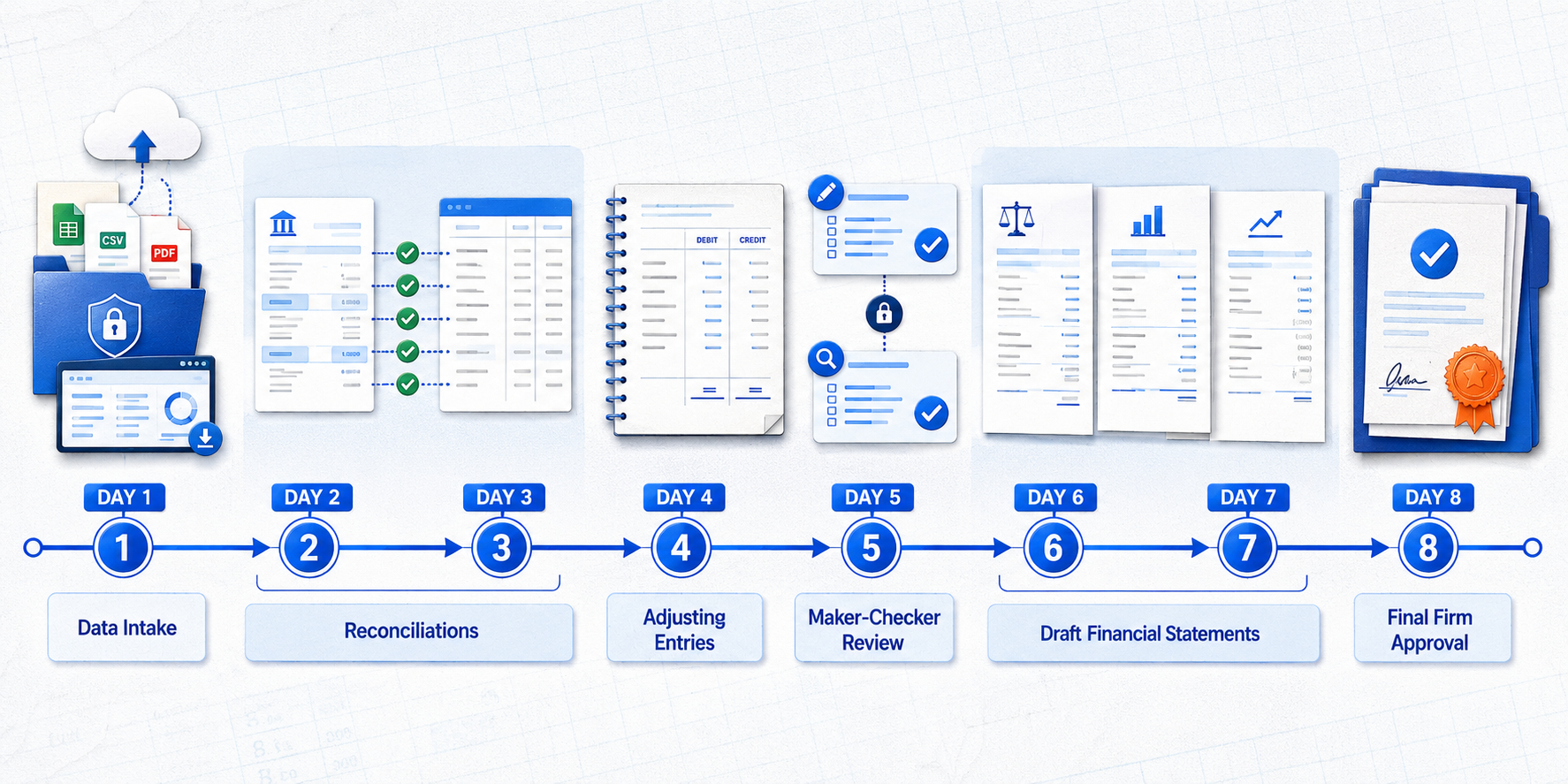
What Does the Month-End Close Workflow Look Like Day by Day?
A well-run close moves through clear stages. The offshore cycle can also extend the firm’s production day, allowing work handed off in the evening to progress while the US team is offline.
Day | Stage | Main responsibility |
Days 1 to 2 | Data intake and cutoff | Confirm bank feeds, bills, payroll data, and missing documents |
Days 2 to 4 | Reconciliations and cleanup | Reconcile accounts, classify transactions, and investigate differences |
Days 3 to 5 | Close entries | Prepare accruals, prepaids, payroll, intercompany, and adjusting entries |
Days 4 to 6 | Maker-checker review | Review reconciliations, schedules, entries, and unresolved exceptions |
Days 5 to 8 | Reporting package | Prepare the trial balance, draft statements, and variance analysis |
Final stage | Firm review and delivery | Approve adjustments, interpret results, and communicate with the client |
These stages may overlap. A clean client with timely data can move quickly, while a client with incomplete records or unresolved prior-period issues will require more time.
The close calendar should define cutoff dates, required documents, preparers, reviewers, escalation owners, and the expected delivery date.
How Long Does an Outsourced Month-End Close Take?
A realistic planning range is five to ten business days. A clean, mature close with timely data may compress to three to five business days, while the first close or a cleanup-heavy file may take longer.
These ranges should not be treated as guaranteed benchmarks. Turnaround depends on:
- Transaction volume
- Number of accounts and entities
- Data availability
- Client responsiveness
- Prior-period cleanup
- Required review depth
- Reporting complexity
- Close-calendar discipline
Speed should come from familiarity and process consistency, not from skipping review. A standing team that knows the client’s accounts can usually work more efficiently than a different resource assigned each month.
Expert Insight
“A fast close is not created by asking the team to work faster. It comes from fixing the cutoff, documenting the checklist, assigning clear review ownership, and resolving missing-data questions before they stop the entire file.”
CA Anshul Agrawal
Accounts Director, SafeBooks Global
What Actually Drives Month-End Close Turnaround?
The largest turnaround factors are data readiness and response time, not the team’s location.
Closes usually slow down because:
- Bank feeds are incomplete
- Vendor bills arrive after cutoff
- Payroll data is delayed
- Intercompany balances do not agree
- Prior-period differences remain unresolved
- Client questions go unanswered
- No fixed close date exists
- Review ownership is unclear
A documented close calendar, shared open-item list, daily overlap window, and dedicated team provide more value than a vague promise of fast delivery.
SafeBooks also offers practice management support for CPA firms to track missing documents, reconciliations, entries, review stages, and close deadlines across recurring client engagements.
What Does the Offshore Team Handle and What Stays With the Firm?
Clear responsibility prevents duplicated work and protects the client relationship.
Offshore team handles | CPA firm retains |
Reconciliations and transaction cleanup | Final reconciliation approval |
AP and AR cutoff support | Client-specific cutoff decisions |
Accrual and prepaid schedules | Technical accounting judgment |
Draft journal entries | Final entry approval |
Supporting schedules | Material variance review |
Draft financial statements | Interpretation and client delivery |
Open-item tracking | Sensitive client communication |
Close checklist updates | Final close sign-off |
Under a white-label accounting support model, the offshore team works behind the firm’s brand. The CPA firm remains responsible for review, client communication, professional judgment, and final approval.
What Should CPA Firms Expect in the First 90 Days?
The first close is usually part production and part calibration.
First close
The team learns the chart of accounts, reporting package, cutoff rules, recurring entries, software, and review expectations. Historical cleanup and undocumented exceptions may become visible.
Second close
The checklist becomes clearer, recurring questions decrease, and review feedback is incorporated into the next cycle.
Third close
The same professionals understand the file, recurring entries are documented, responsibilities are established, and the close becomes more predictable.
The goal should not be an unrealistically perfect first month. It should be measurable improvement across review notes, turnaround, unresolved items, and internal reviewer time.
SafeBooks’ remote bookkeeping services for accounting firms include reconciliations, journal-entry support, account review, balance sheet cleanup, P&L checks, and close-ready files.
How Do CPA Firms Maintain Quality and Control?
Control comes from requirements that can be documented and measured:
- A complete close checklist
- Named preparers and reviewers
- Maker-checker review before handoff
- A service-level agreement with a close date
- Defined materiality and escalation thresholds
- Role-based access and multifactor authentication
- Activity logs and access-removal procedures
- Final approval retained by the CPA firm
SafeBooks publicly states that it holds SOC 2 Type II certification covering Security, Availability, Processing Integrity, Confidentiality, and Privacy. Firms should request the current report, confirm its scope, and review the controls applying to their delivery environment before providing client access.
A Predictable Financial Close Is the Real Outcome
A well-run outsourced financial close should arrive on an agreed date, in a consistent format, reconciled and ready for review.
Outsourcing does not create that discipline on the first day. It provides the standing capacity needed to document the workflow, assign ownership, incorporate feedback, and repeat the process each month.
Start with one or two clients. Document the checklist, run a supervised close, measure review notes and turnaround, and expand only after the process becomes stable.
Discuss month-end close support with SafeBooks Global to review your client volume, reporting calendar, software, workflow, and dedicated-team requirements.