
Schedule M 3 and Schedules K 2 K 3 are no longer rare filings. They are now some of the most time heavy and risk sensitive components of corporate and partnership compliance. These schedules demand large data intake, detailed categorization, and narratives that explain book tax differences and foreign credit allocations clearly.
Meanwhile AI adoption in accounting has accelerated rapidly. Recent surveys indicate adoption has moved from under 10 percent to well above 40 percent within roughly one year. Firms have shifted from experimentation to real application. AI now reads financials, extracts foreign tax values, classifies accounts, and drafts variance explanations that used to consume hours of human attention.
For SafeBooks clients building scalable remote workflows, this shift is not theoretical. It is already changing how work is allocated, reviewed and completed.
Why M 3 And K 2 K 3 Slow Down Tax Teams
Schedule M 3 applies once an entity crosses 10 million dollars in assets. It expands traditional reconciliation into a line by line breakdown of temporary and permanent differences with supporting narratives. Anyone who has handled M 1 reconciliation understands the foundation. Our resource on M 1 adjustment journal entries highlights the complexity even before M 3 is added.
K 2 and K 3 bring similar friction to international reporting. Even partnerships with minimal foreign activity often file because partners need foreign tax credit data. These schedules can stretch beyond twenty pages and change whenever the IRS updates exceptions or guidance.
Common bottlenecks include
- High volume of unstructured source documents
- Mapping that resets every tax season
- Variances that require fresh explanatory language
- Quiet review risks if numbers shift year over year
This is exactly where AI and structured offshore workflows outperform manual processes.
How AI Improves M 3 Reporting End To End
Smarter mapping of trial balances
Document AI reads trial balances, depreciation schedules and consolidation exports, then suggests mapping to M 3 categories without rebuilding worksheets annually. Teams using SafeBooks tax support gain further leverage because we prepare standardised mapping models before review begins. More time moves to judgement instead of typing.
Automated variance explanations
AI highlights year to year changes and drafts explanation language, letting reviewers edit instead of writing from scratch.
A real use case
During an engagement, AI detected a shift in foreign withholding rates between years. That insight redirected treatment of the foreign tax credit and prevented over reporting for multiple partner K 3 outputs. The model surfaced the change. Human review validated and finalised the filing position.
Built in control checks
AI driven review steps catch issues before sign off including
- Reconciliation mismatches
- Inconsistent treatment of permanent differences
- Unusual movement compared to prior year
Partners review flagged points rather than rechecking the entire return manually.
Where AI Eliminates Workload On K 2 And K 3
Foreign income data extraction
Custodian statements, foreign dividend reports and multi page PDFs become machine readable tables. Tools like CCH Axcess Scan already handle K 1s and 1099s. Firms now extend this workflow to international schedules so data enters clean rather than copied manually.
Multi partner K 3 creation
Entity level foreign data is stored once. Partner attributes apply automatically. Draft K 3s generate in minutes instead of days. This approach aligns closely with the infrastructure and process design we discuss inside best tech stack for offshore accounting firms.
Exception qualification detection
Domestic filing and small partnership exceptions evolve. AI monitors IRS guidance and alerts when a client qualifies or no longer qualifies, reducing unnecessary filing.
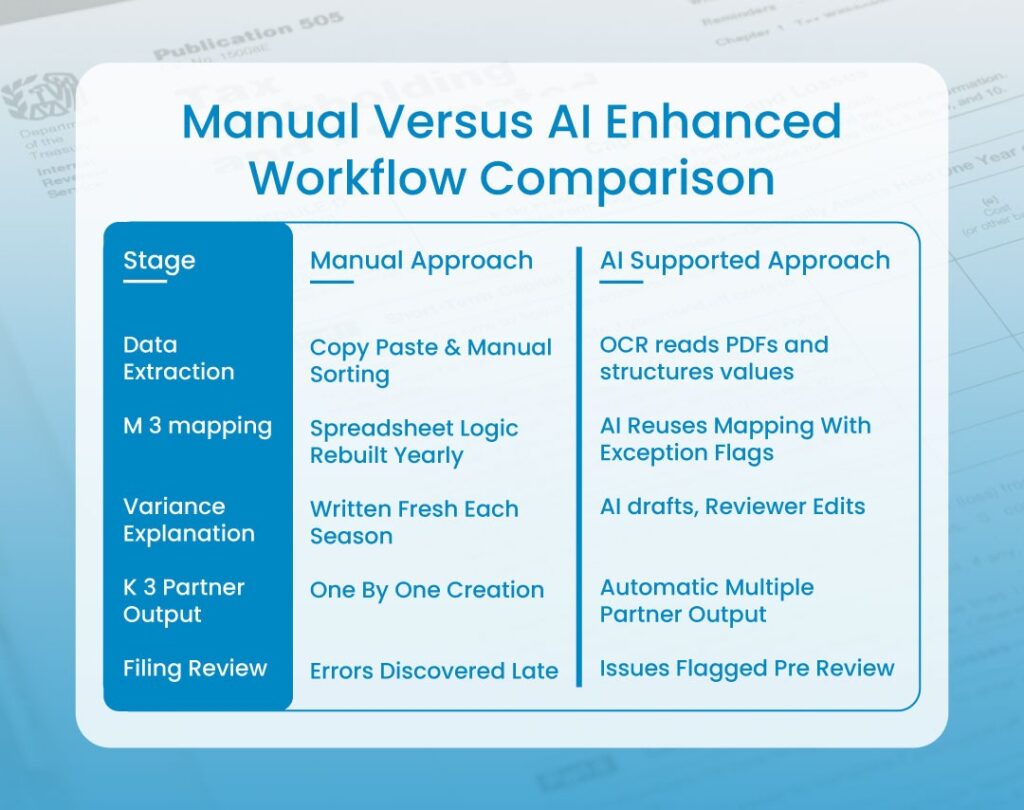
The transformation is simple. AI reduces the mechanical volume so reviewers and partners focus on correctness, position and communication.
Expert Insight
“Most firms think M 3 and K 2 K 3 problems are caused by complexity alone. In reality, the real issue is repetition. The same mappings, explanations, and foreign data handling get rebuilt every year. AI changes this by preserving structure and surfacing only what truly needs judgment. When you combine AI-assisted preparation with a disciplined offshore workflow, reviewers stop redoing work and start validating positions.”
-Shivangi Agrawal
Managing Director (CA, CPA USA), SafeBooks Global
The Future Of M 3 And K 2 K 3 Compliance Is Hybrid People plus AI
The profession is shifting toward a model where technology handles extraction and mapping while human teams handle interpretation and signing authority. That hybrid model is already outperforming manual workflows in time, consistency and defensibility.
SafeBooks operates inside this model. Our offshore teams work with AI driven prep and mapping to deliver structured schedules that reviewers can finalize without rebuilds. You retain control. We handle the operational load.
If your firm wants to reduce manual work on M 3 and K 2 K 3, shorten review cycles and scale without internal hiring pressure, you can explore support options here Support for accounting firms or get in touch directly through contact us