If AI Does the Junior Work, Who Trains the Future Senior Accountant?
AI is changing how accounting work gets done.
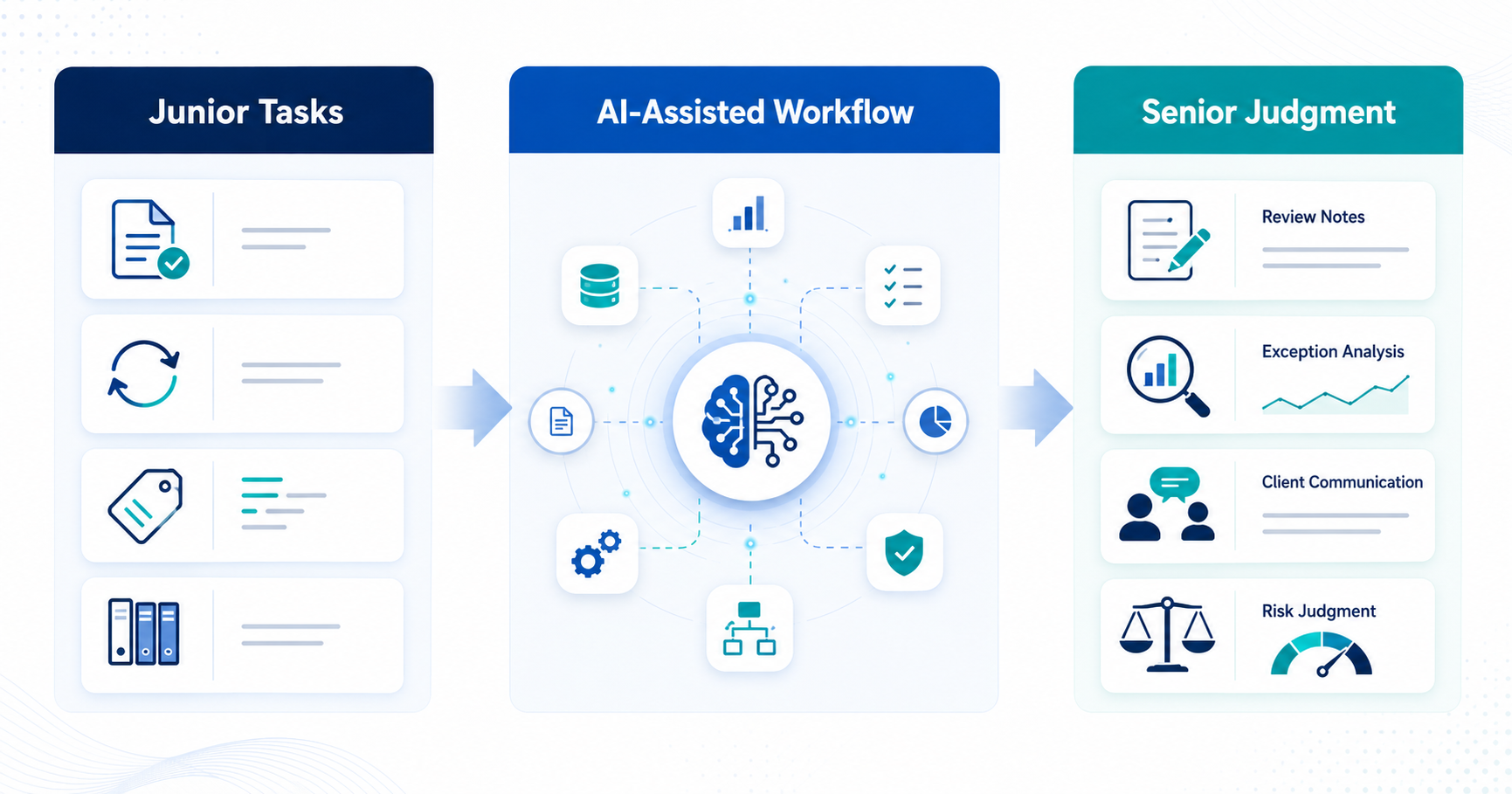
Tasks that once took junior accountants hours to complete can now be supported by automation. Document extraction, transaction matching, coding suggestions, reconciliation support, draft workpapers, and exception summaries are all becoming faster.
That is a good thing for firm efficiency. But it creates a new challenge for CPA firm talent development.
For years, junior accountants learned through repetitive work. They checked documents, matched transactions, prepared reconciliations, reviewed coding, built workpapers, chased missing information, and fixed small errors before they became larger issues.
Some of that work was tedious. But it was not meaningless.
It helped young accountants build pattern recognition, documentation discipline, professional skepticism, and review judgment.
So the real question is not only whether AI will reduce junior work. The bigger question is this:
If AI does the junior work, how will firms train future senior accountants?
Junior Accounting Work Was Also a Training Ground
Entry-level accounting work is often described as basic production work. But the learning inside that work is deeper than it looks.
When a junior accountant prepares a reconciliation, they learn how timing differences appear. When they review source documents, they learn what missing support looks like. When they check transaction coding, they learn how errors move through the ledger. When they prepare workpapers, they learn how clean documentation supports review.
The work may have been repetitive, but the learning was not.
Those early tasks helped junior accountants understand how accounting problems actually show up in client files. They saw unclear vendor names, inconsistent coding, incomplete documents, unreconciled balances, unusual account movement, and client follow-up gaps.
That exposure matters. It is how future reviewers learn what risk looks like.
If firms remove all of that exposure without replacing it with a better training model, they may solve today’s efficiency problem while creating tomorrow’s leadership problem.
The Risk Is Not AI. The Risk Is Weak Training Design.
AI is not the problem. Weak training design is the problem.
If junior accountants only see final AI-generated outputs, they may not understand the process behind them. They may know the answer, but not the logic. They may see a clean reconciliation, but not understand the exception that should have been questioned. They may trust a system output before developing the professional skepticism needed to challenge it.
This is where automation bias becomes a serious concern.
In accounting, professionals still need to ask:
- Does this number make sense?
- What source document supports it?
- What changed from last period?
- Is this an actual exception or a system issue?
- What needs to be escalated to the reviewer or client?
AI can prepare output. It cannot replace the judgment path that creates strong accountants.
CPA Firms Need to Train Judgment Earlier
The traditional model trained judgment slowly through repeated exposure. The AI-era model has to be more intentional.
If AI handles more first-draft work, firms need to move junior training closer to review thinking. Junior accountants should not only learn how to complete tasks. They should learn how to evaluate outputs, question exceptions, and explain what changed.
This means training should shift from task completion to review discipline.
A junior accountant should learn how to compare AI-prepared outputs against source documents. They should learn how to identify missing support, unusual account movement, coding inconsistencies, and incomplete explanations.
They should also learn how to write clear review notes. A future senior accountant is not only someone who finds an issue. It is someone who can explain the issue clearly enough for the next person to act.
A Better Training Model for AI-Era Accountants
Firms do not need to bring back repetitive manual work just to preserve learning. They need to redesign learning around the new workflow.
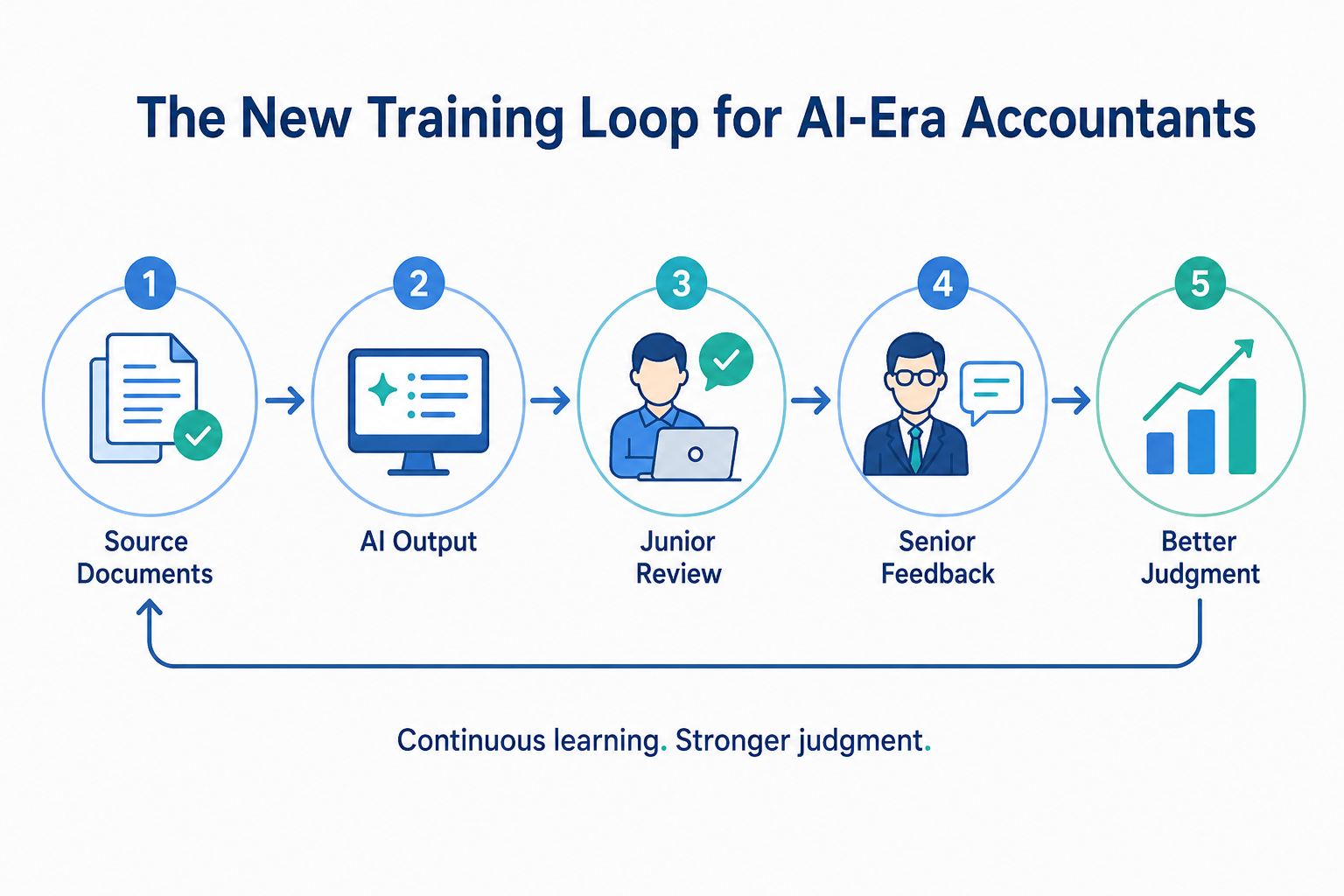
A practical AI-era training model should include five habits.
- Shadow AI outputs
Junior accountants should compare AI-prepared reconciliations, workpapers, and summaries against source documents. The goal is to understand what the system did correctly and what still needs review. - Review exceptions early
Clean items teach less than unusual items. Missing documents, unmatched transactions, duplicate entries, and inconsistent coding help juniors build stronger judgment. - Use practice cases
Firms should give juniors exposure to messy books, incomplete workpapers, unclear client responses, and unusual account movements before they encounter them in live client work. - Train review-note writing
Juniors should learn to document what they checked, what changed, what remains open, and what needs escalation. Review notes are one of the clearest signs of professional maturity. - Keep senior feedback in the loop
AI can support work, but it cannot replace coaching from someone who understands risk, client context, and professional judgment.
This is how firms can remove repetitive work without removing the learning path.
Remote Accounting Teams Need the Same Development Model
This issue is not limited to in-house teams.
Remote accounting teams also need structured development. If remote staff are treated only as task support, firms miss the opportunity to build stronger, more reliable accounting capacity.
A strong remote team should understand source documents, workflows, review expectations, exception handling, client communication, and escalation standards. They should not only process work. They should learn how to prepare review-ready work.
This becomes even more important when AI tools are part of the workflow. Remote staff need to know when to trust automation, when to question it, and when to escalate.
SafeBooks supports CPA firms through structured bookkeeping and accounting support and back-office support for accounting firms designed around workflow discipline, review readiness, and scalable delivery.
SafeBooks has also discussed how reliable remote accounting workflows help firms build consistency before scaling distributed teams.
Expert Insight
“AI can reduce repetitive work, but firms still need to create structured learning. Junior accountants do not become strong reviewers only by seeing final outputs. They need exposure to source documents, exceptions, review notes, client communication, and senior feedback. The firms that redesign training around judgment will build stronger future seniors.”
Shivangi Agrawal, Managing Director (CA, CPA USA), SafeBooks
AI Should Remove Repetition, Not the Learning Path
AI can improve accounting workflows. It can reduce repetitive tasks, speed up preparation, and help teams focus on higher-value work.
But firms should be careful not to remove the learning path that creates future senior accountants.
Junior accountants still need exposure to the logic behind the work. They need to see exceptions, investigate unusual items, write review notes, and receive feedback from experienced professionals.
The future of accounting training will not be based only on doing more manual work. It will be based on better-designed learning.
The firms that get this right will not simply have faster accounting teams. They will have stronger future reviewers, managers, and advisors.
For CPA firms ready to build scalable accounting support without losing training discipline, SafeBooks helps create structured remote accounting teams with clear workflows, review systems, and development-focused delivery. To discuss how this could support your firm, contact SafeBooks.