A Cost and Capacity Analysis for US-Based Accounting Firms
A growing accounting firm can sell more work faster than it can staff the backend.
That is where the real pressure starts. Client work keeps coming in, but partners and managers are pulled into cleanup, reconciliations, review notes, and unfinished monthly close work instead of advisory, client communication, and final review.
This is why many US-based accounting firms are comparing in-house accounting staff with offshore bookkeeping teams. The decision is not simply about which option costs less. It is about which model gives the firm enough production capacity without weakening review control or client trust.
For many firms, the strongest answer is a hybrid model: keep judgment, review, and client-facing work in-house, while using offshore bookkeeping support for structured preparation work.
Key Takeaway: Which Model Costs Less and Scales Better?
Offshore bookkeeping usually costs less for structured production work, while in-house accounting staff add more value in review, advisory, client communication, and judgment-heavy decisions.
A US accounting firm should compare the fully loaded cost of in-house hiring against the total operating cost of offshore bookkeeping, including onboarding, review time, security setup, software access, communication, and rework risk.
Why US Accounting Firms Are Comparing Both Models
The accounting talent picture is improving, but that does not remove today’s capacity problem.
AICPA reported that accounting bachelor’s and master’s degree completions fell to 55,152 in the 2023-24 academic year, down 6.6% from the prior year. More recent enrollment data is more encouraging: four-year undergraduate accounting enrollment rose 8.9% in spring 2026 to 205,180 students, the third straight year-over-year increase. (Journal of Accountancy)
That recovery helps the long-term pipeline, but it does not instantly create experienced bookkeepers, staff accountants, reviewers, or managers. Firms still need capacity now.
BLS projects employment for accountants and auditors to grow 5% from 2024 to 2034, with about 124,200 openings each year on average. For bookkeeping, accounting, and auditing clerks, BLS reports a 2024 median wage of $49,210 and about 170,000 projected annual openings, even though employment in the role is expected to decline as automation changes routine clerical work. (Bureau of Labor Statistics)
The Real Cost of In-House Accounting Staff
The in-house cost is more than salary.
BLS reported the median annual wage for accountants and auditors was $81,680 in May 2024. For bookkeeping, accounting, and auditing clerks, the median annual wage was $49,210. Those figures are useful baselines, but accounting firms also need to account for payroll taxes, benefits, PTO, recruiting, training, software, hardware, manager supervision, and turnover risk. (Bureau of Labor Statistics)
That does not make in-house staff inefficient. It means they should be used where they create the highest value: client communication, final review, advisory interpretation, sensitive decisions, and quality control.
The Real Cost of Offshore Bookkeeping
Offshore bookkeeping can lower the cost of recurring production work, but a low rate alone does not guarantee savings.
A strong offshore model includes trained bookkeeping support, secure access, SOP alignment, open-item tracking, workpaper preparation, and a clear review workflow. A weak model creates hidden cost through rework, unclear communication, poor documentation, and manager frustration.
For planning purposes, many firms evaluate offshore bookkeeping as a dedicated monthly cost or hourly support model. A practical directional range for offshore bookkeeping support is often around $18 to $28 per hour for dedicated support, depending on role level, provider structure, geography, supervision, and security controls. Firms should confirm actual pricing with the provider instead of treating this as a universal benchmark.
SafeBooks’ bookkeeping and accounting support for accounting firms helps firms move recurring preparation work into a more structured review-ready workflow.
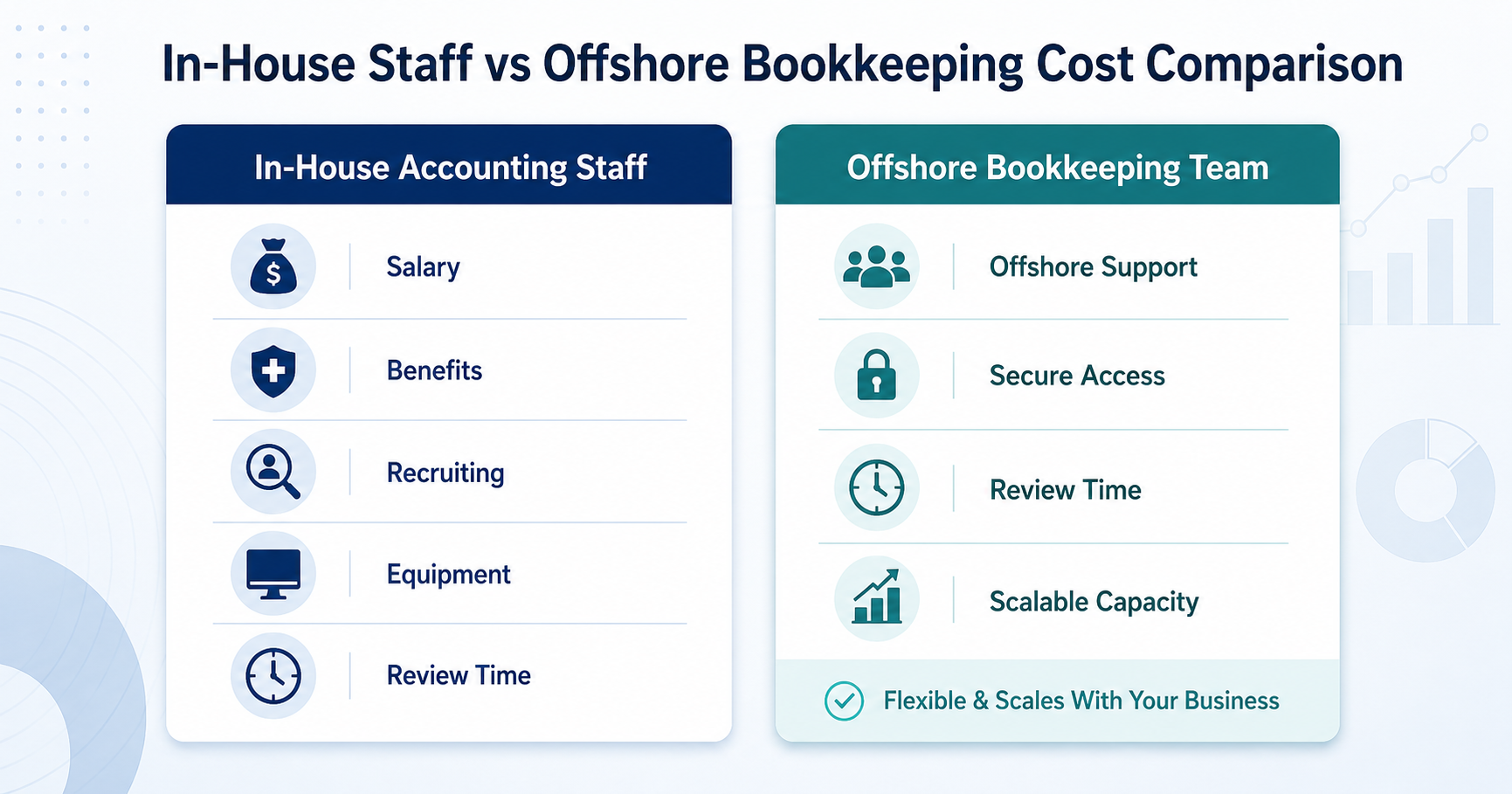
Cost and Capacity Comparison
Factor | In-House Accounting Staff | Offshore Bookkeeping Team |
Average base salary / rate | Bookkeeping clerks: $49,210 median annual wage; accountants/auditors: $81,680 median annual wage | Often evaluated around $18-$28/hour for dedicated offshore bookkeeping support, depending on role and provider |
Fully loaded cost | Higher than base salary after benefits, payroll taxes, recruiting, software, equipment, and overhead | May include staff, infrastructure, supervision, and secure access depending on provider model |
Time to deploy | Slower because recruiting, interviews, hiring, and onboarding take time | Faster when the provider has trained capacity available |
Software and infrastructure | Firm absorbs licenses, devices, access setup, and office support | Provider may support infrastructure, while the firm controls system access |
Scalability | Limited by local hiring speed and payroll budget | Easier to scale for recurring work or busy-season pressure |
Best use | Review, advisory, client communication, final approval | Ledger hygiene, reconciliations, cleanup support, workpaper prep, open-item tracking |
Main risk | Fixed cost and hiring delays | Rework if SOPs, security, or review standards are weak |
Where In-House Staff Adds the Most Value
In-house accounting staff should stay close to the work that requires judgment and client trust.
This includes final month-end review, client-facing reporting, advisory conversations, cash flow interpretation, chart of accounts decisions, sensitive client issues, and final approval.
For CPA firms, the goal should not be to push every accounting task offshore. The goal is to protect senior staff from routine production work so they can focus on review quality and client value.
Where Offshore Bookkeeping Adds Capacity
Offshore bookkeeping works best when the work is structured, repeatable, and reviewable.
That includes ledger cleanup, bank and credit card reconciliations, receipt matching, historical balance cleanups, AP/AR processing, monthly support schedules, exception lists, and draft close packages.
This kind of support helps firms reduce bottlenecks without adding local headcount. SafeBooks’ blog on remote accounting workflow setup explains how distributed accounting work can be structured more clearly.
The Review-Control Question
The biggest risk with offshore bookkeeping is not geography. It is weak workflow design.
A strong process should define where documents are stored, who assigns work, how exceptions are flagged, what the close checklist includes, who reviews adjustments, and when the file is ready for final approval.
Firms should track turnaround time, first-pass review quality, rework volume, open-item ageing, and manager review comments. These metrics show whether offshore bookkeeping is improving capacity or simply moving the bottleneck.
Security and Data Access Considerations
Bookkeeping involves bank feeds, payroll records, invoices, vendor information, and financial reports. Security needs to be part of the workflow before access is granted.
CPA firms should use MFA, role-based access, secure portals, audit logs, restricted permissions, and separate preparation access from approval authority. Shared logins and email attachments should be avoided.
The FTC Safeguards Rule requires covered financial institutions to develop, implement, and maintain an information security program with safeguards to protect customer information. The FTC also defines multi-factor authentication as using at least two authentication factors.
For offshore bookkeeping partners, firms should also ask whether the provider supports clean-room controls, restricted local data caching, disabled USB or print access where applicable, staff NDAs, and activity logging. SafeBooks explains its approach in how SafeBooks protects client financial data.
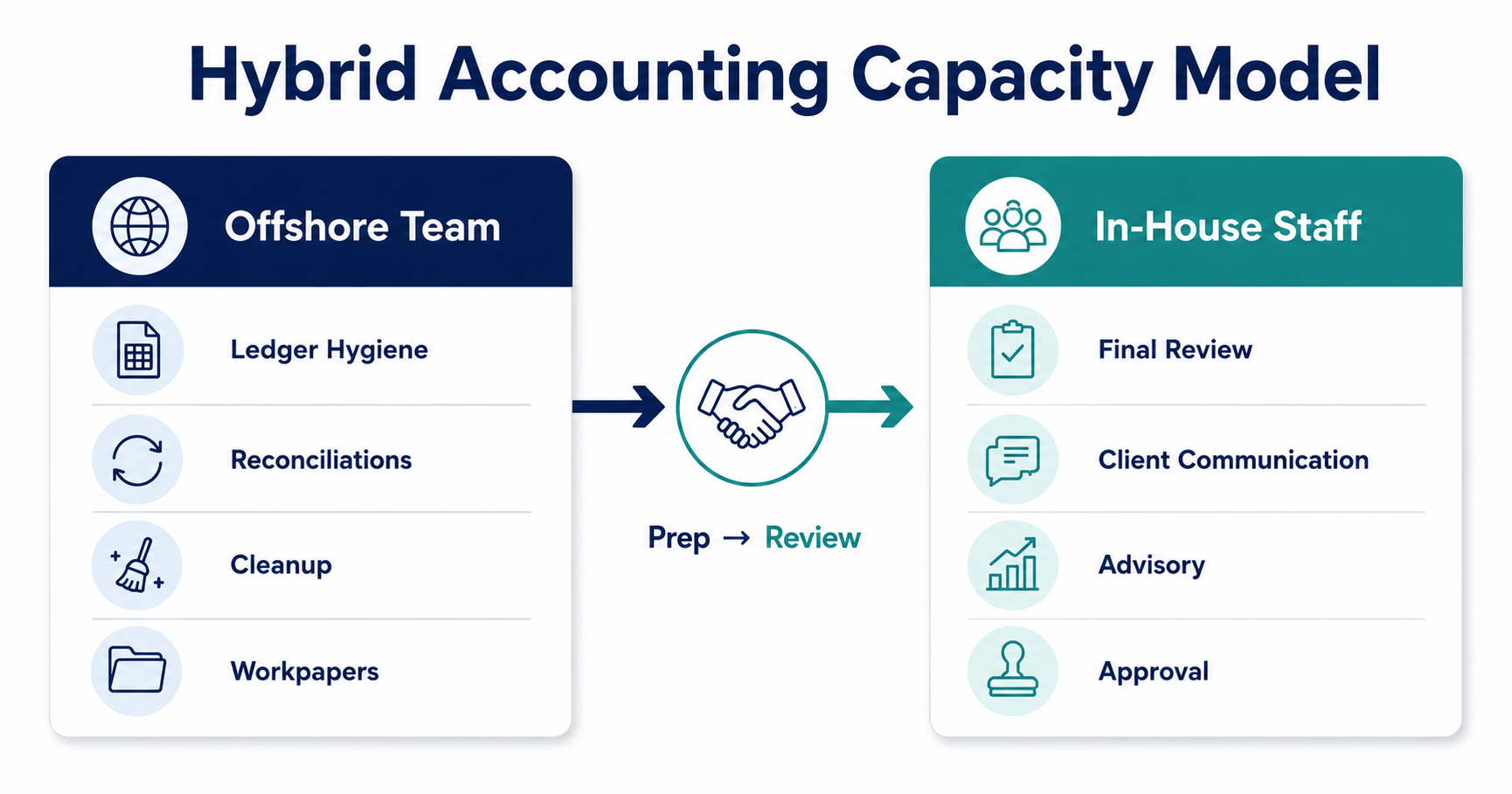
Hybrid Model: In-House Judgment + Offshore Preparation
The best structure for many firms is a hybrid model.
The offshore team handles preparation-heavy work such as ledger hygiene, reconciliations, cleanup support, open-item tracking, and workpaper preparation.
The in-house team handles final review, client communication, advisory interpretation, and approval.
This model gives firms capacity without giving up control.
Where SafeBooks Fits Into the Cost and Capacity Equation
SafeBooks Global helps US accounting firms build offshore bookkeeping capacity around their current workflow, tools, deadlines, and review standards.
For firms that need recurring monthly support, SafeBooks can assist with bookkeeping cleanup, reconciliations, AP/AR support, workpaper preparation, open-item tracking, and back-office accounting workflows.
Accounting firms can explore SafeBooks’ support for accounting firms, bookkeeping and accounting, and back-office support.
Expert Insight
“The best firms do not look at offshore bookkeeping and in-house staff as an either-or decision. They use in-house talent for judgment, client communication, and review, while offshore teams handle structured preparation work that keeps the monthly workflow moving.“
Anshul Agrawal
Accounts Director, CA, SafeBooks Global
In-house accounting staff and offshore bookkeeping teams solve different capacity problems.
In-house staff are best for judgment, client communication, review, and advisory. Offshore bookkeeping is best for structured preparation work that can be assigned, tracked, and reviewed.
For US accounting firms trying to protect margins and capacity, the stronger model is often hybrid: keep final control in-house and move recurring bookkeeping preparation to a secure offshore team.
To map which parts of your accounting workflow can move offshore safely, schedule a capacity discussion with SafeBooks Global.