AI Won’t Save a Messy Accounting Process. It Will Expose It.
AI is now part of almost every accounting conversation. Firms are looking at tools for document intake, data extraction, reconciliation support, exception management, review preparation, and reporting.
That does not mean AI can fix a weak accounting process.
In fact, it often does the opposite.
AI works best when the workflow underneath it is already structured. When the process is messy, AI does not remove the mess. It exposes it faster.
This is where many CPA firms and finance teams need to pause. Buying an AI tool is not the same as building an AI-ready accounting workflow. Industry discussion around AI in accounting increasingly points toward document intake, extraction, exception handling, and review-ready outputs, but these tools still depend on clean inputs, clear workflows, and human review.
Before adding AI to accounting workflows, firms should first fix the process gaps that create errors, delays, and rework.
Why AI Exposes Weak Accounting Workflows
AI depends on structure. It needs clean source documents, consistent coding rules, clear review steps, reliable client follow-up, and defined close timelines.
If invoices arrive through multiple channels, reconciliations are handled differently by each staff member, and review ownership is unclear, AI will not create order by itself. It may extract faster, classify faster, and flag exceptions faster, but the final output will still reflect the weakness of the underlying process.
This is why AI should be treated as an amplifier, not a shortcut.
A clean accounting process becomes faster with AI. A messy accounting process becomes more visibly messy.

7 Process Gaps to Fix Before Adding AI
1. Messy Source Document Intake
AI extraction depends on clean inputs. If client documents come through email, portals, shared drives, screenshots, and unorganized attachments, the workflow is already broken before AI begins.
Firms need a standard intake process. Documents should be collected through defined channels, named consistently, linked to the right client or entity, and checked for completeness before processing starts.
2. Inconsistent Coding Rules and COA Mapping
AI can help classify transactions, but it needs consistent logic to follow.
If one staff member codes a software subscription under technology expense and another codes the same vendor under office expense, AI learns from inconsistency. That is why Chart of Accounts standardization matters. Firms need clear account definitions, vendor mapping rules, coding logic, and exception handling before automation can work reliably.
3. Weak Reconciliation Standards
Reconciliation cannot depend on personal habits.
If every accountant reconciles bank accounts, credit cards, payroll, and intercompany balances differently, AI will struggle to support a consistent process. Firms need standard reconciliation templates, thresholds, exception rules, and review notes.
The goal is not only faster reconciliation. The goal is review-ready reconciliation.
4. Unclear Review Ownership
AI can prepare outputs, but someone still needs to own the review.
A common mistake is assuming that AI-generated work is automatically ready for approval. It is not. Firms need clear rules around who reviews the output, what gets checked, what gets escalated, and what can be approved.
This is especially important for close workflows, tax preparation, bookkeeping cleanup, and multi-entity accounting, where small errors can compound quickly.
5. Poor Client Follow-Up
AI can identify missing items, but it cannot fix a weak client follow-up process.
If teams delay information requests, ask unclear questions, or chase documents manually at the last minute, the workflow will still slow down. Firms need a structured follow-up process with standard request formats, due dates, ownership, and escalation rules.
A clean client communication process makes AI-assisted workflows much more effective.
6. Unstructured Month-End Close
AI works better when the close process is already mapped.
Many firms still handle month-end close through informal checklists, spreadsheet trackers, and staff memory. That creates risk. A proper close process should define tasks, dependencies, cutoff dates, review points, and final sign-off.
SafeBooks has covered the importance of structured remote accounting workflows for firms trying to build reliable delivery models.
7. Weak Documentation and Audit Trail
AI outputs need to be explainable.
Firms should be able to trace what source document was used, what assumption was made, who reviewed the output, what changed, and when it was approved. Without this, AI can create more review risk instead of reducing it.
Speed without traceability is not efficiency. It is exposure.
AI Should Support Judgment, Not Replace Review
The best use of AI in accounting is not to remove accountants from the process. It is to move them away from repetitive work and closer to judgment-based work.
AI can help extract data, match transactions, summarize exceptions, prepare draft outputs, and speed up review preparation. But accountants still need to validate the logic, question unusual items, apply professional judgment, and explain the result to clients.
This is why AI implementation should begin with process design, not software selection.
A firm with clean workflows, review ownership, and documentation standards will get more value from AI than a firm that simply buys another tool.
Where Remote Accounting Teams Fit In
AI-ready accounting is not only about technology. It is also about the people and process around the technology.
Remote accounting teams can support AI adoption when they help standardize document intake, maintain reconciliation discipline, prepare review-ready workpapers, manage follow-ups, and keep close calendars on track.
But this only works when the remote model is structured. Without clear workflows, review systems, and communication standards, remote teams can face the same process gaps as internal teams.
SafeBooks supports CPA firms through structured back-office support and bookkeeping and accounting support designed around process discipline, review readiness, and scalable delivery.
Expert Insight
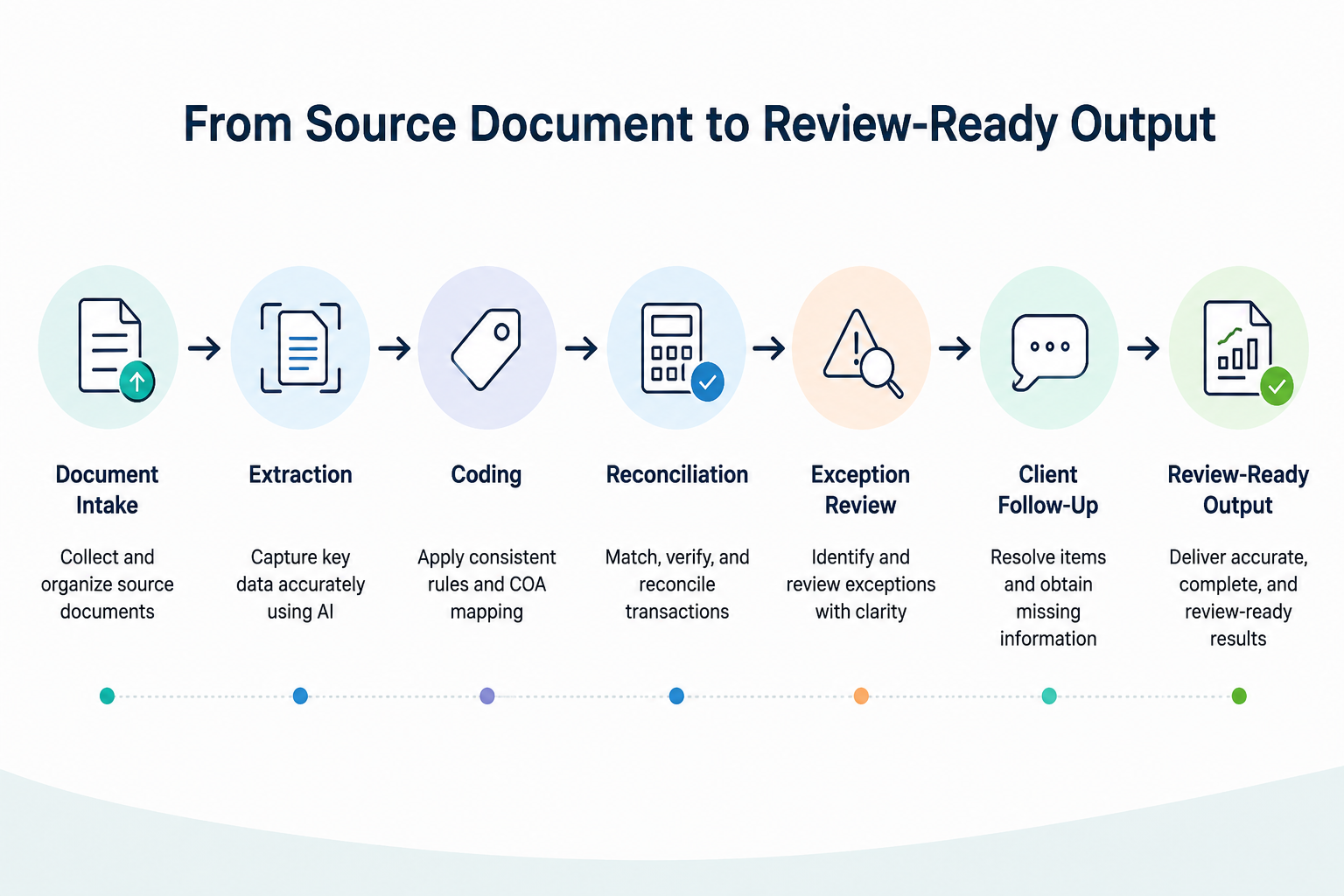
“AI can speed up accounting work, but it cannot replace process discipline. If document intake, reconciliations, review ownership, and close timelines are unclear, AI will only expose those gaps faster. The firms that benefit most from AI are the ones that first standardize how accounting work moves from source document to review-ready output.”
Anshul Agrawal
Accounts Director, CA, SafeBooks
Build the Workflow Before You Automate It
AI can be a strong advantage for accounting firms, but only when it is added to a workflow that is ready for it.
A messy process with AI is still a messy process. It just moves faster.
Before adding another automation tool, firms should review how documents enter the system, how transactions are coded, how reconciliations are prepared, how exceptions are handled, how clients are followed up with, and how final review is documented.
The firms that gain the most from AI will not be the ones that adopt tools first. They will be the ones that build cleaner workflows first.
For CPA firms ready to improve accounting delivery before scaling automation, SafeBooks helps build structured remote accounting teams with clear workflows, review systems, and process discipline. To discuss how this could support your firm, contact SafeBooks.