The Next Great Accountant Won’t Just Know Debits and Credits.
The accounting role is changing.
For years, accountants were seen mainly as recordkeepers. They posted entries, reconciled accounts, prepared reports, supported tax work, and helped businesses stay compliant.
That foundation still matters. Debits and credits are not going anywhere. Technical accuracy, close discipline, reconciliations, and compliance knowledge remain essential.
But they are no longer the full job.
The modern accountant is expected to understand how data moves through systems, how automation affects workflows, how dashboards support decisions, and how financial information should be explained to business owners, clients, and leadership teams.
CFO.com has reported that finance leaders are prioritizing AI and data-analysis skills as the finance talent squeeze continues. Deloitte’s Finance Trends 2026 survey also points to stronger demand for AI, automation, data analysis, and technology integration across finance teams.
The message is clear: the next great accountant will not be less technical. They will be more connected to data, systems, communication, and business decisions.
Debits and Credits Are Still the Foundation, Not the Finish Line
Accounting fundamentals still form the base of the profession.
A strong accountant needs to understand journal entries, accruals, reconciliations, revenue recognition, expense classification, financial statements, tax records, and reporting deadlines.
But in modern finance, those fundamentals sit inside a larger operating system.
A transaction may begin in a POS system, move through a payment processor, sync into accounting software, connect with inventory records, affect payroll or sales tax, and then appear in a dashboard reviewed by management.
The accountant’s job is no longer only to record what happened. It is also to understand whether the data moved correctly, whether the workflow created errors, whether the dashboard tells the right story, and whether the business can rely on the output.
That requires more than technical accounting knowledge.
It requires systems thinking.
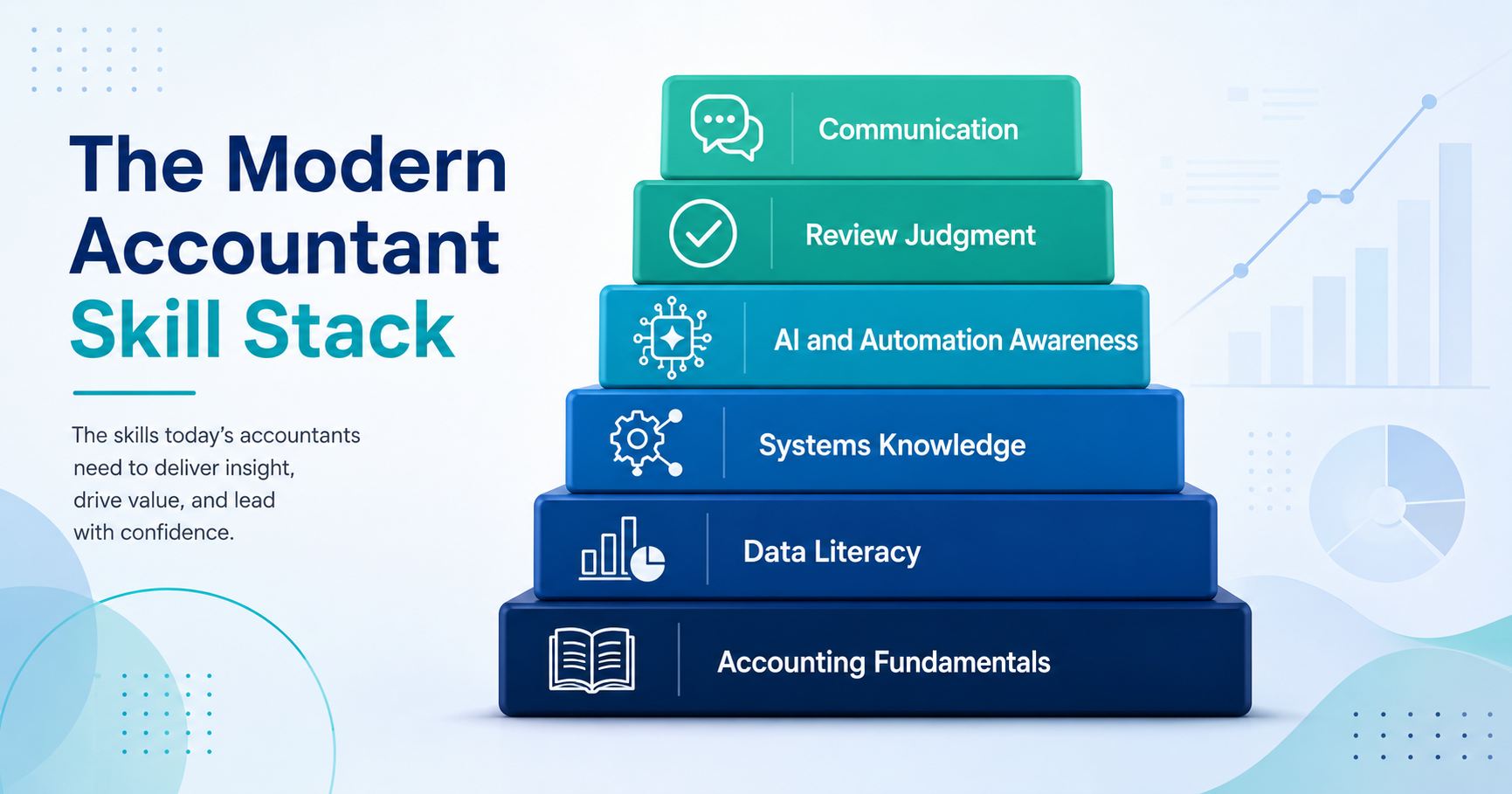
The New Skill Stack for Modern Accountants
The future accountant needs a broader skill stack. Not because accounting has become less technical, but because finance work now sits inside tools, workflows, data pipelines, and communication loops.
Data literacy helps accountants understand where numbers come from, whether data is complete, which trends matter, and which exceptions need attention.
Systems knowledge helps them understand how accounting data moves across general ledgers, payroll systems, AP, AR, banking platforms, inventory tools, POS systems, CRMs, and reporting dashboards.
AI and automation awareness helps accountants understand what automation can support, where human review is required, and how to validate AI-assisted outputs.
Review judgment helps them identify when numbers look wrong, even if the report looks polished.
Communication turns accounting work into business value. Clients and business leaders do not only need numbers. They need context, risk explanation, next steps, and clear recommendations.
This is where the accountant’s identity is expanding. The profession is moving from recordkeeping toward interpretation, review, and decision support.
Why This Skill Shift Matters for CPA Firms
CPA firms are already facing a talent squeeze. Hiring more people is important, but it is not the full answer.
The stronger long-term strategy is to develop better-skilled people.
Junior accountants should not be trained only to complete tasks. They should be trained to understand the process behind the task. When they prepare a reconciliation, they should understand the source data, the system flow, the review expectation, and the business impact.
When they prepare books for a client, they should understand how clean reporting supports cash flow decisions, tax planning, lender conversations, investor updates, and business growth.
When they use automation, they should understand what the tool is doing and what still requires human judgment.
This is where CPA firm talent strategy needs to change. Training should not stop at technical execution. It should include systems awareness, communication habits, review thinking, and client-readiness.
A task-trained team can complete work. A system-aware team can improve work.
A Practical Development Path for Modern Accounting Teams
The shift does not require every accountant to become a data scientist or software expert. It requires a structured way to build modern skills into everyday work.
A CPA firm can start by training staff to ask better process questions:
Where did this data come from?
Which system created it?
Was it changed manually?
Is the exception real or caused by a workflow issue?
Can this result be explained clearly to a client or reviewer?
This type of training builds better judgment. It also helps accounting teams move from simply processing work to understanding the work.
Firms can also create learning paths around common workflow areas such as month-end close, AP and AR, payroll, sales tax, cash reconciliation, and reporting. The goal is to connect technical accounting with systems, review notes, and client communication.
SafeBooks has also discussed the importance of building reliable remote accounting workflows before scaling distributed accounting teams.
Communication Is Becoming a Core Accounting Skill
Accounting communication is no longer limited to sending reports or answering client questions.
Modern accountants need to explain what changed, why it changed, what it means, and what should happen next.
A business owner may not want a technical explanation of every account movement. They may want to know why margins dropped, why cash is tight, why payroll cost increased, or why sales tax liability is higher than expected.
A CPA partner may not want only completed workpapers. They may want clear review notes, identified exceptions, unresolved questions, and a concise summary of risk areas.
This is why communication is now part of accounting quality.
Poor communication creates rework, delays, missed context, and client frustration. Strong communication improves review speed, client confidence, and advisory potential.
The modern accountant needs to be comfortable moving between numbers and narrative.
Remote Teams Cannot Be Task-Only Anymore
Remote accounting teams are now part of how many CPA firms build capacity. But the best remote teams cannot be treated only as execution support.
A strong remote team should understand systems, workflows, data quality, review preparation, and communication expectations. If tasks are unclear, review steps are missing, or communication standards are weak, remote work will only expose those gaps.
There is also a human side to remote performance. When team members do not feel comfortable questioning unclear instructions or flagging unusual items, errors surface late. Strong remote operations solve this with clear escalation habits, checklist-driven workflows, and a culture where raising issues early is treated as quality control, not failure.
When the model is structured, remote teams can support bookkeeping, reconciliations, close preparation, reporting, client follow-ups, and back-office accounting work with consistency and scale.
SafeBooks supports CPA firms through structured back-office support and bookkeeping and accounting support designed around workflow discipline, review readiness, and scalable delivery.
For firms evaluating technology alongside staffing, SafeBooks’ guide to the best tech stack for offshore accounting firms offers a useful next step.
Expert Insight
“The future accountant will still need strong accounting fundamentals, but those fundamentals now sit inside a larger operating system of data, tools, workflows, and client communication. Firms that train people only to complete tasks will struggle. Firms that train people to understand systems, ask better questions, and explain financial information clearly will build stronger teams.”
Shivangi Agrawal, Managing Director (CA, CPA USA), SafeBooks
The Future Accountant Is More Connected to the Business
The accounting profession is not moving away from fundamentals. It is expanding beyond them.
The next great accountant will still know debits and credits. They will still understand reconciliations, close timelines, tax records, reporting accuracy, and compliance.
But they will also understand how accounting data moves, how systems connect, how AI-supported outputs should be reviewed, and how to explain financial information in a way that helps businesses make decisions.
For CPA firms, this means talent development has to evolve.
The goal is not only to find more accountants. The goal is to build accountants who are technical, system-aware, communication-ready, and prepared for modern finance work.
For firms ready to strengthen their accounting delivery model, SafeBooks helps build structured remote accounting teams with clear workflows, review systems, and process discipline. To discuss how this could support your firm, contact SafeBooks.