Why MFA Alone Won’t Get You Approved
For years, enabling Multi-Factor Authentication was considered the golden ticket to cyber insurability.
In 2026, that era is over.
Carriers no longer ask, “Do you have MFA?”
They ask, “Can you prove your controls are working right now?”
Underwriting has shifted from checkbox questionnaires to technical validation. Logs. Telemetry. Restore evidence. Incident response timelines. Access records. Configuration states.
For CPA firms and accounting practices handling financial transactions and sensitive tax data, this shift is structural rather than procedural.
Cyber insurance is no longer an IT conversation.
It is a financial governance conversation.
Insurability now reflects how well your firm prevents financial loss, not just how well it documents security intentions.
The Shift from Checkbox to Technical Underwriting
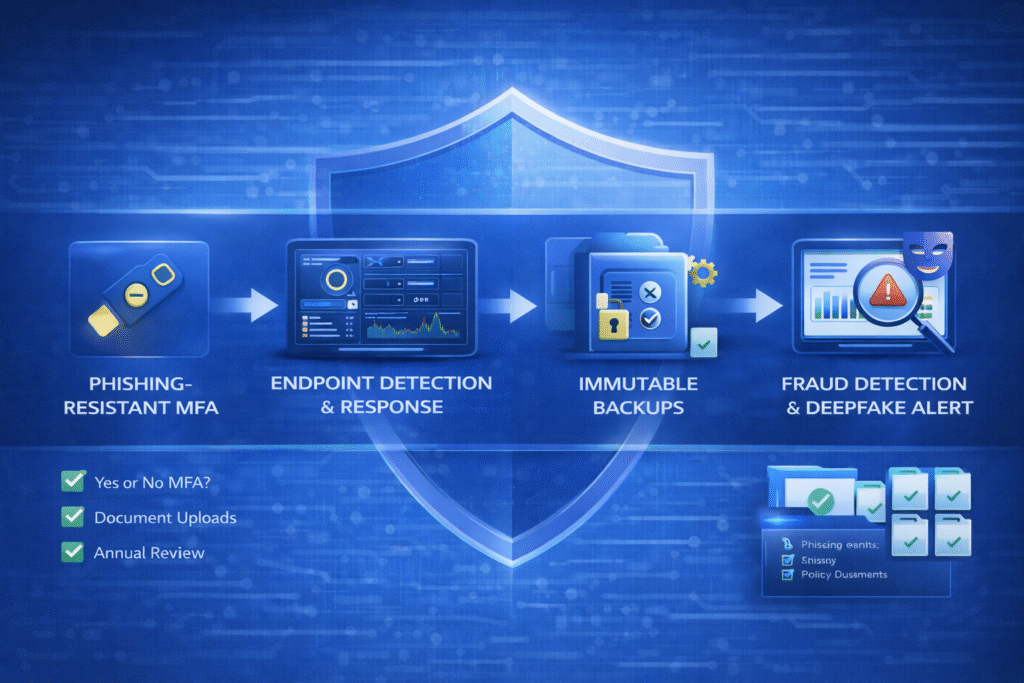
Until recently, cyber insurance relied on qualitative assessments:
- Yes or No questionnaires
- Policy document uploads
- Annual renewal reviews
By 2026, underwriting has become technical.
Carriers now require proof of:
- Phishing-resistant MFA
- Endpoint Detection and Response coverage
- Immutable and tested backups
- Privileged access controls
- Incident response testing
- Vendor risk oversight
- Email domain protection and monitoring
Evidence must be current.
Not last year’s audit.
Underwriters increasingly perform external scans, review security ratings, and request control screenshots during the quoting phase. Some carriers now conduct mid-term validation rather than waiting until renewal.
This evolution reflects a hard market reality. Loss severity from ransomware, business email compromise, and supply-chain attacks forced insurers to move from trust-based underwriting to verification-based underwriting.
Firms that cannot produce telemetry often face higher deductibles, lower sublimits, or coverage restrictions.
The MFA Fallacy
MFA is still mandatory.
But not all MFA is equal.
Standard methods such as SMS codes and basic push approvals are increasingly viewed as weak controls.
Attackers now exploit:
- Adversary-in-the-middle attacks that steal session tokens
- MFA fatigue where users approve repeated prompts
- SIM swapping targeting SMS-based authentication
- AI-powered phishing pages that perfectly mimic login portals
Phishing kits now replicate enterprise login portals with precision. Once a user completes MFA through a proxy page, the attacker captures the session token and bypasses further authentication.
From an underwriting perspective, the question is no longer whether MFA exists. The question is whether MFA meaningfully reduces breach probability.
Because of this, insurers increasingly require phishing-resistant MFA for privileged and executive access.
MFA Methods Compared in 2026
MFA Type | Security Strength | Underwriting View |
SMS Codes | High Risk | Often Rejected |
Standard Push | Moderate Risk | Under Scrutiny |
Number Matching Push | Strong | Recommended |
Phishing-Resistant MFA (FIDO2) | Best-in-Class | Required for High Limits |
For firms seeking $5M+ limits, phishing-resistant MFA is quickly becoming a baseline rather than a differentiator.
Identity security is now viewed as the strongest predictor of breach prevention.
Why CPA Firms Face Higher Scrutiny
Most cyber losses in 2026 originate in the inbox.
Business email compromise and fraudulent wire instructions remain among the highest-cost claims for insurers.
CPA firms are high-value targets because they:
- Manage payroll disbursements
- Process vendor payments
- Facilitate tax refunds
- Advise on capital transfers
- Maintain access to multiple client financial systems
Deepfake voice impersonation is no longer theoretical. Attackers now use AI-generated voice synthesis to impersonate managing partners or client executives, instructing finance teams to initiate urgent transfers.
Underwriters understand that the weakest link is often transaction verification.
Insurers now assess whether firms have:
- Independent call-back verification procedures
- Dual approval for wire transfers
- Segregation of duties within ERP systems
- Anomaly detection for unusual payment patterns
- Structured review layers before fund release
The underwriting lens has shifted from perimeter defense to transaction integrity.
Manual Reconciliation Is a Material Risk Factor
Spreadsheet-driven reconciliation creates blind spots.
When transaction verification occurs monthly rather than continuously, fraud may compound before detection.
Underwriters increasingly associate manual processes with:
- Delayed fraud detection
- Control bypass opportunities
- Documentation gaps
- Weak segregation enforcement
- Dependency on individual staff knowledge
Modern cloud-based accounting environments, such as those discussed in Cloud vs On-Prem Accounting for CPA Firms, reduce structural friction and improve visibility.
Automation shifts control validation from reactive to proactive.
Financial Governance Comparison
Control Model | Manual Processes | Automated Governance |
Data Coverage | Sampling | 100% Monitoring |
Detection Timing | Monthly Review | Real-Time Alerts |
Audit Evidence | Manual Compilation | Instant Documentation |
Underwriting View | Elevated Risk | Lower Risk Profile |
Firms implementing structured governance layers similar to those described in Offshore Accounting That Works often experience smoother underwriting conversations because control evidence is centralized and defensible.
Operational maturity translates directly into insurability.
The 2026 Cyber Insurance Baseline
Beyond MFA, insurers expect:
1. Endpoint Detection and Response
Active monitoring with automated isolation capability and documented response timelines.
2. Immutable, Tested Backups
Backups must be encrypted, isolated, and restore-tested. Carriers increasingly request proof of the most recent restore exercise.
3. Privileged Access Management
Least privilege enforced across ERP, payroll, and accounting systems. Toxic access combinations must be eliminated.
4. Incident Response Maturity
Tabletop exercises within the past 12 months. Evidence of remediation tracking after testing.
5. Mailbox-Level Security
DMARC enforcement, phishing filtering, and quarterly awareness training.
Quarterly simulations significantly reduce phishing susceptibility compared to annual-only programs, strengthening underwriting confidence.
Artificial Intelligence and the New Silent Risk
AI is both a defensive advantage and an emerging exposure category.
In 2026, insurers are closely examining:
- Deepfake impersonation leading to wire fraud
- AI-generated invoice manipulation
- AI-assisted phishing at scale
- Autonomous accounting automation errors
Deepfake-enabled fraud represents a significant underwriting concern for CPA firms. A single manipulated call appearing to come from a managing partner can bypass traditional email-based verification processes.
Insurers now evaluate whether firms have layered controls that include:
- Voice verification protocols
- Transaction escalation triggers
- AI usage governance policies
- Review layers for AI-assisted bookkeeping
- Monitoring systems that flag unusual transaction sequences
AI without oversight is viewed as an uncontrolled multiplier of financial risk.
AI with structured governance is viewed as a resilience enhancer.
The distinction matters during renewal.
Expert Insight
“Insurers are no longer evaluating whether a firm has security tools. They are evaluating whether a firm can prevent financial loss. Governance, review layers, and transaction discipline are now underwriting differentiators.“
Bindesh Jain, Tax Director at SafeBooks
How SafeBooks Supports Governance-First Offshore Models
SafeBooks helps CPA practices standardize offshore delivery under secure, documented frameworks designed specifically for Accountants and CPAs.
Our structured model supports:
- Secure document architecture
- Workflow accountability
- Review-layer alignment
- Regulatory documentation support
- Performance dashboards
If your firm is evaluating offshore structure upgrades, schedule a structured discussion through Contact Us.
Offshore accounting in 2026 is not about saving money.
It is about building a resilient, documented, scalable operating system that supports advisory growth, protects compliance posture, and increases operational control.
Firms that engineer their offshore model outperform firms that simply outsource.
The difference is structure.