

Schedule M-3 vs M-1: Who Must File M-3 and How to Prepare It
A corporate tax client expects $9.8 million in year-end assets. Another projects $10.2 million.
Both require book-to-tax reconciliations, but the second may trigger additional reporting under Schedule M-3.
For calendar-year C corporations, December 31, 2026, is the critical measurement date. Total assets of $10 million or more at year-end generally require Schedule M-3 rather than Schedule M-1 alone.
CPA firms handling larger corporate, partnership, and S corporation clients should identify these requirements before preparing returns.
Schedule M-3 vs M-1: Key Differences
Both schedules reconcile financial accounting income with income reported for federal tax purposes.
Feature | Schedule M-1 | Schedule M-3 |
Purpose | Summarized book-to-tax reconciliation | Detailed reconciliation |
Typical Form 1120 requirement | Below $10 million in assets | $10 million or more |
Reporting | Combined adjustments | Separate income, expense, and adjustment classifications |
Differences | Summarized | Temporary and permanent differences identified separately |
Complexity | Lower | Higher |
Schedule M-3 provides greater visibility into the individual adjustments connecting financial statement income and taxable income.
Who Must File Schedule M-3?
For C corporations filing Form 1120, the requirement generally begins when year-end assets reach $10 million, including exactly $10 million.
The test uses year-end assets, not average assets, revenue, or taxable income.
Different rules apply to other entities:
- S corporations: Generally required to file Schedule M-3 at $10 million or more in year-end assets.
- Partnerships: Filing may be triggered by $10 million in year-end assets, $10 million in adjusted total assets, $35 million in receipts, or qualifying reportable entity partner ownership.
What About Consolidated Corporate Groups?
The corporate threshold generally considers consolidated assets of corporations included in the consolidated federal tax return, after applicable eliminations.
For example, a parent and subsidiary filing a consolidated Form 1120 may meet the $10 million test even if neither entity individually reports that amount.
However, worldwide financial statement assets cannot automatically be substituted for consolidated federal return assets. The entities included in each group must be examined.
Can a Corporation File M-3 Part I With M-1?
Certain corporations with year-end assets below $50 million may complete Schedule M-3 Part I and Schedule M-1 instead of completing M-3 Parts II and III.
When using this option, Schedule M-1, line 1, must equal Schedule M-3 Part I, line 11.
Corporations with at least $50 million in assets generally must complete the full M-3.
Eligible corporations below the mandatory threshold may also file Schedule M-3 voluntarily.
If a required M-3 is omitted, the return does not satisfy the applicable reporting instructions. The firm should determine the appropriate correction and whether any penalty exposure exists based on the circumstances. 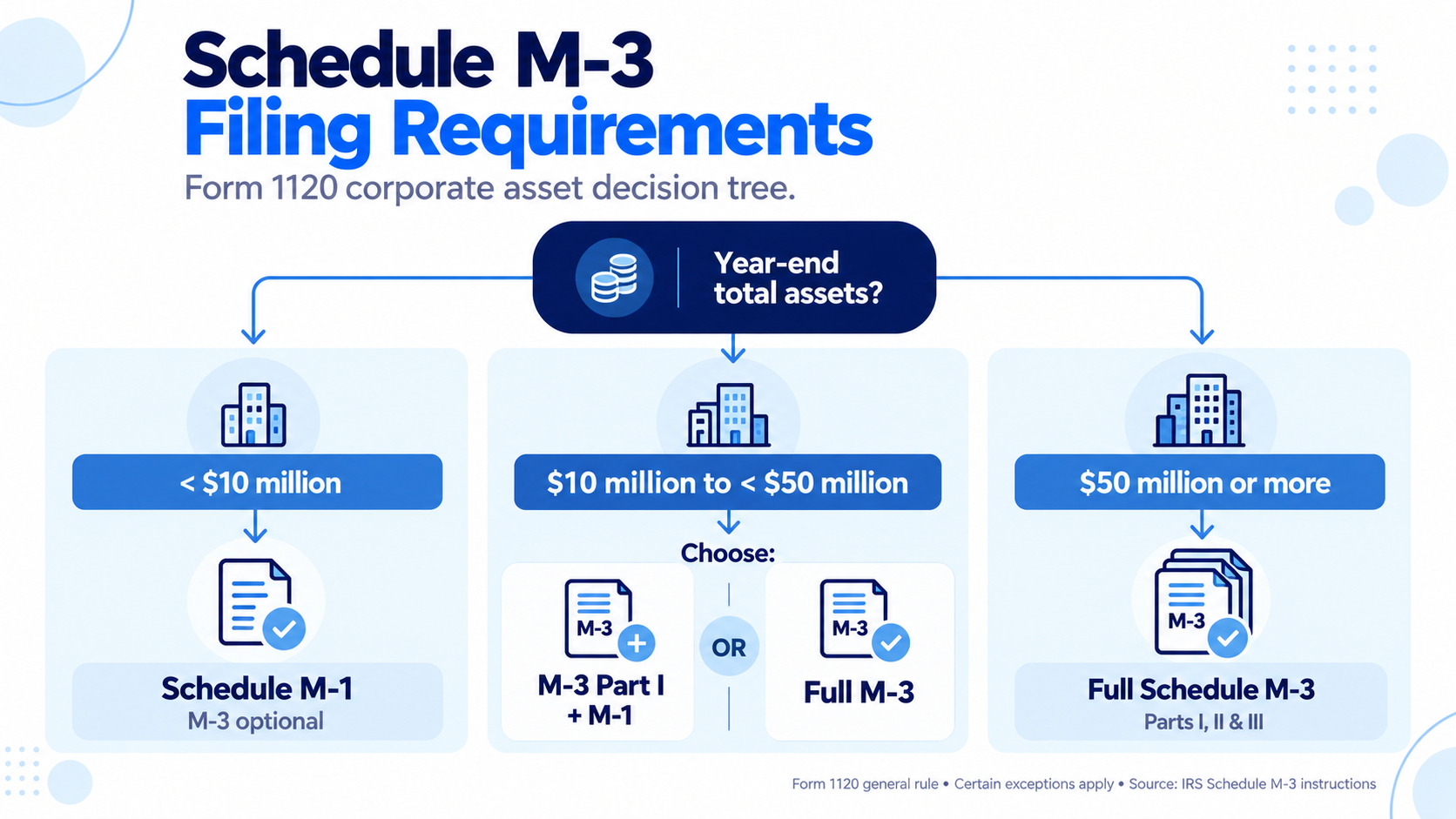
How to Prepare Schedule M-3
Preparation should begin with financial statements, trial balances, and supporting tax schedules.
Step 1: Confirm book income. Reconcile the applicable financial statements to the general ledger and determine the amount reportable in Part I.
Step 2: Identify book-tax differences. Review depreciation, income taxes, tax-exempt income, accruals, and nondeductible expenses.
Step 3: Classify adjustments. Distinguish temporary differences that reverse in future periods from permanent differences.
Step 4: Complete reporting sections. Part II covers income and loss items, while Part III addresses expenses and deductions.
For example, book and tax depreciation differences are generally reported in Part III, line 31, with the applicable temporary difference in column (b). Current and deferred income tax expenses have separate reporting lines within Part III.
Step 5: Reconcile totals. Confirm that adjustments agree with supporting workpapers and the tax return.
Schedule M-3 Reconciliation Example
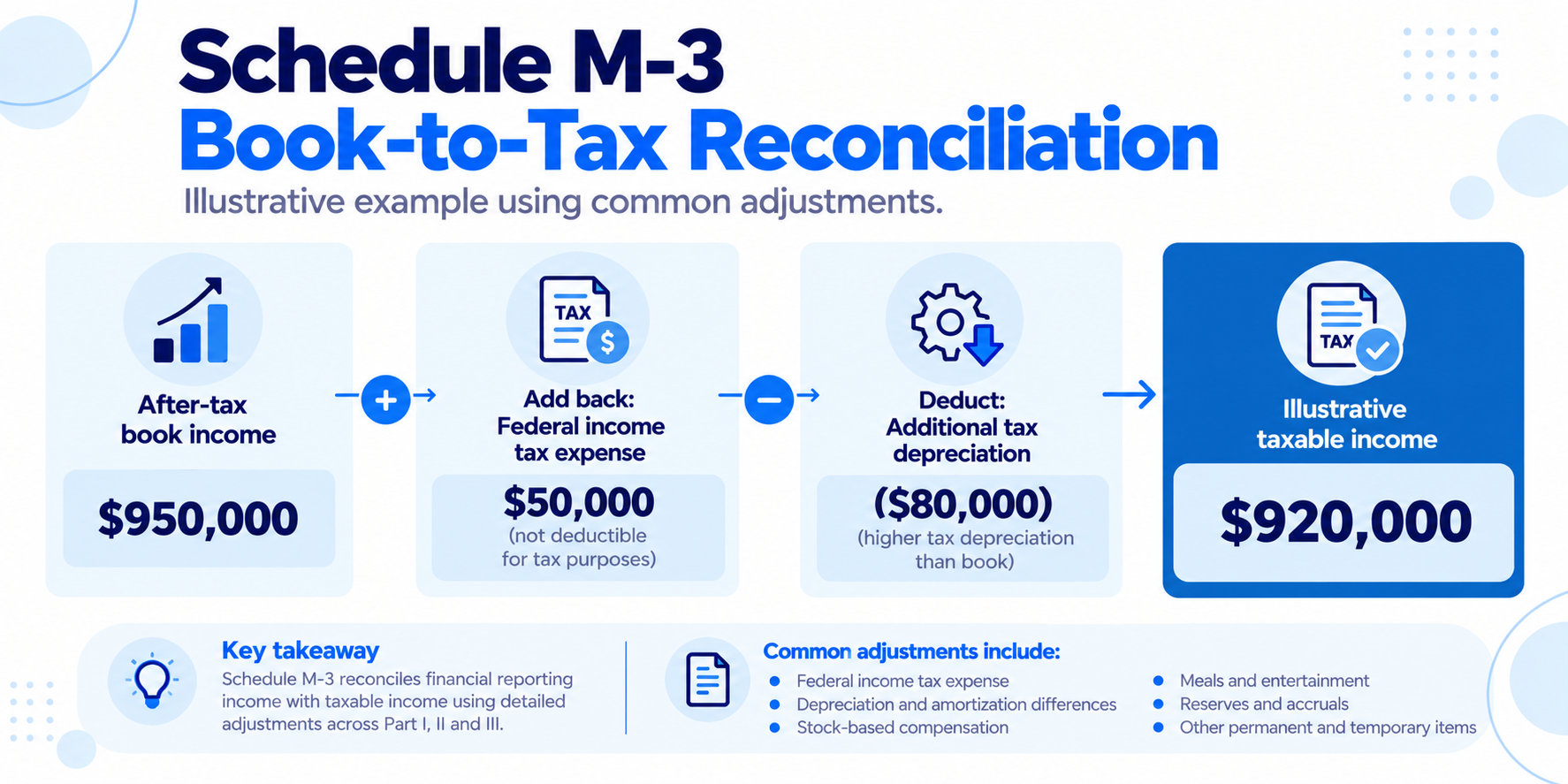
Consider a corporation with $1 million in book income before federal income taxes.
Its books include $50,000 in federal income tax expense, while tax depreciation exceeds book depreciation by $80,000.
Reconciliation item | Amount |
Book income before federal income taxes | $1,000,000 |
Less: Federal income tax expense | ($50,000) |
Book income after tax | $950,000 |
Add: Federal income tax expense | $50,000 |
Less: Additional tax depreciation | ($80,000) |
Illustrative taxable income | $920,000 |
This simplified example assumes no other adjustments.
The $80,000 depreciation difference is temporary because book and tax depreciation recognition can differ across years. The federal income tax expense is separately identified and reconciled under the applicable M-3 income tax expense reporting lines.
Common Schedule M-3 Preparation Errors
Several errors can create avoidable review work:
- Using average assets instead of year-end assets.
- Overlooking consolidated corporate asset calculations.
- Applying corporate filing thresholds to partnerships without checking additional tests.
- Failing to reconcile M-1 line 1 with M-3 Part I, line 11, when using the simplified option.
- Combining current and deferred income tax expense without following the applicable reporting instructions.
For CPA firms handling multiple complex returns, account-level difference schedules and documented review procedures can reduce inconsistencies.
How SafeBooks Supports Schedule M-3 Preparation
Schedule M-3 preparation requires detailed, traceable financial records.
An offshore accounting professional can help map trial balance accounts, prepare book-to-tax difference schedules, reconcile depreciation records, and organize supporting documentation.
US tax professionals can then determine the appropriate classifications, review tax treatment, and approve the completed reconciliation.
SafeBooks Global provides tax preparation support and bookkeeping and accounting support for US CPA firms.
This separation of preparation and technical review can help firms manage complex corporate and partnership workloads.
Final Takeaway
Schedule M-3 requires more detailed reporting than Schedule M-1, making early identification of filing obligations important.
Before December 31, 2026, CPA firms should review projected year-end assets, consolidated-group structures, and partnership filing tests.
Addressing these requirements before return preparation reduces avoidable reconciliation and documentation work.
Contact SafeBooks Global to discuss offshore tax preparation and accounting support.