The 7-Point Operating System for U.S. Firms
The average U.S. CPA firm spends 8 to 12 days per month managing manual workflows, review cycles, and staffing gaps during peak seasons.
At the same time:
- The CPA pipeline continues to shrink
- Senior professionals are retiring
- Client expectations for turnaround speed are rising
- Regulatory scrutiny on data protection is increasing
Offshore accounting is no longer about reducing labor cost.
In 2026, it is about building a governance-first operating system that protects margins, safeguards data, and increases advisory capacity.
When structured correctly, offshore becomes a performance multiplier.
When implemented casually, it becomes a liability.
This guide outlines the 7-point operating system U.S. firms must implement to make offshore accounting truly work.
Why Most Offshore Models Fail
Firms that struggle with offshore usually experience:
- Fragmented architecture
- Inbox-driven document exchange
- Undefined review ownership
- Inconsistent quality benchmarks
- Poor vendor oversight documentation
The issue is not geography.
It is system design.
The 7-Point Offshore Operating System
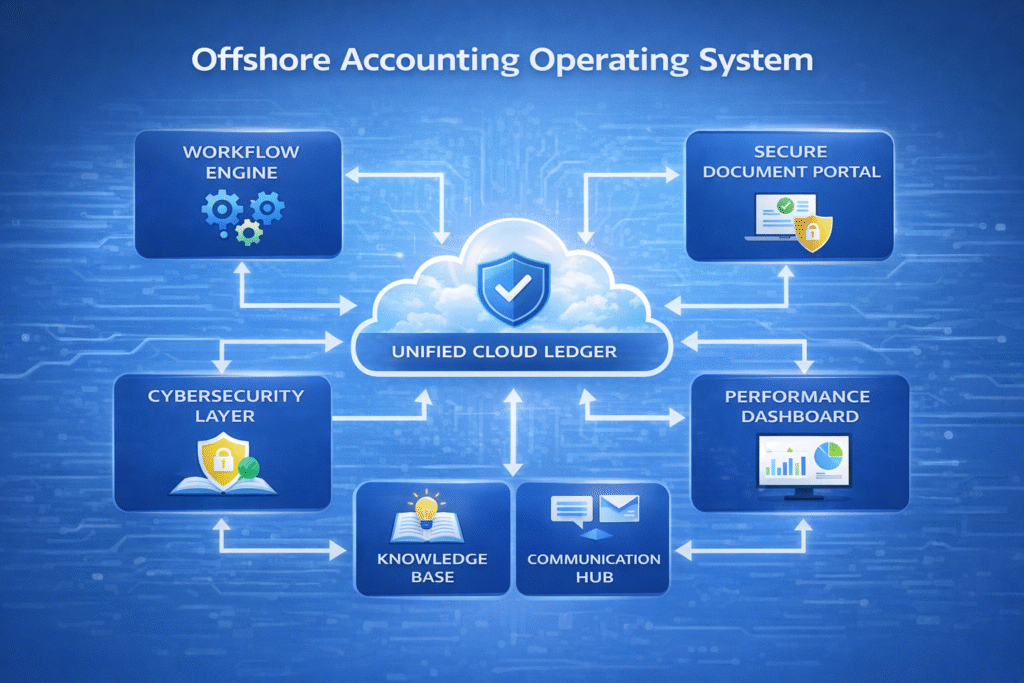
1. Unified Cloud Architecture
One Ledger. One System of Record.
Every offshore model must begin with a cloud-native core.
This includes:
- Centralized ERP or accounting platform
- Real-time ledger access
- API-based integrations
- Controlled user permissions
Disconnected tools create reconciliation delays and duplicate work.
When optimizing your firm’s technology foundation, integration must eliminate manual data handoffs.
This is where firms serving mid-sized practices often standardize workflows through structured environments designed specifically for accounting firms.
A unified architecture ensures:
- 24-hour production cycles
- No version control conflicts
- Continuous audit visibility
2. Workflow Engineering with Accountability Gates
Offshore without workflow discipline increases review burden.
Every task must pass through structured checkpoints:
- Defined scope
- Assigned owner
- SLA deadline
- Quality validation
- Escalation trigger
If an accountability gate is missed:
- Workflow software flags the task
- Review cannot proceed
- Escalation notification is triggered
This is not optional.
It prevents silent failure.
Firms that build structured review environments often leverage back-office support for accounting firms to standardize quality gates across recurring compliance cycles.
3. Secure Document Management and Controlled Access
Email is not a compliance tool.
A proper offshore OS requires:
- Role-based access
- Encrypted portals
- Automated audit trails
- Version control enforcement
- Mandatory MFA
This directly supports Written Information Security Plan requirements.
Firms working with regulated clients must ensure offshore access remains fully auditable.
Secure portals replace scattered inbox threads.
4. Layered Cybersecurity and Regulatory Alignment
Offshore must meet U.S. regulatory expectations.
Minimum security stack:
- Multi-factor authentication
- Managed devices
- Endpoint monitoring
- VPN or Zero Trust access
- Vendor confidentiality agreements
IRS safeguards expectations and FTC Safeguards Rule require documented vendor oversight.
Offshore partners must operate inside that framework.
Governance-first offshoring protects the firm from downstream liability.
5. Performance Intelligence and Escalation Monitoring
Micromanagement does not scale.
Data oversight does.
Track:
- Turnaround time
- Reconciliation accuracy
- Revision rates
- SLA compliance
- Exception volume
Performance dashboards create transparency without daily supervision.
Operational Performance Comparison
Metric | Traditional In-House Model | Governance-First Offshore Model |
Capacity Scaling | Fixed hiring cycles | Elastic seasonal scaling |
Cost Efficiency | High overhead | Structured cost optimization |
Error Detection | Manual review heavy | Escalation-trigger driven |
Turnaround Time | Limited by local hours | 24-hour production cycle |
Compliance Oversight | Fragmented documentation | Centralized audit trails |
6. Knowledge Management and Standardized Training
Documentation becomes critical.
Operating system must include:
- SOP repository
- Version-controlled procedures
- Recorded training modules
- U.S. GAAP alignment documentation
Standard-first training reduces review friction.
It also improves client confidence because execution becomes consistent.
7. Strategic Communication and Time Zone Engineering
Time zone is leverage.
Daily overlap window ensures:
- Offshore completes execution
- U.S. team performs review
- Clients receive faster responses
This improves client experience through:
- Faster tax prep cycles
- Lower review bottlenecks
- More advisory time
The 77 Percent Automation Reality
Nearly 77 percent of general accounting operations can now be automated.
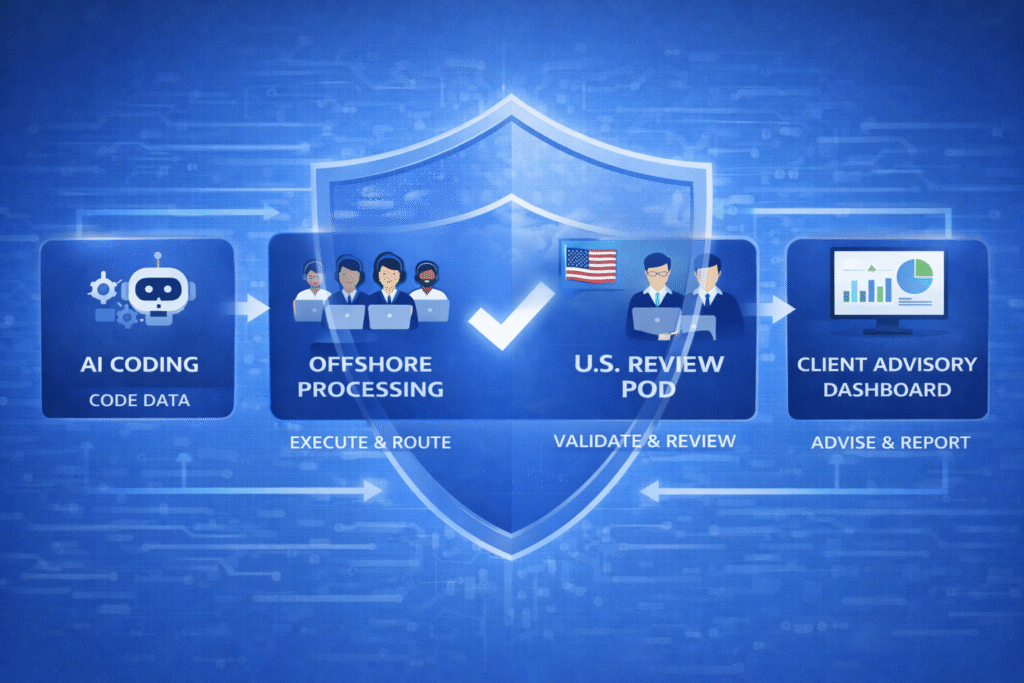
Offshore teams should focus on:
- Exception handling
- Structured reconciliations
- Process execution
- Compliance support
U.S. CPAs should focus on:
- Review
- Advisory
- Risk management
- Client strategy
This is governance-first architecture.
Not labor-first delegation.
Economic Logic Simplified
Offshore works when system efficiency exceeds management overhead.
If system discipline is weak:
Savings evaporate.
If operating system discipline is strong:
Margins expand without sacrificing quality.
Implementation Timeline
Most firms can stand up a structured offshore OS within:
- 30 days for workflow alignment
- 60 days for full operational integration
- 90 days for performance stabilization
Phased rollout reduces risk.
Start with one function, such as bookkeeping or reconciliations.
Scale after process stability.
Expert Insight
“Offshore success is never about cost alone. Firms that treat it as a governance structure with defined review layers, documented controls, and measured performance always outperform those that treat it as simple task delegation.“
Anshul Agrawal, Accounts Director (CA), SafeBooks
How SafeBooks Supports Governance-First Offshore Models
SafeBooks helps CPA practices standardize offshore delivery under secure, documented frameworks designed specifically for Accountants and CPAs.
Our structured model supports:
- Secure document architecture
- Workflow accountability
- Review-layer alignment
- Regulatory documentation support
- Performance dashboards
If your firm is evaluating offshore structure upgrades, schedule a structured discussion through Contact Us.
Offshore accounting in 2026 is not about saving money.
It is about building a resilient, documented, scalable operating system that supports advisory growth, protects compliance posture, and increases operational control.
Firms that engineer their offshore model outperform firms that simply outsource.
The difference is structure.