The average accounting team spends 10 to 15 days closing the books each month. By the time leadership reviews financials, the data is already two to three weeks old.
In a remote-first environment, that delay is no longer acceptable.
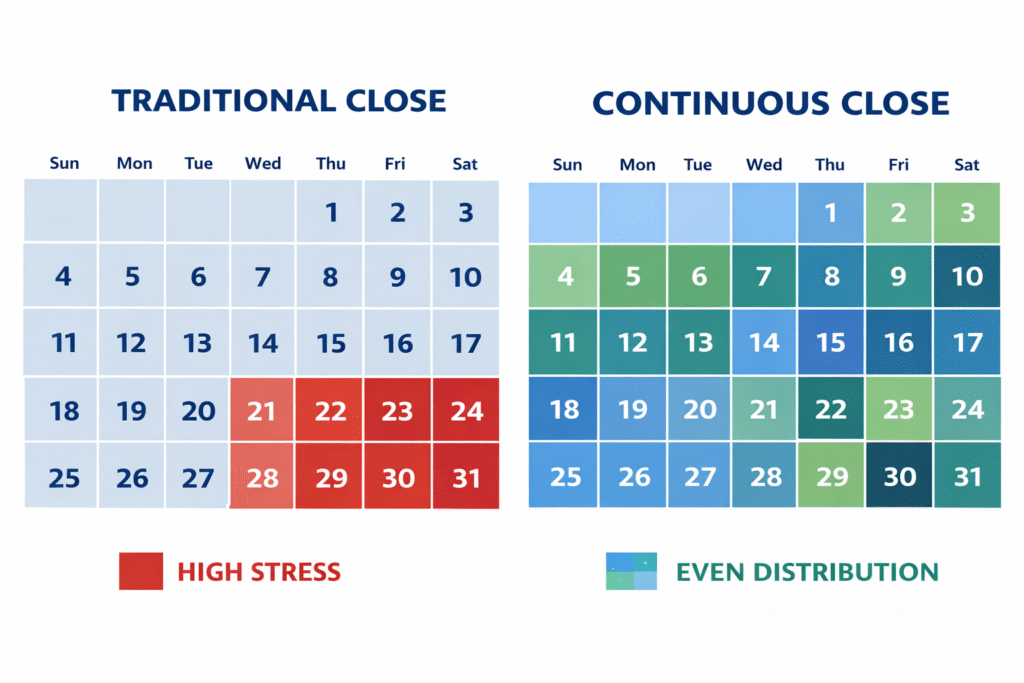
Continuous Close replaces batch-based month-end reconstruction with event-driven validation, meaning tasks are triggered by the transaction itself rather than a calendar date. Instead of scrambling at month-end, accounting teams validate, reconcile, and confirm transactions daily.
Month-end becomes confirmation, not reconstruction.
Why the Traditional Close Model Breaks in Remote Firms
The legacy close model is calendar-driven. Teams wait until the last week of the month to reconcile bank accounts, review accruals, adjust prepaids, investigate variances, and draft reports.
These silos result in:
- Workload spikes
- Staff burnout
- Increased error rates
- Delayed advisory insights
When documents live in inboxes and spreadsheets operate outside the GL, the close becomes reactive.
Firms that first standardize intake and reconciliation using a structured approach similar to this remote accounting workflow setup guide eliminate these bottlenecks early.
Continuous Close vs Traditional Close
Feature | Traditional Close | Continuous Close |
Trigger | Calendar-driven | Event-driven |
Workload | Month-end spike | Even daily flow |
Reconciliation | Manual batch | Automated daily matching |
Data visibility | Retrospective | Real-time insight |
Audit readiness | Periodic fire drill | Always ready |
Nearly 77 percent of general accounting operations can now be automated. The firms that redesign workflows around that reality gain speed without sacrificing accuracy.
1. Eliminating Latency with Real-Time Data Capture
Continuous Close begins with disciplined intake.
- Daily bank feeds
- OCR invoice extraction
- Structured client portal uploads
- No email attachments
If transaction data is delayed, reconciliation is delayed.
Firms strengthening their client financial data protection framework reduce both risk and processing friction.
2. Reducing Manual Work with AI-Assisted GL Coding
AI engines now:
- Auto-categorize recurring vendors
- Detect posting anomalies
- Assign confidence scores
- Flag exceptions instantly
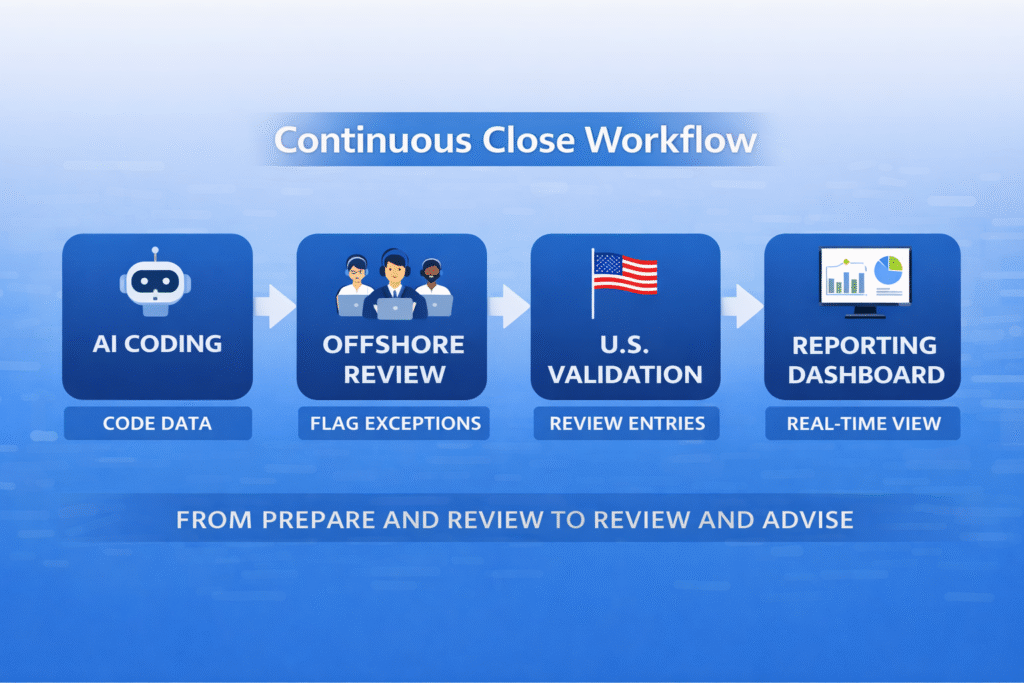
Accountants move from data entry to judgment validation.
The evolution toward AI-supported workflows mirrors trends covered in this analysis of AI in tax preparation and document automation.
3. Turning Reconciliation into a Daily Control System
Traditional reconciliation is retrospective.
Continuous Close uses automated matching engines that:
- Clear 85 to 95 percent of transactions automatically
- Flag only outliers for human review
Reconciliation becomes a hygiene process performed daily, not a month-end emergency.
4. Automating Accruals and Prepaids to Remove Month-End Bottlenecks
Recurring accruals and prepaid amortization often delay close.
Modern systems:
- Detect prepaid invoices at entry
- Generate amortization schedules automatically
- Reverse accruals when matching invoices arrive
For firms navigating compliance nuances such as IRS prepaid rules, automation reduces risk. If you manage recurring prepaid compliance, review how the 12-month rule for prepaid expenses interacts with small business taxpayer thresholds.
5. Embedding Human Oversight with Structured Review Pods
Continuous Close does not eliminate humans. It elevates them.
AI handles transaction volume. Reviewers:
- Validate exceptions
- Confirm judgment-based classifications
- Approve ledger integrity
The model is automation plus accountability.
Many firms scale this through hybrid or offshore review structures similar to those outlined in this guide on offshore bookkeeping workflow models.
Expert Insight
“Continuous Close is not about speeding up month-end. It is about redesigning accounting so month-end becomes a confirmation step instead of a reconstruction process.“
Anshul Agrawal, Accounts Director (CA), SafeBooks
Technology Architecture for Continuous Close
A scalable Continuous Close stack typically includes:
- Cloud ERP such as QBO, NetSuite, or Sage Intacct
- Secure client portal
- API-based integration layer
- AI reconciliation engine
- Workflow management system
The difference between fragmented architecture and system design is integration discipline.
Firms evaluating maturity often begin by modernizing their cloud versus on-premise accounting systems and then refining their technology stack strategy to support automation.
Governance and Audit Readiness
Continuous Close strengthens control environments.
It enables:
- Real-time anomaly detection
- Automated segregation of duties monitoring
- Daily audit trail creation
- Faster PBC list generation
Security controls must include:
- Multi-factor authentication
- Role-based access control
- Encrypted portals
- Continuous monitoring
Structured workflows combined with disciplined governance help firms meet modern compliance expectations while improving advisory capacity.
Measurable Performance Impact
Metric | Traditional Model | Continuous Close |
Close duration | 14 to 21 days | 2 to 5 days |
Manual journal entries | High volume | Reduced 60 to 80 percent |
Reconciliation accuracy | 85 to 90 percent | 99 percent plus |
WIP aging | 30 days plus | Under 7 days |
Audit prep time | High compression | Distributed daily |
The shift from periodic batching to event-driven accounting unlocks advisory bandwidth.
How Continuous Close Impacts Tax Season
Continuous Close reduces tax season compression.
Because reconciliations, accruals, and documentation are validated throughout the year:
- Trial balances are clean
- Adjustments are minimized
- Advisory begins earlier
- Extension reliance decreases
Tax preparation becomes strategic rather than reactive.
How SafeBooks Supports CPA Firms Implementing Continuous Close
If your firm is transitioning toward:
- AI-assisted processing
- Remote accounting teams
- Offshore review pods
- Structured portal intake
- Standardized close workflows
SafeBooks helps CPA firms design structured back-office systems that eliminate month-end chaos.
Explore tailored support options for Accountants and CPAs and scalable solutions for Accounting Firms, including dedicated Back-Office Support Services.
To evaluate your current readiness, schedule a structured workflow audit through Contact SafeBooks.