
Remote Bookkeeping Pod for E-Commerce and SaaS Firms
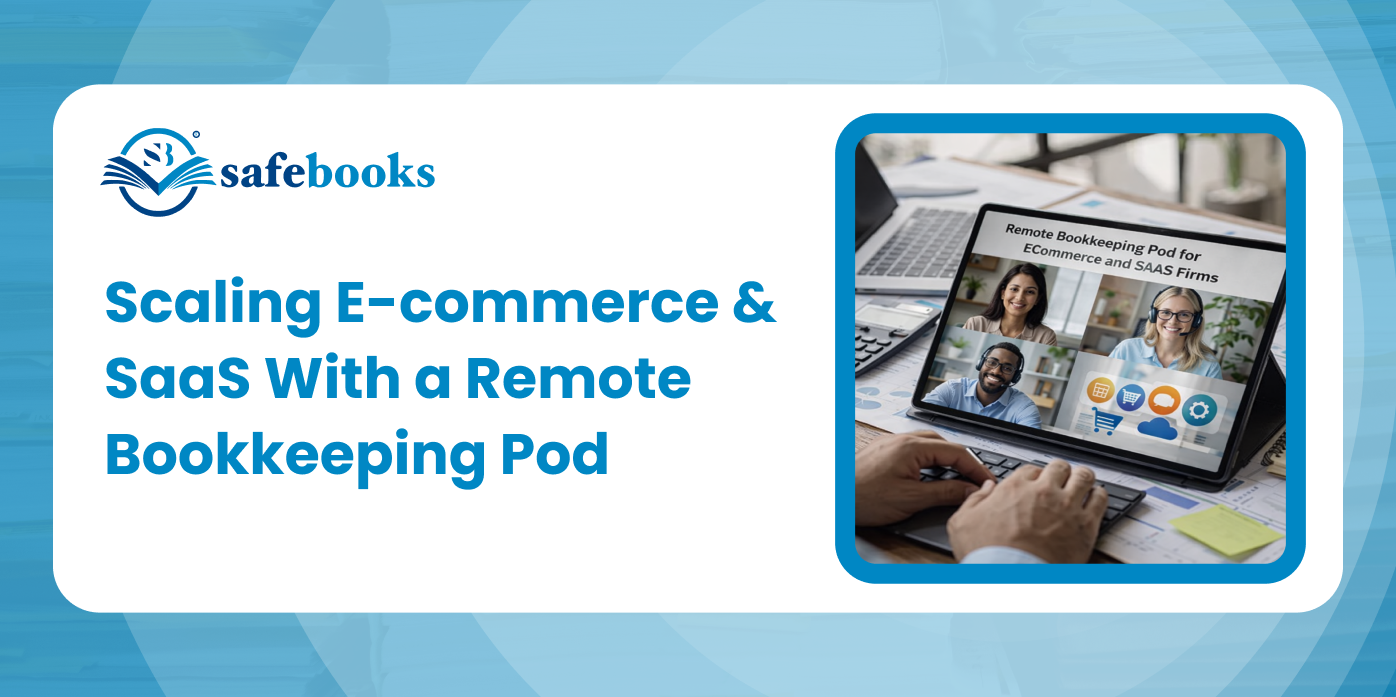
How Safebooks Built a Remote Bookkeeping Pod for a CAS Firm Serving e-commerce and SaaS Clients
A boutique California based CAS practice serving Shopify stores, Amazon FBA sellers, and small SaaS companies needed a scalable bookkeeping solution. High transaction volumes, multi-channel data sources, and hiring challenges limited the firm’s growth potential. Safebooks helped them standardise workflows, build a dedicated remote bookkeeping pod, and automate core month end processes.
This workflow driven approach aligns with Safebooks services for Bookkeeping and Accounting, Back Office Support, and AR and AP Integration.
Client Overview
This CAS practice works primarily with online retailers and subscription based software businesses. Their clients rely on platforms such as Shopify, Amazon, Stripe, PayPal, and various SaaS billing engines. Before engaging Safebooks, the firm used QBO, Xero, A2X, Stripe reports, and Excel spreadsheets to piece together monthly financials.
Growth Roadblock
The partners wanted to scale from 40 monthly bookkeeping clients to more than 80. The local talent market made hiring difficult, and the complexity of reconciliations absorbed most of the team’s time.
For context on why offshore bookkeeping has become a strategic solution, see Why Offshore Bookkeeping Is the Smartest Move for US Businesses.
Challenges Before Safebooks
Complex Multi Channel Reconciliations
Shopify, Amazon FBA, and Stripe generated large transaction volumes with multiple payout schedules, fees, refunds, chargebacks, and timing differences. Staff often spent several days each month reconciling payment processors and sales tax reports. This made month end close unpredictable and time consuming.
Data Entry Dependent Processes
Bank feeds were inconsistent. Many adjustments and classifications had to be done manually. Each bookkeeper used a slightly different workflow which created reporting inconsistencies.
Limited Capacity to Scale
The partners could not double their client base with their existing team structure. Hiring locally was slow and costly, and the internal team was already overwhelmed with reconciliations and catch up work.
Safebooks Solution
Safebooks designed a structured approach that combined process standardisation, a dedicated offshore pod, and selective automation to support predictable growth.
Phase 1: Standardising the CAS Playbook (4 Weeks)
Safebooks analysed the firm’s top 10 e-commerce and SaaS clients to understand patterns in revenue streams, fee structures, and reconciliations. From this analysis, the team created a unified CAS playbook.
Playbook Deliverables
- Chart of accounts templates tailored to e-commerce and SaaS models
- Standard rules for revenue recognition, refunds, and chargebacks
- A uniform month end checklist covering reconciliations, reporting, and review steps
- Standard naming conventions for workpapers and uploaded documents
This standardisation mirrored recommendations outlined in Why Outsourcing Accounting With a Dedicated Team Makes Business Sense.
Phase 2: Building a Dedicated Remote Bookkeeping Pod
From the Safebooks US aligned team, the CAS practice onboarded:
- One senior bookkeeper who acted as team lead
- Two staff bookkeepers who handled daily processing and reconciliations
The pod logged into the firm’s accounting systems using secure VPN access as described on the Safebooks Security Standards.
Responsibilities of the Safebooks Pod
- Bank and credit card reconciliations
- Merchant and platform reconciliations for Stripe, Shopify, PayPal, and Amazon
- Month end close packages including P and L by channel, cash flow summaries, and KPI dashboards
This structure gave the firm a predictable capacity engine that could absorb additional clients without increasing partner workload.
Phase 3: Automation and Reporting Cleanup
Safebooks refined several parts of the firm’s workflow.
Key Improvements
- Optimised bank rules in QBO and Xero for cleaner classifications
- Introduced template driven Excel and BI reports aligned to common e-commerce KPIs
- Implemented weekly calls with the in house team to review exceptions and surface advisory opportunities for clients
These improvements created a repeatable, scalable model for the firm’s entire CAS offering.
Results After 9 Months
Client Capacity Doubled
The practice grew from 40 to 92 monthly bookkeeping clients without hiring additional US based staff.
Partner Time Reallocated
Partner involvement in bookkeeping decreased from about 40 percent of their time to between 10 and 15 percent. This allowed them to focus on pricing, advisory services, and higher value client meetings.
Faster Turnaround
Monthly closes were consistently delivered by the tenth of the month instead of the twentieth to twenty fifth. The improved speed strengthened the firm’s advisory capabilities.
Higher Margins
CAS gross margin improved by 18 percentage points. This came from the combined effects of offshore cost efficiency and standardised processes that reduced rework.
What This Case Shows About Safebooks
Many outsourcing firms focus mainly on staffing. Safebooks positions itself as a process partner that helps firms scale with remote teams, technology alignment, and workflow design.
The CAS practice selected Safebooks because it wanted a stable bookkeeping pod built on consistent processes that could support long term growth.
Firms that want to adopt a similar model can contact the Safebooks team through the Get Started.
Case Study
Recent Case Studies